
Why the Fridge Is Not Automatically Safe for Peptides
The assumption most people make is that cold equals safe. Put the vial in the fridge, problem solved. If your label says to refrigerate, the fridge is the right place — but a fridge on its own is not a storage system, and the way vials sit inside it makes a real difference.
A standard household refrigerator is designed to keep food fresh. It was not designed around small glass vials. Three specific problems turn a poorly set-up fridge into a liability:
- Door zone swings. Every time the refrigerator door opens, room air floods in. The door shelf — where most people put vials — warms up first and recovers last. Multiply that by ten fridge trips a day and the door rack is the least steady place in the appliance.
- Light every time the door opens. The fridge light comes on the moment the door opens. If your label says to protect the product from light, uncovered vials on a shelf get lit up ten times a day.
- Loose vials tipping and rolling. A fridge shelf is not a stable surface. Vials knock against each other, roll toward the edge when the shelf is pulled out, and fall during normal fridge use. A cracked or broken vial is a total loss.
Design a fridge case for your shelf
Add the vials you keep in the fridge, check the exact case size against your shelf, and get a fitted pocket for every vial.
None of these problems mean the fridge is the wrong place. When your label calls for refrigeration, it is exactly the right place — but only when the setup is right. The fridge provides the cold. A proper case provides everything else.
The Temperature Reality Inside Your Fridge
Before ranking storage options, it helps to understand that a refrigerator is not one temperature. Most people set the dial once and assume the whole interior holds it. It does not.
- Door shelves: the biggest swings. The door is the farthest point from the cooling and the first surface hit by warm air every time the door opens. In a warm kitchen it can briefly run well above the rest of the fridge. Not a good home for vials.
- Front of interior shelves: moderate swings. Better than the door, but still in the path of the warm draft that comes in when the door opens.
- Back of middle shelves: the steadiest zone. The back of the middle shelf is the sweet spot in most refrigerators. It is closest to the cold airflow, farthest from the door, and least affected by warm air coming in.
- Near the cooling vent or freezer: can run too cold. The area right by the vent, or directly under the freezer compartment in some units, can dip low enough to freeze. If your label says do not freeze, keep vials away from it.
- Crisper drawers: high humidity. Crispers hold moisture by design, so vials kept there come out wet, labels smear, and the storage area stays damp.
The practical takeaway: the back of a middle shelf is where your vials belong, inside a case that keeps the light off and holds each vial in a fixed, upright position. If you want to know what your fridge actually does, a small digital thermometer on that shelf will tell you.
What a Peptide Fridge Case Must Do
Not every container that fits in a fridge qualifies as a peptide case. A proper fridge case needs to do four specific things:
- Hold vials upright and separated. Individual slots stop vials touching each other, eliminate rolling, and let you lift out one vial without disturbing the others.
- Keep light out when the fridge door opens. A closed hard case means the fridge light never reaches your vials. The protection is passive and constant — you never have to think about it.
- Fit the shelf without blocking airflow. A case that is too big crowds the shelf and restricts the air moving around it. The right size leaves room for cold air to circulate.
- Handle fridge moisture. A refrigerator is humid compared with a room. A hard plastic case won't soak up moisture or go soggy the way cardboard, foam or fabric can over months in the fridge.
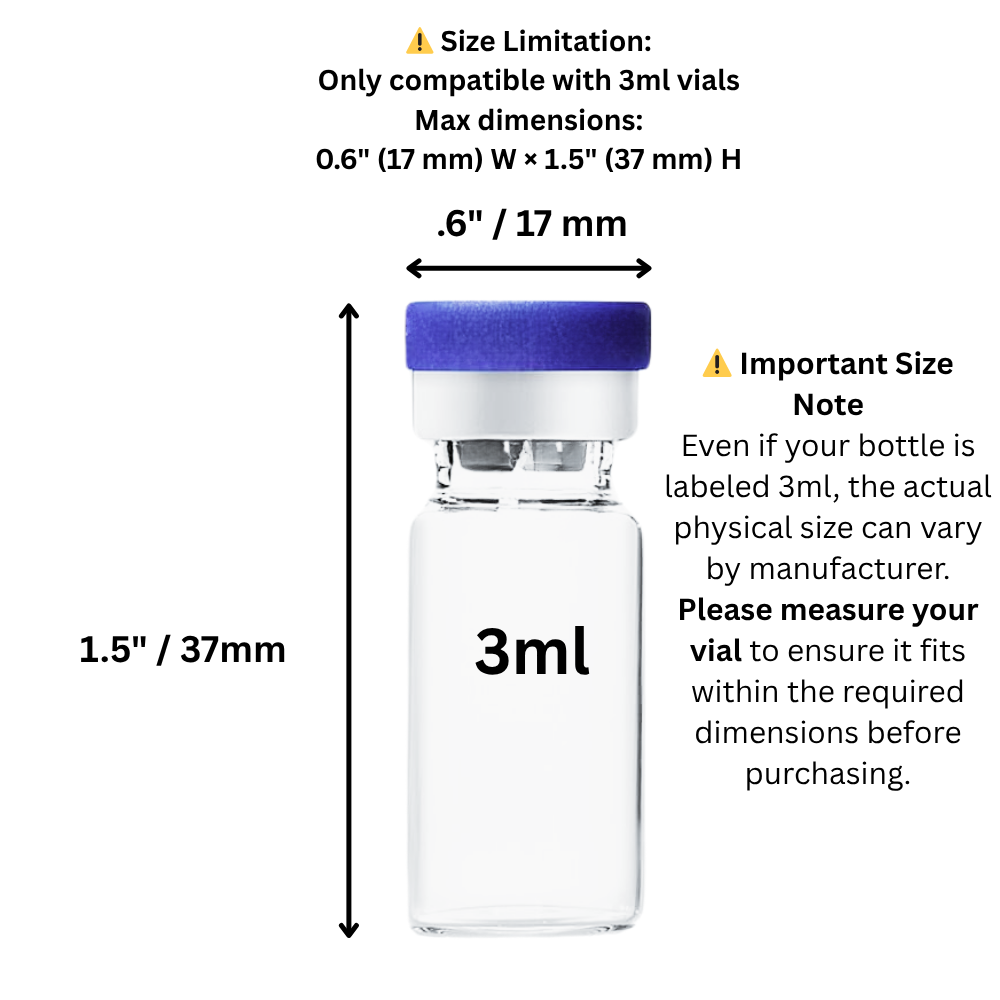
Fridge Storage Options Ranked: Worst to Best
Here is an honest ranking of every approach people actually use to keep vials in the fridge, judged on three things: how steady the spot is, how well light is kept off, and how secure the vials are.
Worst: Loose Vials on the Door Shelf
This is the most common and most damaging approach. Loose vials on the door shelf combine every fridge storage failure in one setup. The door swings warm every time it opens. Vials tip over, roll, and knock against each other. The fridge light hits them directly. There is no organization, so you pick through vials to find the right one every time. One vial rolls off the shelf and it's gone. If you store vials on the door shelf now, this is the single highest-impact change you can make: move them.
Bad: Generic Plastic Container With No Slots
An improvement over loose vials only because they are in one box. The problems remain significant. Without individual slots, vials roll against each other — constant glass contact is how hairline cracks start and caps loosen. A clear container keeps no light out, and even an opaque one lets the vials shift and collide every time you open or close the fridge. Better than nothing, but only barely.
Mediocre: Repurposed Egg Carton
Egg cartons are exactly the wrong shape for vials. The cups are made for eggs, not narrow 3 mL vials, so a vial sits loosely and can still tip sideways. The carton is cardboard — it absorbs fridge moisture, goes soggy over a few weeks, and leaves damp pulp around your vials. Light blocking is partial at best, and nothing keeps the lid shut. A stopgap that creates new problems while only half-solving the old ones.
Good: Small Box or Tray With Individual Slots
A box or tray with individual slots sized for vials is a real step forward. Each vial has a home, it can't roll, and it doesn't touch the others. With a lid, light protection improves a lot. The main limitation here is usually material — many slot trays are foam or flimsy plastic that doesn't hold up to fridge moisture. If the slots really are sized for your 3 mL or 10 mL vials, this is genuinely adequate. The gap to the best option is build quality, moisture resistance, and a proper latch.
Best: A Hard-Shell Custom Case on the Middle Shelf, Back Position
A hard-shell case built around your vials, placed at the back of the middle shelf, is the right setup for fridge storage. With the PeptideCase™ builder, every vial you add gets its own fitted pocket, so nothing shifts or tips, and shorter vials stand on a raised floor so every top lines up at the rim, easy to grab. The closed shell keeps the light off. A hard plastic case doesn't soak up fridge moisture. A locking latch keeps it shut if the shelf gets bumped. And because the case lives in the steadiest spot in the fridge, your vials sit where conditions change least. It is a protective organizer, not a cooler — the fridge does the cooling, and the case handles everything else.
The Fridge Door Shelf: Why It Is the Worst Place to Store Peptides
The door shelf deserves its own section because so many people default to it. It is visible, it is accessible, and it feels convenient. But it is the worst choice in the fridge.
A busy household opens the fridge many times a day. Each time, the door shelf swings out into room air for as long as someone stands there deciding what to eat. It warms first, and it takes longest to come back down once the door closes.
So a vial on the door shelf rides through dozens of warm-then-cold swings every week, plus a bump every time the door is opened or slammed. Even if the average temperature looks fine, those swings and knocks are exactly what you are trying to avoid when your label asks for steady refrigeration.
The door shelf is fine for condiments. It is not the place for vials you paid for and can't easily replace.
Best Placement in the Fridge: Middle Back Shelf
The design of most refrigerators points to the same spot: the back of the middle shelf. Here is why it is the steadiest zone:
- Close to the cold air. Most refrigerators push cold air in from the back. Items at the back of the shelf sit in that airflow first.
- Far from the door. The farther a vial is from the door, the less it feels warm air coming in. By the time room air reaches the back of the shelf, it has already been cooled by everything in front of it.
- Middle height. The very top (near the freezer in top-freezer units) and the very bottom (near the compressor) are less consistent. The middle shelf sits in the most even zone of the cabinet.
The specific instruction: place your case flat on the middle shelf, pushed toward the back but not pressed against the cooling vent. Don't pile anything in front of it that blocks the airflow.
Pro Tip: Don't store vials next to the fridge light. A closed hard case keeps the light off them, but if you ever open the case inside the fridge, keep it away from the bulb housing, and close it again before you shut the door.
What About a Mini Fridge?
A dedicated mini fridge is the best possible fridge setup, and it is worth considering if you keep several vials on hand.
The main advantage is fewer door openings. A mini fridge used only for vials gets opened once or twice a day, instead of the constant traffic of a shared kitchen fridge. Each opening is shorter too, because you aren't hunting past food. What you want is right there.
Other advantages: no food spills near your vials, no fight for shelf space, the freedom to set the temperature to whatever your label calls for without affecting anyone's groceries, and discreet storage other people in the house don't touch.
Before you buy, measure the inside of the mini fridge and compare it with the case size the builder shows, so the case fits on a shelf with room for air around it. See our roundup of mini fridges for peptide storage for options.
Organizing Multiple Vials in the Fridge
Keeping more than one kind of vial at a time calls for a system. Random placement leads to mistakes: grabbing the wrong vial, losing track of which one was opened first, or forgetting a date your label told you to track.
The most effective system uses three principles:
- Slot assignment by vial. Every kind of vial gets a set position in the case and never moves. If one kind lives in the front-left pocket, it always lives there. That lets you reach for the right one in low light, half awake, without reading labels.
- Labels with name and date. Every vial should show at least what it is and any date your label or pharmacist tells you to track, such as when you opened it. A fine-tip permanent marker on the vial, or a cold-proof label if you need more room. Never rely on memory for dates.
- First in, first out. The oldest vial of each kind gets used before a newer one. When a fresh vial goes into the case, it goes behind the one already open. You always take from the front, so nothing gets forgotten at the back.
Color-coded caps make the first principle even faster: one color per kind of vial, visible from above when the case is open.
Color-code your vials
Custom snap-on caps for 3 mL or 10 mL vials, with a cap color plus an icon or letters. Sets from 25 caps.
PeptideCase™ Fridge Setup: Designing the Layout
Instead of fitting your vials into someone else's slot plan, you can design the layout around your fridge routine. Start with an empty case, tap "Add item," and add what lives in the fridge kit, with a count for each. Here is one way to think about it:
A larger fridge kit: add 3 mL or 10 mL vials for the ones you are using now, plus extra pockets for unopened spares, a BAC water bottle bay, and syringes and alcohol pads if you keep them with the kit. Keep the open vials in the pockets nearest the front of the shelf and the spares behind them. The case goes at the back of the middle shelf, closed and latched.
A smaller fridge kit: add only the vials you keep on hand and one spare pocket for anything new. A small case leaves more of the shelf free for airflow and is easy to lift out and put back in one move.
Auto-arrange packs either kit into the most compact layout, and the builder shows the exact length, width and height, with top, lid and 3D views, so you can check the case against your fridge shelf before you order. Add a temperature sensor item — a clip-in window in the lid or a socket inside the case for a small digital thermometer — if you want to keep an eye on the shelf. Every pocket has a finger scoop, and the latch keeps everything secure on the trip from fridge to counter and back.
When to Use Freezer vs. Fridge
Whether a vial belongs in the fridge, the freezer, or neither is set by its product label and by your pharmacist or provider — not by a general rule. Read the label, store the vial exactly as it says, and ask your pharmacist if anything is unclear.
- If the label says refrigerate: keep the vial on a steady fridge shelf, in a closed case, away from the door and the cooling vent.
- If the label says do not freeze: watch for cold spots near the vent or under the freezer compartment, and never move the vial to the freezer "just to be safe."
- If anything went wrong — a vial froze by accident, the fridge lost power, or a vial was left out — ask your pharmacist or provider whether it is still usable rather than guessing.
Make your own custom fridge case
The fridge setup above works best with a case built for it, and you can design one in a few minutes. In the PeptideCase™ builder, start with an empty case, tap "Add item," and pick what lives in your fridge: 3 mL vials, 10 mL vials, peptide, TRT or glutathione vials, other size vials, a BAC water bottle, or a custom space you size yourself. Every item becomes fitted pockets or an open bay sized for that many.
The tallest item sets the height, and shorter vials stand on a raised floor so every vial top lines up at the rim — open the lid and every cap is right there. Auto-arrange keeps the footprint as small as possible so the case leaves room on the shelf, and the builder shows the exact size before you order. Choose Black or RGB Metallic, a Wide or Deep shape, and one or two latches, then print a word or icon into the lid so nobody mistakes it for leftovers. It's a hard case and organizer, not a cooler, and it's printed to order in the US. Design your fridge case