
Quick Answer: Yes, GLP-1 Pens Travel Fine
Prefilled GLP-1 pens, whether multi-use pens, single-use weekly pens or autoinjectors, can be brought on planes, on cruise ships and across international borders for personal medical use. TSA's medically necessary liquids exemption covers them. Major US airlines accommodate medication storage requests, and international customs is generally permissive for personal-use prescription medication when you carry the right documents.
The differences matter at the margins: how long your particular pen may be kept out of the fridge, what counts as "in use" versus unopened, how to handle a 14-hour flight, and which countries want an advance declaration. The rest of this guide gets specific about each.
Design a travel case around your GLP-1 pens
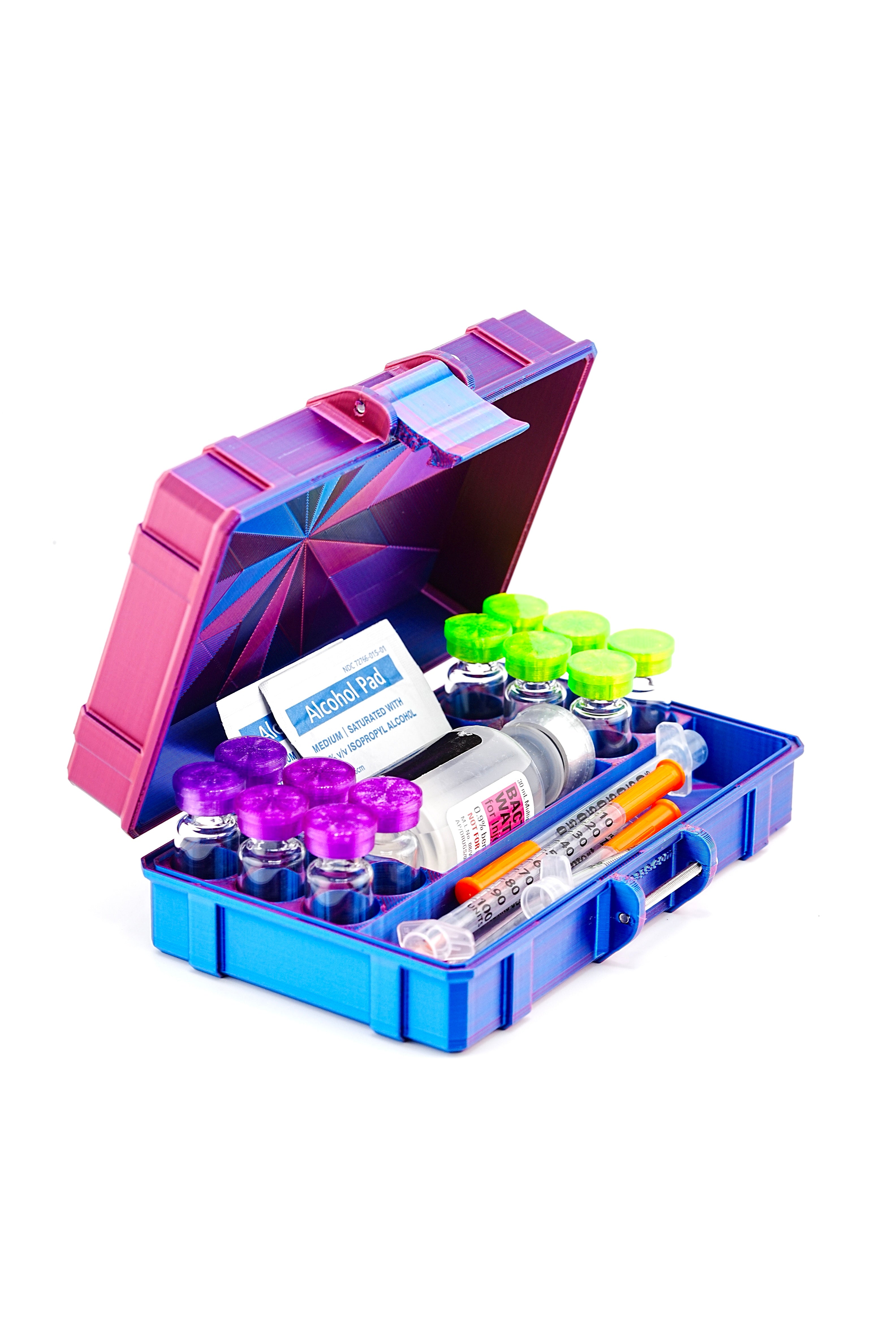
Add your pens, cartridges and a space for needles or a sharps container. The builder sizes the case so it fits your cooler bag or carry-on.
Branded pens vs. compounded vials: This guide focuses on prefilled pens in their original manufacturer packaging. If you travel with compounded GLP-1 vials from a pharmacy, see our guide to traveling with GLP-1 vials.
Room Temperature: Check Your Pen's Leaflet Before You Pack
The single most useful travel fact about your pen is printed in the leaflet that comes with it: how long, and up to what temperature, that pen may be kept out of the refrigerator, and whether that allowance starts when you first use it. The limits differ from one product to the next and between multi-use and single-use pens, and manufacturers update them. Read yours before every trip, and ask your pharmacist if anything is unclear.
| What to look for in the leaflet | Why it matters on a trip |
|---|---|
| How long the pen may be kept out of the fridge | Decides whether you need a fridge at your destination |
| The highest temperature allowed out of the fridge | Decides whether you need a cooler bag in transit |
| When that allowance starts | Unopened and in-use pens can follow different rules |
| Whether the pen may be frozen | Tells you to keep ice packs from touching the pens |
| Whether to keep the pen in its carton | Tells you to travel with the original box, not loose pens |
The practical implication: on a short trip, your leaflet may allow more flexibility than you'd expect. On a long one, you may need a refrigerator at your destination. Either way, two risks apply to every pen: serious heat, such as a closed car in summer, and freezing. Plan around your leaflet, not around a chart on a blog.
TSA Rules for GLP-1 Pens
TSA treats GLP-1 pens the same way it treats other prescription medication under the medically necessary liquids exemption. That means:
- Carry-on is allowed, including liquid medication over the usual 3.4 oz / 100 ml liquids limit.
- Frozen gel ice packs are allowed when they accompany medication. They should be frozen solid at screening; slushy or partly thawed packs may be questioned at some airports.
- Pen needles and other sharps are allowed in carry-on when they travel with the medication.
- Prefilled pens are allowed, including multi-use pens, single-use pens and autoinjectors.
- Original packaging is recommended but not required for domestic flights.
- No prescription check. TSA doesn't verify prescriptions on domestic flights.
What to Say at the TSA Checkpoint
Before your bag goes on the X-ray belt, tell the officer: "I have medication and ice packs." That's the whole script. The pens and packs may be screened separately or X-rayed in a tray, and the process usually takes a minute or two. If you're asked what the medication is, the name on your pharmacy label is the simplest answer.
Always Carry On, Never Check
A checked bag goes where you can't watch it. It can sit on a hot ramp or in a cold hold, it gets thrown and crushed, and it can be delayed or lost. A pen in a checked bag can't be moved somewhere cooler, checked on or replaced quickly at your destination. If your leaflet says not to freeze the pen, the hold is a risk you have no way to manage. Carry your pens on, every flight, no exceptions.
For a wider look at airport screening, see our complete TSA guide.
How to Pack Each Pen Type for a Flight
Packing a Multi-Use Pen
A multi-use pen is used over several weeks, so the same pen may travel with you more than once.
- Keep the original carton with the prescription label visible; it helps at TSA and at customs.
- Pack the pen lying flat in a padded compartment or a case bay, not loose in a bag pocket.
- Keep track of the in-use allowance from your leaflet, and plan around it.
- Bring spare pen needles in their original sealed packaging.
Packing Single-Use Weekly Pens
Single-use pens are used once each, so there's no in-use pen to track across the trip.
- Bring the pens your prescription covers for the trip, plus a spare if your prescription allows, in their original packaging.
- For a long trip, check your leaflet and plan to refrigerate at your destination if needed.
- Pack a small sharps container: used single-use pens count as sharps.
Packing Autoinjector Pens
Autoinjector-style pens are bulkier than flat multi-use pens, so they don't pack as neatly.
- Use a case or compartment deep enough for the pen body, so it isn't squeezed when the bag is full.
- Keep each pen in its own bay so pens don't knock against each other or against other items.
- The original carton with its barcode is useful at international customs.
Cooling Strategies by Trip Length
Short Trips
For weekend trips and short business travel, an insulated medication pouch or cooler bag with a frozen gel pack covers most flights and ground transport, if your leaflet calls for cold at all. When you arrive, move the pens to the hotel fridge, and check that fridge with a small thermometer before you trust it.
Medium Trips
Depending on your leaflet, refrigeration during a one- to two-week trip may be helpful or required. Plan to refrigerate at your destination: most US hotels have an in-room fridge or provide one on request as a medical accommodation. International hotels are similar; ask at check-in if your room doesn't have one.
Long Trips
Once a trip runs past the out-of-fridge allowance in your leaflet, reliable refrigeration at your destination becomes essential. For very long trips, talk to your prescriber in advance about supply and about filling a prescription where you're going.
Cruise Ships
Most modern cruise cabins include a small fridge. See our cruise ship guide for Carnival, Royal Caribbean and NCL, and our Disney, Princess, Holland America and MSC guide for the others. Some lines ask you to request a true medical fridge in advance; others include suitable refrigeration in standard staterooms.
Long-Haul International Flights
On flights of eight hours or more, ask the flight attendant whether galley refrigeration is available for medication. Many long-haul carriers will help on request. Bring your pens in a small, clearly labeled insulated bag so the crew can store and return them easily.
International Customs by Country
Rules change, so treat this as a starting point and check the destination's official government or customs website before you travel.
European Union (Schengen Zone)
Schengen countries generally permit travelers to bring personal-use prescription medication. Personal-supply quantities usually need no advance declaration. Bring the original packaging and your prescription paperwork in case of questions.
United Kingdom
The UK allows travelers to bring personal medication. Bring prescription documentation. UK and EU procedures diverged after Brexit, but for personal-use prescription medication both remain straightforward.
Canada
Canada allows personal-use prescription medication within reasonable limits; the Canada Border Services Agency generally accepts a personal supply of up to about three months. Bring the original prescription and pharmacy label.
Mexico
Mexico permits personal-use medication with a declaration. For short tourist visits the process is informal and most travelers pass without questions. For longer stays, bring documentation.
Japan
Japan is stricter. If you're bringing more than about a month's supply of a prescription medication, you need a Yakkan Shoumei (medication import certificate) issued before you travel. The application takes a few weeks and is processed by Japan's Ministry of Health, Labour and Welfare. Short trips with modest carry-on quantities are usually fine without one, but if your trip is borderline, apply.
Singapore
Singapore is strict about medication. The Health Sciences Authority expects travelers to carry the original prescription and may require a permit for larger supplies. Personal quantities for a trip are usually accepted with a doctor's letter and the original prescription, but verify the current rules with the HSA before you go.
United Arab Emirates (UAE)
The UAE has detailed medication rules, and some medicines are restricted. GLP-1 medications are generally accepted with a prescription, but the safest path is to register your medication with the Ministry of Health and Prevention through its online portal before travel, especially for longer stays or work trips.
Australia
Australia allows travelers to bring personal-use medication for stays under three months. Carry the prescription, the medication in its original packaging and ideally a doctor's letter. The Therapeutic Goods Administration's traveller rules apply.
Other International Destinations
For countries not listed here, see our broader international travel guide. As a rule, popular tourist destinations accept personal-use prescription medication in original packaging with documentation. Countries with stricter pharmaceutical rules, such as Japan, Singapore, the UAE, Saudi Arabia and China, deserve a check of the official government website before you book.
Documentation: What to Bring (And What's Optional)
For US domestic travel, no documentation is required. For international travel, here's the order of usefulness:
- Original pharmacy-labeled box. The label shows your name, the medication, the prescriber and the pharmacy. It's the strongest single piece of evidence.
- Prescription paperwork. The prescription itself, on paper or as a printed PDF.
- Doctor's letter. A one-page letter from your prescriber or telehealth provider confirming that you're under their care and authorized to travel with the medication. Especially useful for stricter destinations.
- Medication ID card. Some pharmacies provide one. Optional but handy.
For international trips, bring all four. They take no space and settle most customs questions in seconds.
What If Your Pen Gets Damaged or Lost
Even with good planning, pens break, go missing or get held up. Here's what to do, in order:
- Contact your prescriber. Most can send a prescription to a pharmacy at your destination. National pharmacy chains in the US can usually transfer prescriptions between locations; international transfers depend on the country.
- Telehealth backup. Many telehealth services can help travelers who can document their original prescription.
- Travel insurance. Policies with prescription coverage may reimburse replacements, and some include a medical helpline that coordinates new prescriptions.
- A local pharmacy. In many countries GLP-1 medications are available at local pharmacies with a locally issued prescription, which local urgent care or in-country telehealth can provide.
What NOT to Do
- Don't check your pens. Checked bags are out of your control and can be lost. No exceptions.
- Don't leave a pen in a parked car. Interiors get very hot in summer, fast.
- Don't freeze pens. Keep them away from dry ice and keep a layer between the pens and frozen ice packs if your leaflet says not to freeze.
- Don't stretch the out-of-fridge allowance in your leaflet. Repeated warm spells on a trip count, so plan to stay comfortably inside it.
- Don't take medication out of its original pen for travel. Keep pens whole, in their packaging, exactly as dispensed.
- Don't assume your destination stocks your pen. Some products aren't sold in every country. Bring what you need.
Sharps Disposal While Traveling
Used pen needles and used single-use pens are sharps. They don't belong in regular trash, including hotel trash.
- Pack a small portable sharps container. Travel-size containers fit in a toiletry bag or a case bay.
- At hotels: ask housekeeping or the front desk about their sharps disposal procedure. Most major chains have one.
- On cruise ships: the ship's medical center accepts sharps.
- At pharmacies: many pharmacies in the US and abroad accept sharps containers for safe drop-off.
- Never put loose pens or needles in a trash bag. It's a needlestick hazard for cleaning staff and against the rules at most lodging.
Make your own custom GLP-1 pen travel case
Pen cases sold online are usually soft pouches with one size of pocket, and they rarely fit a pen, its spare needles and a sharps container together. In the PeptideCase™ builder you start with an empty case, tap "Add item" and pick exactly what travels with you: pens, pen cartridges, vials if you carry any, alcohol pads, and a custom space with your own width, depth and height for a box of pen needles or a small sharps container. Each item becomes a fitted bay sized for that many, with a finger scoop to lift it out. Auto-arrange packs it all into the most compact layout and shows the exact length, width and height, so you can make sure it slides into your cooler bag or personal item. Add a temperature sensor window if you want to read a small digital thermometer without opening the case. Keep in mind the case is a protective organizer, not a cooler. Build your pen travel case