
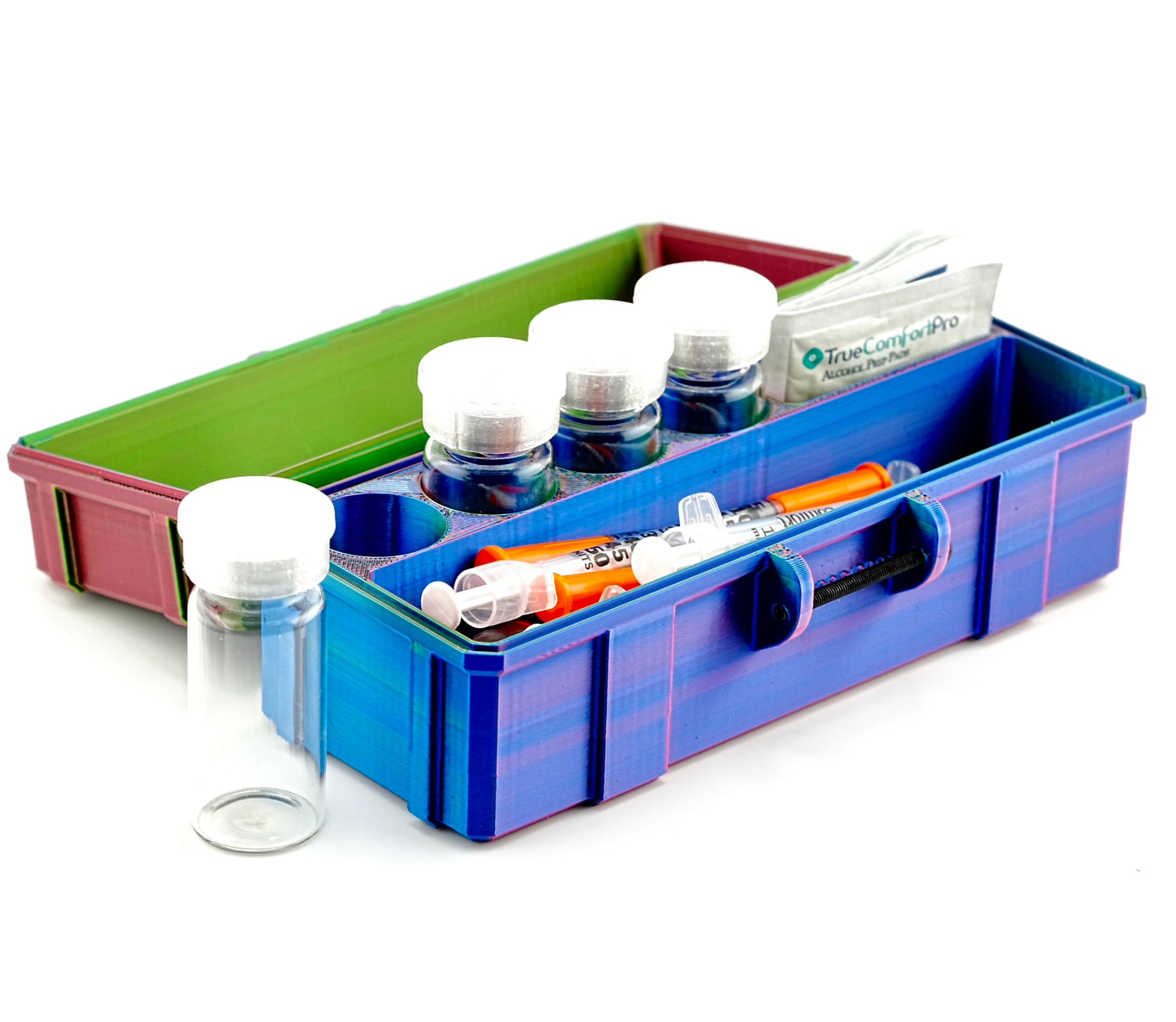
Keeping GLP-1 vials, TRT vials and peptide vials in one case comes down to three things: a fitted spot for every vial you own, a fixed zone for each group, and a case small enough to live on one fridge shelf or in your carry-on. Get those right and a cabinet full of loose glass becomes one box you can grab and go.
This guide walks through what a combined kit usually holds, why each group needs its own zone, how to assign pockets, and how to travel with all of it. If you would rather skip hunting for a case that almost fits, you can design one around your exact vials in a few minutes.
Design one case for GLP-1, TRT and peptides
Add your 10 mL vials, 3 mL vials, syringes and BAC water bottle. The builder sizes every pocket and shows the finished case in 3D.
What a Combined GLP-1 + TRT + Peptide Kit Looks Like
Before solving the storage problem, it helps to list what a typical combined kit actually contains. The setup we see most often looks something like this:
- GLP-1: usually one 10 mL multi-use vial, sometimes a smaller 3 mL vial, or a pen instead of a vial.
- TRT: one or two 10 mL testosterone vials. These are often the tallest glass in the kit.
- Peptide vials: anywhere from one to five small vials, most often 3 mL.
- Supplies: a BAC water bottle, syringes in more than one size, and alcohol pads.
Add it up and a moderate combined kit is 6 to 12 vials in two or three sizes, plus syringes that should never be rolling around loose. The organizing challenge is real, and the chance of grabbing the wrong vial is highest when everything sits in one pile.
Why Each Component Has Different Storage Needs
The vials in a combined kit are not interchangeable. They come from different pharmacies, in different sizes, and each one carries its own storage instructions. Some labels say refrigerate, some say room temperature, some say keep away from light. Follow the storage instructions on your product label or from your pharmacist or provider for every vial, and never assume one rule covers all of them.
What a case can do is make those instructions easy to follow. When each group has its own zone, you can see at a glance which vials are which, keep the case wherever the label says those vials belong, or split the kit into two cases when the instructions differ. A hard case is a protective organizer, not a cooler: it keeps glass from breaking and vials from wandering, and it can sit inside a fridge or a cooler when a label calls for cold.
Key takeaway: Different vials, different labels. Give each group its own zone so you can follow every label without digging. If all your labels point to the same place, one case works; if they don't, use two.
The Organization Problem With Multi-Vial Storage
The chaos that comes with a combined kit is not random. It follows a few predictable patterns, and knowing them helps you set up a system that avoids them.
Vial confusion. A 10 mL GLP-1 vial and a 10 mL testosterone vial are the same physical size. Without zones and labels, the only way to tell them apart is to read the label every single time, and at 6 a.m. people skim. Fixed zones remove most of that risk.
Syringe confusion. Many combined kits use more than one syringe size. Tossed together in a drawer, they are easy to confuse. Give each size its own trough so the right one is always in the same spot.
Date tracking. Every vial has its own dates: the day you opened it and the discard date from its label or your pharmacist. With six vials, that is six sets of dates. Without a system you are relying on memory, or on marker ink that has since smudged.
Travel packing. If storage is disorganized at home, packing for a trip is worse. What goes? What stays? An organized all-in-one case answers that for you: if it is in the case, it travels.
Choosing a Case That Fits Everything
The right all-in-one case for a combined GLP-1, TRT and peptide kit has to solve several problems at once. Here is what to look for:
Mixed vial capacity. Your kit likely includes 10 mL vials, smaller 3 mL vials and a BAC water bottle. The case needs a spot for each size, ideally in clearly defined zones. A case with only small pockets forces your 10 mL vials into improvised positions; a case with only large pockets leaves small vials rattling around.
Total vial count. Count what you keep on hand: GLP-1, TRT, each peptide, the water bottle, any sealed spares. Most moderate kits land at 6 to 10 vials. Leave a little room to grow, but a case twice the size you need just eats fridge space.
Hard-shell construction. Glass vials do not forgive soft cases. A fabric or neoprene pouch gives almost no crush protection. Set a bag down hard, or let something heavy land on it in a suitcase, and glass in soft storage can crack.
Light protection. Many vial labels say to keep the contents away from light. A closed, solid-walled case keeps vials in the dark; mesh panels, clear windows and thin fabric do not.
Portability. For travel, the case should fit in a carry-on or personal item without taking over the bag. A tidy hard case of labeled vials also makes a security check simpler for everyone.
Off-the-shelf cases come in fixed layouts, so a combined kit usually ends up with empty pockets in one size and too few in another. That is the gap the PeptideCase™ builder fills: you tell it how many of each item you carry, and it lays out a case with a fitted spot for every one.
Slot Assignment Strategy for Combined Kits
Having a case is step one. Knowing which vial goes where is step two. A clear, consistent layout turns a case from storage into a system.
The most effective approach divides the case into zones by group:
Zone 1: GLP-1. Give your GLP-1 vial or pen the most accessible spot, so it is easy to find and lift out without disturbing anything else.
Zone 2: TRT. Keep your testosterone vials together in the next zone, so the two 10 mL lookalikes never end up side by side by accident.
Zone 3: Peptide vials. Give each peptide its own pocket, in the order you reach for them. The same pocket every time means you stop hunting.
Zone 4: Supplies and spares. The BAC water bottle, sealed backup vials and anything you reach for less often go here.
Label each zone. The case should tell you what belongs where at a glance, so you notice right away when something is missing or out of place.
Organization tip: Color-code the vials themselves: one color for GLP-1, another for TRT, another for each peptide. You know what you are holding before you read the label, which also helps anyone else who needs to find something in your kit.
Color-code your vials
Custom snap-on caps for 3 mL or 10 mL vials, with a cap color plus an icon or letters. Sets from 25 caps.
Travel With Your Full Kit
Traveling with GLP-1, TRT and peptide vials together takes more planning than traveling with one vial. Here is how to pack it.
Always carry on. Keep the case in your carry-on or personal item, not checked luggage. Cargo holds can get very cold or very hot, checked bags get thrown, and sometimes they get lost.
Cold packs when a label calls for cold. If any of your vials should stay refrigerated, put the case in a small cooler with a gel cold pack. Wrap the pack in a cloth or paper towel so it never presses directly against the glass. The case itself is not a cooler; it keeps the vials still, upright and together inside one.
Room-temperature vials. If some of your vials are labeled for room temperature, they don't need to ride against the ice pack. A separate zone, or a second small case, keeps them apart.
Documentation matters more with a combined kit. A case with ten vials, syringes and cold packs gets a closer look than a single pen. Keep medication in its original labeled packaging where you can, carry your prescriptions or a short letter from your prescriber listing what you carry, and check the current rules of TSA, your airline and your destination yourself before you go. See our guides on flying with vials through TSA and traveling with GLP-1 and peptide vials.
Hotel fridge management. If a label says refrigerate, confirm the hotel fridge is actually cooling (feel the back wall) before you rely on it, and keep the whole case on one shelf instead of spreading vials around. A case with a temperature sensor window holds a small digital thermometer right in the lid, so you can keep an eye on it.
Trip length. For a short trip, the whole case simply goes with you. For a longer one, plan what you need ahead of time and talk to your pharmacist or provider about refills or spares. The case only has to hold what you actually bring.
Avoiding Cross-Contamination and Wrong-Vial Errors
Grabbing the wrong vial ranges from annoying to genuinely dangerous, and almost every one of these errors comes from poor organization. These habits remove most of the risk:
Read the label every time. The most common error is assuming you know what a vial is because of where it sits. The pocket gets you to the right vial; the label confirms it. Three seconds is worth it.
Keep syringe sizes apart. If your kit uses more than one syringe size, give each one its own trough so you never pick up the wrong size.
One vial out at a time. Take out one vial, use it, put it back in its pocket, then take out the next. Two open vials on the counter is how errors happen.
Label anything you set aside. If something leaves the case and will not go straight back, label it right away. An unlabeled item on the counter is an accident waiting to happen.
Separate opened vials from sealed ones. Keep the vials you are using in an "active" row and sealed backups in a "reserve" row, so you never open a backup by mistake.
The Ideal All-in-One Case Setup
Based on everything above, here is what a well-organized all-in-one setup looks like for a combined GLP-1, TRT and peptide kit:
The case itself: a hard shell with a fitted pocket for every vial, sized for the 10 mL and 3 mL vials you actually own, with room for syringes and the water bottle. It should slip into a carry-on without hogging the bag.
Zone labeling: mark each zone (GLP-1, TRT, Peptides, Supplies) and, where you can, each pocket, so you see right away what belongs where.
Vial labeling: every vial, without exception, gets a label with its name, the date you opened it and the discard date from its label or your pharmacist. Waterproof label tape and a fine-tip permanent marker work; a label maker works better. Our guide on how to label peptide vials covers the details.
Supplementary supplies: syringes in their own trough, alcohol pads in their own bay, the BAC water bottle standing in its own spot, and your prescriptions or prescriber letter in your bag.
Cold chain: when a label calls for cold, a small cooler and a slim gel pack with the case inside. Chill the pack the night before you leave.
Bottom line: A combined GLP-1, TRT and peptide kit does not need to be complicated, but it does need a system: one case with a spot for everything, a fixed zone for each group, and labels you can read at a glance. That is enough to keep 10 or more vials in order without confusion, and to stop the broken vial that a loose drawer eventually produces.
Make your own custom GLP-1, TRT and peptide case
The PeptideCase™ builder starts with an empty case. Tap "Add item" and pick what you carry and how many: 10 mL vials for GLP-1 and TRT, 3 mL peptide vials, a BAC water bottle, syringes, alcohol pads, even a peptide pen or pen cartridges. Every item becomes fitted pockets or an open bay sized for that count, and every space has a finger scoop.
The tallest item sets the case height. Shorter vials stand on a raised floor, so your 3 mL and 10 mL vial tops line up at the rim and are easy to grab. Auto-arrange packs everything into the most compact layout, and the builder shows the case length, width and height with a top view, a lid view and a 3D view you can open, close and turn.
Choose Black or RGB Metallic, a Wide or Deep shape, and one or two latches. Add a temperature sensor window if you keep a small digital thermometer with your kit, and put your name or an icon on the lid in a second color. Each case is printed to order on the maker's own print farm in the US. Design your all-in-one case