
Understanding the Three Vial Types in Your Kit
Before you can choose the right case, you need to know what makes each vial type different — because their sizes don't match, and the best case holds all of them without compromise.
GLP-1 vials and pens: Compounded GLP-1s usually come in 3 mL or 5 mL glass vials with rubber stoppers; branded GLP-1s come as pens. The vials look and handle exactly like peptide vials, which simplifies things. Store them the way your pharmacy label says.
TRT vials: Testosterone usually comes in 10 mL vials. They're taller, wider and heavier than peptide vials, so they need a bigger, deeper slot — squeezed into a small-vial slot, a 10 mL vial is the first thing to crack in a drop. Follow the storage instructions on the label.
Peptide vials: Peptides usually come in small 2-3 mL vials. They're light, easy to knock over and easy to confuse with one another, which makes fixed slots and clear labels important.
The key insight: these three vial types come in different sizes and often carry different storage instructions. Follow each label exactly. What the case has to do is give each size the right slot, keep everything in the dark and protected, and fit wherever your labels say the vials should live.
Design one case for GLP-1, TRT and peptides
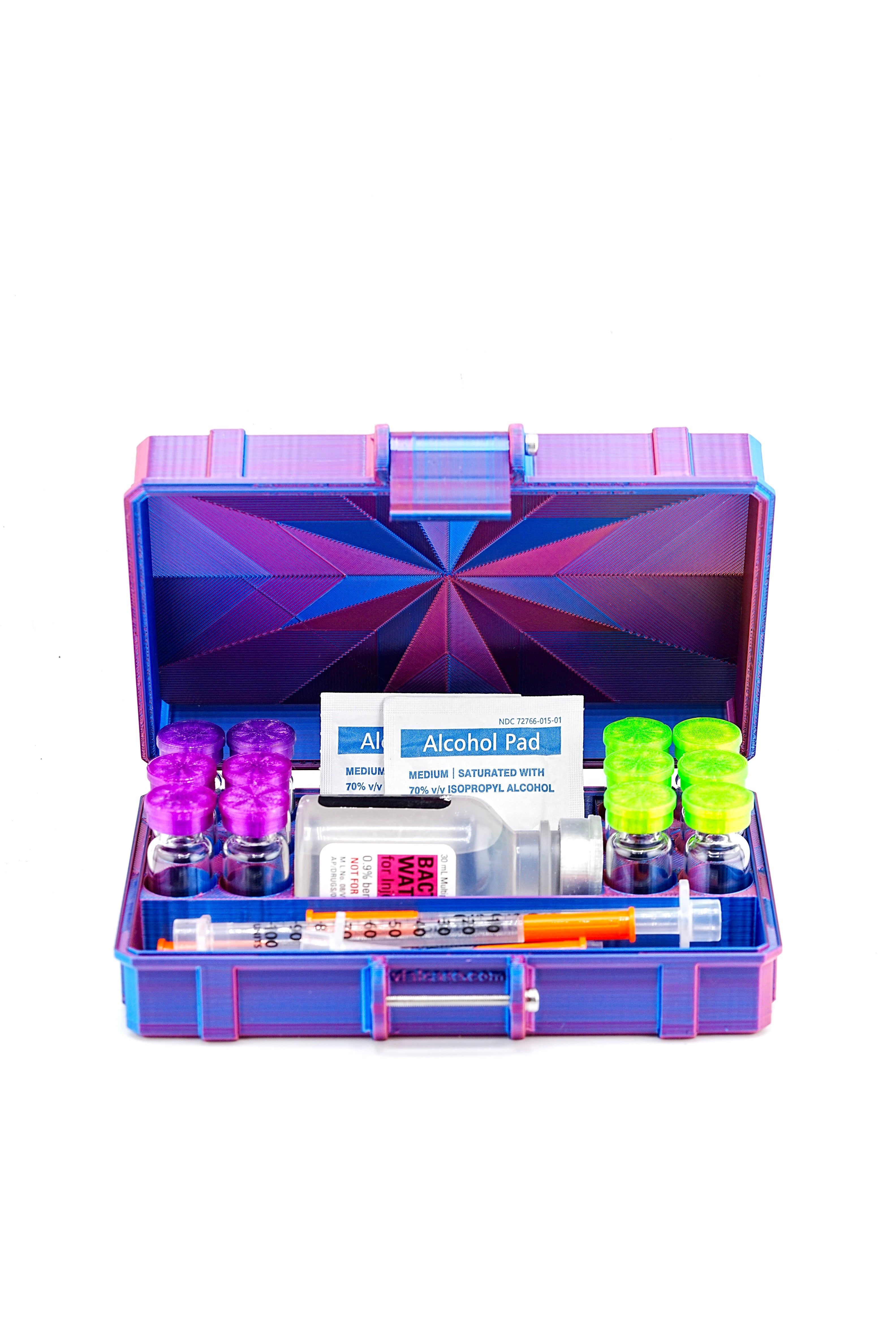
Add your TRT vials, GLP-1 and peptide vials and syringes, and the builder lays them out in one hard case with every vial top at the rim.
Why Generic Cases Fail When You Carry All Three
The generic case failure mode is consistent: the case was designed for one vial type, and someone carrying all three tries to force everything into it. Here's where it falls apart.
Insulin cooler cases are designed for pre-filled pens, not vials. The compartments don't fit 10 mL TRT vials, any inserts don't grip 3 mL peptide vials, and they're sized for a single medication — not a five-vial kit.
Soft-sided travel pouches have no impact protection and often no light blocking. Everything rattles around together. For glass vials, "rattle" eventually means "break." The pouch also collapses under weight, so a water bottle sitting on top of it in a bag can crush vials.
Medical supply bags are too large for everyday carry and have adjustable compartments that don't secure vials. A divider that's perfect for syringes does nothing to stop a 3 mL vial rolling sideways and landing stopper-down on another vial.
Makeup cases and toiletry bags are the most common improvised solution and the worst for vials. They block no light (clear panels are common), offer no impact resistance, and have no vial-specific slots. They do, however, look discreet — which is the only thing they get right.
The unifying failure across all generic cases is the same: they weren't designed around the sizes and fragility of glass vials with rubber stoppers. A case built for vials solves this at the design level, so you don't have to improvise every time.
What Your Case Must Handle
A case for GLP-1, TRT and peptide vials together has to satisfy requirements from three directions at once. Here's the complete checklist:
- Two vial sizes: Your case must take both 3 mL/5 mL vials (GLP-1, peptides) and 10 mL vials (TRT). These have meaningfully different dimensions: a 3 mL vial is roughly 17 mm across and 50 mm tall, a 10 mL vial roughly 20 mm across and 65-70 mm tall. The interior needs slots sized for both.
- Light blocking: Many labels say to protect from light. The shell must be fully opaque — no clear panels, no mesh windows. Light blocking comes from the shell itself, not from a label on the outside.
- Impact resistance: Glass vials need a case that absorbs drops and squeezes without passing the force to the vials. That means a hard outer shell and a fitted slot for each vial, so vials never touch each other.
- Cooler compatibility: A case is a protective organizer, not a cooler. If your labels call for refrigeration, the case should fit inside a small cooler or insulated bag with a gel pack for travel days.
- Enough capacity for your kit: Map your kit before choosing a case. Four different products need at least four vial slots plus a spot for a BAC water bottle if you carry one. Buy for the kit you have now, not one you might have someday.
- Syringe and supply storage: Syringes and alcohol pads need a home in the same case — a dedicated trough or bay keeps them organized without taking up vial slots.
The Best Case Options for a Combined Kit
With the requirements defined, here's how different case configurations handle GLP-1, TRT and peptide vials together:
A custom case (PeptideCase™ builder): The best fit for a combined kit, because no two combined kits are the same. You add TRT vials, peptide vials, 3 mL or 10 mL vials, syringes, alcohol pads and pens in the quantities you carry; each gets fitted pockets or an open bay, and Auto-arrange packs them tight. The 10 mL TRT vial sets the height, and the shorter vials stand on a raised floor so every top lines up at the rim.
Small compact cases (4-6 vial slots): Ideal for 3-4 products plus a BAC water bottle. Best for gym carry, commuting, and overnight travel. The footprint fits easily in any bag. Limitation: little space for supplies and no room to expand.
Medium cases (6-10 vial slots): The sweet spot for most combined kits. Holds five products plus supplies in a case that still fits in a personal item for air travel, and takes 3 mL and 10 mL vials side by side.
Large cases (10-20 vial slots): Best for people who keep a wider range of peptide vials alongside a GLP-1 and TRT. These work well for home storage and carry-on travel but are too large for gym and commute bags.
For most people carrying a GLP-1, TRT and two or three peptide vials, a medium-sized case is the right call — large enough to hold everything without improvising, small enough to go anywhere. Designing it yourself means it's exactly that size, with exactly those slots.
Buy for your current kit, not future expansion. It's tempting to buy a large case "in case" you add more. But a half-empty case has vials sliding around unused slots — exactly the impact risk you bought the case to prevent. Fit the case to the kit.
Setting Up Your Case: Slot Assignment That Works
A good case is only as organized as its slot assignment. The goal is a system where you reach for a specific slot instinctively — without reading labels in a hurry or digging through the case in a gym locker room.
Here's a slot assignment that works for a GLP-1 vial, a TRT vial, two peptide vials and a BAC water bottle:
- Position 1 (front left): GLP-1 vial. Your highest-value vial goes where you see it first when you open the case.
- Position 2 (front right): BAC water bottle, in its own clearly separate spot.
- Position 3 (center): TRT vial. The 10 mL vial needs the widest, deepest slot, and the center keeps the case balanced.
- Position 4 (back left): Peptide vial #1. Back positions are for vials you reach for less often.
- Position 5 (back right): Peptide vial #2.
- Supply area: Syringes (sorted by length) in their own trough, alcohol pads in a flat bay.
The system works because each product always lives in the same slot. Muscle memory develops after a week of consistent use. You stop reading every label and start reaching straight for the right slot — which cuts mistakes and speeds things up.
Traveling With GLP-1, TRT, and Peptides
Travel is where the right case pays off most. Here's how a combined travel setup should work from door to destination:
Pre-trip prep (night before): Check every vial's label and expiration date. Freeze your gel pack according to its instructions, and set out a small cooler or insulated bag that your case fits inside.
Morning of travel: If your labels call for refrigeration, take the case from the fridge, put it in the cooler with the gel pack, and pack the cooler in your personal item bag. The case protects the vials; the cooler does the cooling.
Airport security: Let officers know you're carrying medication and supplies, and expect them to want a look. Open the case and let them see. An organized case with labeled vials answers most questions before they're asked. Keep your prescription or provider letter with you.
In-flight storage: Keep the cooler in your personal item bag under the seat, not in the overhead bin, so it's within reach and doesn't get crushed.
Hotel storage: The case goes into the in-room refrigerator on arrival if your labels call for it. Check the fridge with a thermometer against your labels; if it doesn't hold the range (common in budget hotels), ask the front desk for a different fridge.
International travel note: Testosterone is a controlled substance in many countries, and rules for other medications vary widely. Carry a copy of your prescription, keep medication in its labeled packaging where you can, and check the destination's current rules yourself before you travel.
Labeling Your Vials to Prevent Errors
Carrying three types of vials creates real room for mix-ups, especially in the first weeks. A labeling system brings that close to zero.
The minimum labeling system for a GLP-1, TRT and peptide kit:
- Contents: Write a short name on a small label on the vial body, not the cap (caps get swapped). "GLP," "TRT," "PEP A," "PEP B" is enough.
- Date opened: Write the date you first opened each vial. MM/DD keeps it short.
- Use-by date: Copy the use-by or beyond-use date from your pharmacy label onto the same small label, so it's visible inside the case.
Use small white adhesive labels and a fine-tip permanent marker; they hold up in the fridge. Replace them when they start peeling — a label that comes off inside the case leaves you guessing which unlabeled vial is which. For the full system, see our guide on how to label peptide vials.
Color-code your vials
Custom snap-on caps for 3 mL or 10 mL vials, with a cap color plus an icon or letters. Sets from 25 caps.
How Often to Reorganize Your Case
A case that's perfectly organized on day one can drift into chaos over a few weeks. Here's a realistic maintenance schedule:
After every use: Return the vial to its assigned slot. It takes five seconds and prevents the slow drift that turns a tidy case into a mess. Wipe the outside of any vial with a wet stopper before it goes back.
Weekly: Check every vial against your labels. Make sure dates are current and remove anything past its use-by date — keeping it in the case invites mistakes. Wipe the inside of the case with a dry cloth if there's any residue.
When adding a new product: Before a new vial goes in, reassign slots deliberately. Don't just stuff it wherever there's space. Give it a specific slot, update your mental map (or a written note if you keep five or more), and stick to it from day one.
Monthly: Do a full case check. Look the gel pack over for leaks — they wear out. Inspect the shell, hinge and latch for damage. A case that took a hard drop is worth a close look before you trust it with your vials again.
Make Your Own Custom GLP-1, TRT and Peptide Case
A combined kit is the clearest case for designing your own: no off-the-shelf layout knows that you carry one 10 mL TRT vial, two peptide vials, a GLP-1 vial, a BAC water bottle and a row of syringes. In the PeptideCase™ builder you start with an empty case, tap "Add item" and add exactly that — TRT vials, peptide vials, 3 mL or 10 mL vials, syringes, alcohol pads, a peptide pen, injector pen or pen cartridges — with the quantity for each.
Every item becomes fitted pockets or an open bay sized for that many, and Auto-arrange finds the most compact layout. The tall TRT vial sets the height; everything shorter stands on a raised floor so all the vial tops line up at the rim, each space with a finger scoop. Pick Black or RGB Metallic, a Wide or Deep shape and one or two latches, then check the top view, lid view and 3D view before you add it to cart.