
Customs officers can stop, inspect and hold anything that crosses a border, and medications are no exception. If you travel internationally with your own vials, the best protection isn't a trick; it's being completely open: declare what you carry, keep it in its original labeled packaging with your prescription or documentation, bring a quantity that makes sense for your trip, and pack it so an inspection takes a minute instead of twenty.
This page is about that last part as much as the rest. A neat, latched case with every vial in its own labeled pocket makes you the easiest traveler in the inspection line. You can design one around exactly what you carry.
Design a case that makes inspection easy
Add what you travel with and the builder lays out a compact hard case with a spot for every vial, so an open lid shows everything.
Why customs officers stop medications
Every country sets its own rules for bringing medications in, and officers have wide discretion. Things that commonly lead to a closer look include:
- Missing labels or packaging. Unlabeled vials, or vials moved out of their pharmacy packaging, give an officer nothing to go on.
- No documentation. No prescription, pharmacy label or letter from a provider to show the medication is yours and for your own use.
- Quantities that don't match the trip. A supply far larger than the length of your stay raises questions.
- Undeclared items. Not declaring something that should have been declared turns a routine question into a problem.
- Disorganized bags. Vials scattered through a suitcase are slow to inspect and look careless, even when everything is in order.
None of these is about hiding anything better. They're all fixed by being organized and upfront.
Before you go: check the rules yourself
Rules change and differ by country, so check them for every trip:
- Your destination's rules. Look at the destination country's official customs or health agency guidance, or contact its embassy or consulate, about traveling with your specific medication.
- Your return. Check U.S. Customs and Border Protection (CBP) guidance on bringing medications back into the United States.
- Airlines and transit countries. If you change planes in another country, its rules may apply too.
- Your provider or pharmacist. Ask for a letter describing your medication and supplies if you don't already have one.
Our guides to international travel with peptides and the peptide travel checklist cover the packing side in more detail.
How to pack so inspection is easy
- Original labeled packaging. Keep vials and pens in their pharmacy packaging where you can, or keep the pharmacy label with them.
- Paperwork on top. Prescription, pharmacy label copies and your provider's letter go in the case lid or a pocket you can reach without unpacking.
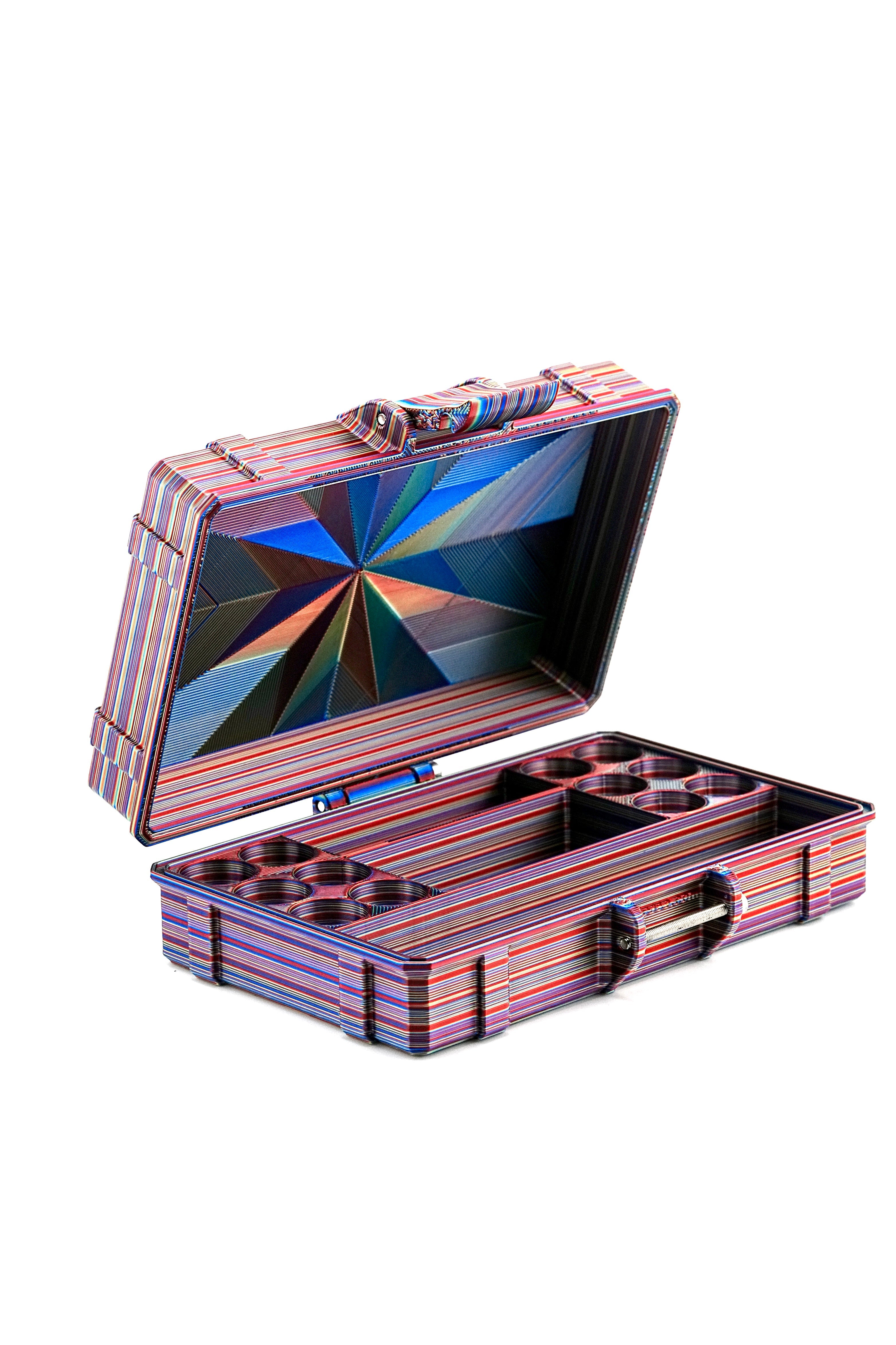
- One case, everything visible. When an officer asks, you open one latched case and every vial, syringe and pad is in its own spot, with labels facing up.
- Carry-on, not checked. Keep medications with you so you can answer questions and so nothing is lost or exposed to extreme heat and cold in the hold.
- A cooler if your label calls for cold. The hard case goes inside an insulated cooler with an ice pack; the case protects the glass, the cooler does the cooling.
- Declare when asked or required. Answer questions plainly and let the officer look.
Why a labeled, organized case helps
An officer looking at a bag of loose vials has to sort out what everything is. An officer looking at an open case with labeled vials in rows, syringes in their own bay and paperwork in the lid sees in seconds what you're carrying and that it lines up with your documents. It doesn't change any rule, but it makes following the rules quick for everyone.
Color-coded caps help too: if you carry several kinds of vials, each kind gets its own cap color, matched to the label and your paperwork.
Color-code your vials
Custom snap-on caps for 3 mL or 10 mL vials, with a cap color plus an icon or letters. Sets from 25 caps.
If your bag is inspected
Stay calm and cooperative, open the case when asked, and show your documentation. Officers make the decisions at the border; if something is held, follow their instructions and the written notice you're given, and contact the agency named on it with any questions. Ask your pharmacist or provider for help with paperwork if you need it.
Design your own custom travel case for border crossings
A case built for travel should hold exactly what you're bringing and nothing that rattles. In the PeptideCase™ builder you start with an empty case, tap "Add item", and add your trip's 3 mL vials, 10 mL vials, peptide pen or injector pen, pen cartridges, syringes and alcohol pads, with how many of each. Each item becomes fitted pockets or an open bay, shorter vials stand on a raised floor so every top lines up at the rim, and every space has a finger scoop, so labels stay readable and nothing hides under anything else.
Auto-arrange packs it into the most compact layout, and the builder shows the exact size, so you can check it fits your carry-on and your cooler bag. Pick Black or RGB Metallic, Wide or Deep, one or two latches, and add your name to the lid. It's printed to order in the US.