
The Short Version
Storing a vial well comes down to two jobs. The first is temperature, and that one is not ours to set: follow the storage instructions on your product label or from your pharmacist or provider, every time. The second job is everything else — keeping the glass from cracking, keeping light off the vial, keeping each vial upright, labeled and easy to find, and getting it from home to wherever you are going in one piece. That second job is what a good case does.
This guide covers the second job in detail: what goes wrong with loose vials, how to set up your fridge, how to pack for travel, and what to look for in a case. A case is a protective organizer, not a cooler. It sits on your fridge shelf, or inside a cooler bag when you are on the move, and keeps your vials safe and sorted wherever the label says they belong.
Design a case around your vials
Pick your vials and supplies, see the exact case size in 3D, and get a hard case with a fitted pocket for every vial.
Temperature: Follow Your Label
Plenty of storage guides print temperature ranges and day counts. We don't. Products differ, and the only numbers that apply to your vial are the ones on its label or the ones your pharmacist or provider gives you. If the label says refrigerate, refrigerate. If it gives a time limit once opened, write that date on the vial.
What a case adds is consistency. A case gives your vials one fixed home on a steady fridge shelf instead of a spot in the door rack, and it keeps them grouped so the fridge door is open for seconds, not minutes, while you look for the right one. On the road, the case goes inside a cooler bag with a gel ice pack, so the vials stay protected inside while the cooler does the cooling.
Light: Keep Vials Covered
Many vial labels say to protect the product from light. Loose vials get light from every direction: the fridge bulb every time the door opens, a kitchen counter, a car seat in the sun. Amber glass filters some of that, but it does not block it.
The simplest fix is a closed hard case. With the lid shut, the vials sit in their pockets out of the light, whether the case is in the fridge, in a backpack, or on a hotel desk. You take out the one vial you need and close the lid again.
Breakage: How Most Vials Are Actually Lost
Vials rarely die in one dramatic drop. They chip from dozens of small knocks: rolling against each other in a bag, tipping over when a fridge shelf slides out, rattling in a backpack pocket next to keys. A chipped neck or a loosened stopper can mean the vial is done.
- Give every vial its own pocket. Separation is what stops glass-on-glass contact. A box with loose vials inside only moves the problem.
- Keep vials upright. Standing vials are easier to grab by the body, and they don't roll.
- Use a hard shell. Soft pouches compress when something heavy lands on them; a rigid case takes the hit instead of the glass.
- Use a real latch. A case that pops open in a bag is not protecting anything.
Labeling and Organizing
An unlabeled vial is a guess. Label every vial with what it is and any date your label or pharmacist tells you to track, such as the date you opened it. Put the same vial in the same pocket every time, so you can reach for it without reading. If you keep more than one kind of vial, color-coded caps let you tell them apart at a glance. Our guide on how to label peptide vials covers label options that survive fridge moisture.
Color-code your vials
Custom snap-on caps for 3 mL or 10 mL vials, with a cap color plus an icon or letters. Sets from 25 caps.
Fridge Setup
- Skip the door rack. It is the least stable spot in the fridge and the one most likely to get knocked.
- Use a middle shelf, toward the back. It is the steadiest zone in most home refrigerators and out of the way of food traffic.
- Keep the case closed and latched. It keeps light off the vials and stops them tipping when the shelf is bumped.
- Keep food away from the case. A dedicated spot means fewer spills and less digging.
For more ideas, see our peptide fridge organization guide.
Travel Storage: Keeping Vials Safe on the Go
- Carry on, don't check. Checked bags get thrown around and sit in the hold, out of your control. Keep vials with you.
- Use a hard-shell case. It protects the glass from impact and keeps everything organized for screening. An organized case is also easier to show at security than loose vials in a plastic bag.
- Add a cooler bag when your label calls for cold. Put the closed case inside an insulated bag with a gel ice pack, wrapped so the pack does not sit directly on the glass.
- Carry documentation. Keep vials in their original labeled packaging where you can, and bring a copy of your prescription or other paperwork. Check your airline's and your destination's current rules yourself before you go. See our guide to traveling through TSA.
- Never leave the case in a parked car. Take it with you, even for a short stop.
What to Look for in a Vial Case
- Pockets sized to your vials — 3 mL and 10 mL vials need different pockets, and loose pockets still rattle.
- Room for the rest of your kit — if the case only fits vials, everything else ends up loose in a drawer.
- A hard shell and a locking latch — protection plus a lid that stays shut.
- A size that fits your fridge shelf and your bag — a case too big to carry gets left at home.
- Easy access — you should be able to lift one vial out without disturbing the rest.
Design your own custom peptide vial case
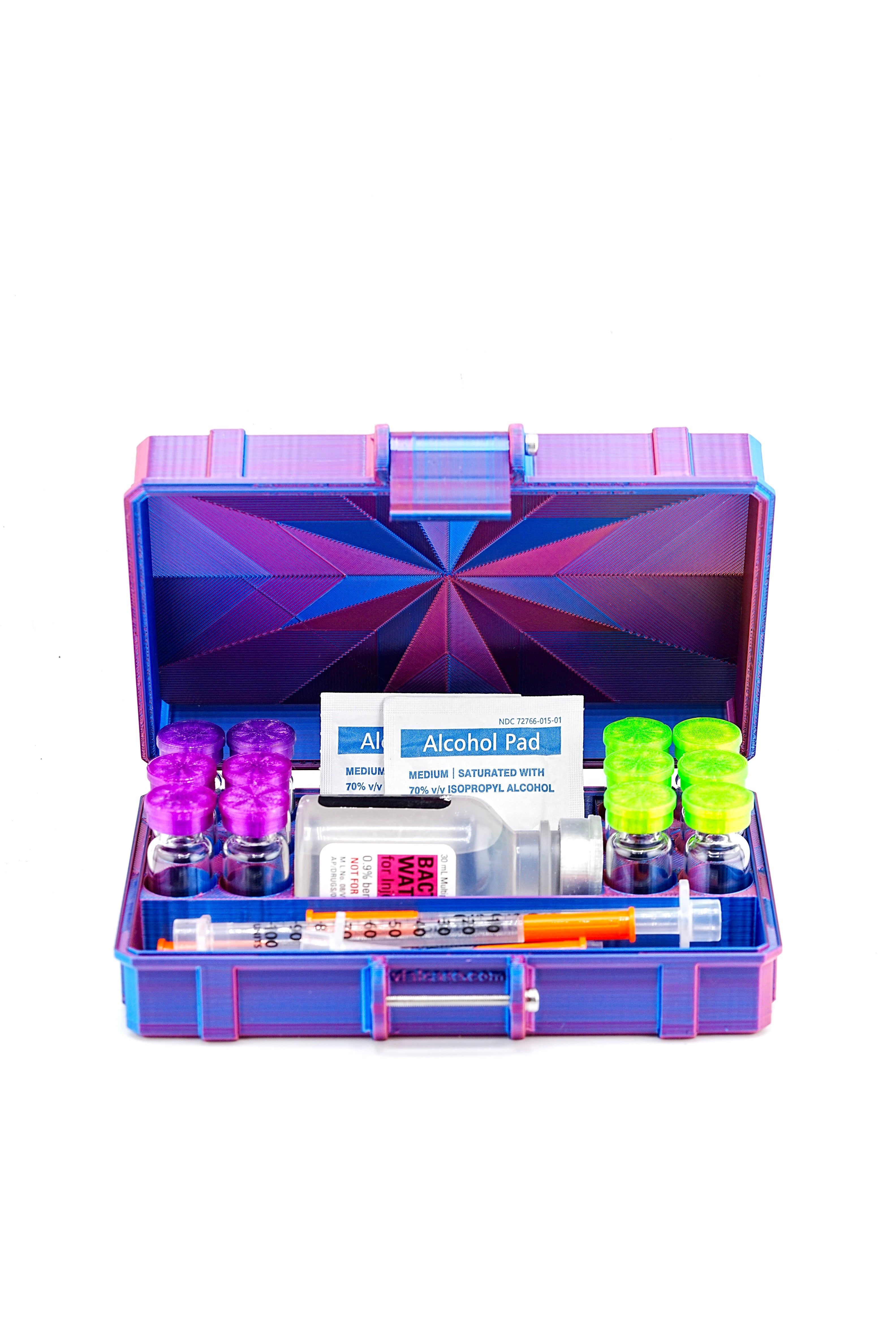
Instead of adapting a generic case, you can build one around the vials you actually keep. Open the PeptideCase™ builder, start with an empty case, tap "Add item" and choose what you carry and how many: peptide vials, 3 mL or 10 mL vials, other size vials, plus a BAC water bottle, syringes or alcohol pads if they live in the same kit. Each item becomes fitted pockets or an open bay sized for that many, and every storage space has a finger scoop.
The tallest item sets the case height, and shorter vials stand on a raised floor so every vial top lines up at the rim, easy to grab from the fridge. Auto-arrange finds the most compact layout, and the builder shows the exact length, width and height with top, lid and 3D views. Pick Black or RGB Metallic, a Wide or Deep shape, and one or two latches, then add a line of text or an icon to the lid if you want it easy to spot. It is printed to order in the US and checks out on vialcase.com. Design a case for your vials