
The best way to store peptides has two parts. The first is set by your product: follow the storage instructions on your product label or from your pharmacist or provider. The second is up to you: keep every vial in a hard case — upright, out of the light, separated from the others and clearly labeled.
This guide covers that second part in detail: where vials should sit in the fridge, how to protect them from breakage and light, how to keep several organized, and how to pack them for travel.
Give every vial its own slot
Add the vials and supplies you store, and the builder lays out a hard case with a fitted pocket for each one, sized to your fridge shelf.
The Short Answer: What Actually Goes Wrong With Stored Vials
Most storage problems come down to four things, and a good setup handles all of them:
- Breakage — vials are small glass bottles with rubber stoppers. They tip over, roll off shelves, crack in bags and chip against each other.
- Light — many labels say to protect from light, and an open fridge shelf puts vials under a bulb every time the door opens.
- Confusion — several near-identical vials with smudged handwriting is how people grab the wrong one or lose track of what they opened when.
- The wrong temperature — usually from a bad spot in the fridge, a warm car or a long travel day without a cooler.
Every rule below exists to handle one of these four. Once you see the "why," the rules become obvious.
Temperature: Follow Your Label
Storage temperatures differ between products, and even between the unopened and opened forms of the same product. That's why we don't publish ranges: the only numbers that count are the ones printed on your label or given by your pharmacist or provider. Read it, follow it, and if anything is unclear, ask.
What you can control is whether the place you keep vials actually holds the range your label asks for. A fridge thermometer with min/max memory answers that in one night. And remember what a case is and isn't: a hard case is a protective organizer, not a cooler. It doesn't keep anything cold on its own — it sits inside the fridge at home, or inside a cooler with ice packs when you travel.
Where in the Fridge to Store Peptides
If your label says refrigerate, placement matters. Not all parts of your refrigerator behave the same:
- Back of the middle shelf — the most consistent spot, least affected by the door opening. This is the ideal place.
- Door shelves — the worst option. Every time the door opens, the door shelves warm up, and bottles there get knocked around.
- Top shelf — often fine at the back, but check it with a thermometer.
- Crisper drawers — an acceptable backup if the middle shelf is crowded, but humid, which smears handwritten labels.
- Next to the freezer vent — can run colder than the rest. If your label says do not freeze, keep clear.
A dedicated case solves the placement problem permanently: it sits at the back of the middle shelf, keeps all your vials together and closes on the light every time the fridge door opens. Our fridge organization guide walks through the full setup.
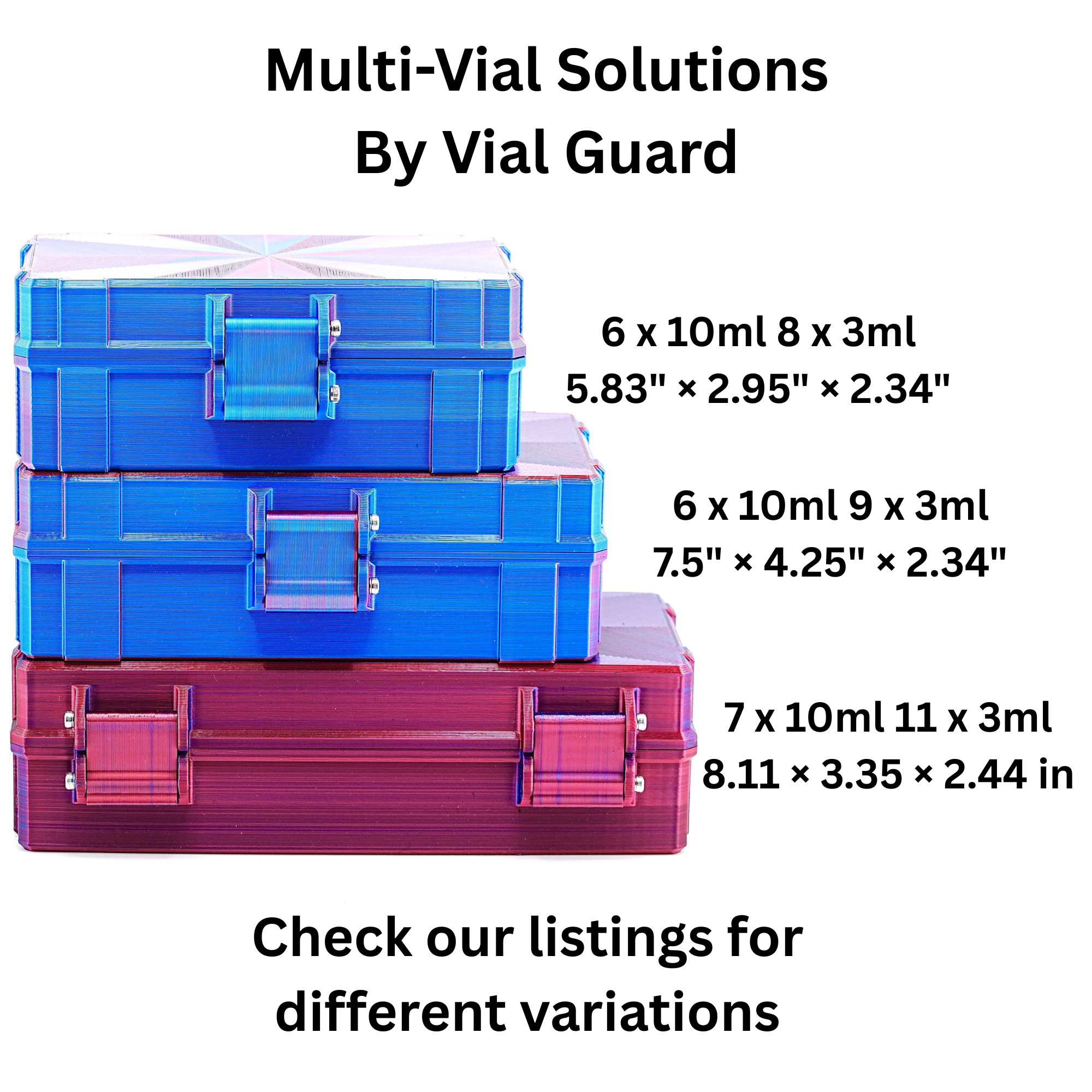
Light Protection: Keep Vials in the Dark
If your label says to protect from light, take it literally. A vial on an open fridge shelf sees the fridge bulb every time someone opens the door — for a busy household, dozens of times a day. A vial left on the counter sees daylight.
Amber vials filter some light, not all. The simple fix is to keep every vial inside an opaque case that closes fully. Lid shut, the vials sit in the dark no matter how often the fridge opens. Take out the vial you need, close the case, and put the vial back as soon as you're done.
Protect Vials From Breakage
Glass vials fail in predictable ways: they tip over and roll off a shelf, they knock together in a bag until one cracks, or a stopper gets damaged when a vial lands on its head. A storage setup should make all three impossible:
- Keep vials upright in slots sized for them, so they can't tip, roll or rest on their stoppers.
- Keep them apart. Each vial gets its own slot, so glass never touches glass.
- Use a hard shell. Soft pouches and zip bags pass every knock straight to the glass. A hard case takes the hit instead.
- Size slots to the vial. A 3 mL vial in a slot built for a 10 mL bottle still rattles. See our guide to 3 mL vs 10 mL vials.
Keep Vials Organized and Labeled
With more than one product, organization is what keeps you from grabbing the wrong vial. A simple system:
- Give every product a fixed slot. Vials in use at the front, unopened backups behind, any BAC water bottle in its own clearly separate spot.
- Label every vial with what's in it and the date you opened it, plus the use-by date from your pharmacy label if it has one. A fine-tip permanent marker survives fridge moisture.
- Use color. Colored caps or colored labels let you tell vials apart at a glance, before you even read them.
- Use the oldest first. Newest vials go to the back, so nothing gets forgotten.
Our guide on how to label peptide vials has more ideas.
Color-code your vials
Custom snap-on caps for 3 mL or 10 mL vials, with a cap color plus an icon or letters. Sets from 25 caps.
Traveling With Peptides
Travel is where most vials break and most temperature mistakes happen. A few habits cover it:
- Keep medication in your carry-on, never in checked bags that get lost, crushed or left on a hot ramp.
- If your label calls for refrigeration, put the hard case inside a small cooler or insulated bag with a gel ice pack. Check your label for how long the product may be out of the fridge.
- Never leave vials in a parked car. A car interior heats up fast in the sun.
- Keep pharmacy labels on vials and carry your prescription or provider letter, and check your airline's and destination's current rules yourself.
For more, see our TSA travel guide.
What to Look For in a Peptide Storage Case
- Hard shell that survives drops and bag compression.
- A fitted slot for every vial, sized for the vials you actually have.
- A lid that closes fully and an opaque body, so no light gets in.
- A secure latch that won't pop open in a bag.
- The right capacity — enough slots for your kit, but not so many that vials slide around empty space.
- A size that fits your fridge shelf and your travel cooler.
Make Your Own Custom Peptide Storage Case
The checklist above is easiest to meet with a case designed for your vials and nobody else's. The PeptideCase™ builder starts with an empty case. Tap "Add item" and pick what you store — peptide vials, 3 mL vials, 10 mL vials, other size vials, a BAC water bottle, syringes, alcohol pads, a peptide pen — and how many of each. Every item becomes fitted pockets or an open bay sized for that many, so each vial stands upright in its own space.
Auto-arrange packs everything into the most compact layout. The tallest item sets the case height, and shorter vials stand on a raised floor so every vial top lines up at the rim, easy to grab, with a finger scoop on every space. The builder shows the length x width and height, so you can check the case fits your fridge shelf before you order. Choose Black or RGB Metallic and a Wide or Deep shape, and add text or an icon to the lid if you like.