
Tirzepatide comes as prefilled pens or as compounded vials, often 10 mL. Whatever storage your label calls for, the vials and pens still need protection from knocks and falls, from light if the label says so, and from the everyday chaos of a shared fridge. Here are ten common storage setups ranked from worst to best, judged on how well each handles a vial or pen you use week after week, at home and on the road.
#10 — Worst: Bathroom Medicine Cabinet
The default for many people with any medication. Bathroom cabinets are one of the worst storage spots in the home: hot showers send the temperature and humidity up and down every day, steam soaks cartons and labels, and the sink right below is where dropped vials end up. It's very hard to keep to any label instruction in a bathroom.
Design a case for your tirzepatide vials
Add 10 mL vials or pens, your backups and supplies, and the builder lays out a compact case sized to your fridge shelf.
#9 — Loose in the Main Fridge (No Container)
If your label calls for refrigeration, this at least gets the location right, but there's no protection and no organization. A loose vial gets knocked over by every jar and container moved past it, and if your label says to protect from light, it gets the fridge light every time the door opens, for every member of the household. Over the weeks a single vial is in use, that adds up to a lot of handling.
#8 — Branded Medication Pouch (Neoprene)
Soft neoprene pouches branded for GLP-1 medication are widely marketed to pen users. They're sized mainly for autoinjector pens, so if you use compounded tirzepatide in 10 mL vials, the pen-shaped pockets don't hold your vials properly. The soft build offers no drop protection, and many let light through the fabric.
#7 — Insulated Travel Pouch With Ice Pack
Built for keeping things cool in transit, not for home storage. If you need to carry tirzepatide to work, on a drive or between homes and your label calls for cold, an insulated pouch with a slim ice pack is the right tool for the trip. At home it adds nothing your fridge doesn't already do, and the ice pack has to be refrozen to stay cold.
#6 — Zip-Up Hard Case (Clear)
Hard-shell, latching cases with clear panels, made for cosmetics or accessories, are a popular repurpose. The rigid shell handles drops well and keeps your supplies together. The clear panel is the weak point if your label says to protect from light: every fridge-door opening lights up the vial for as long as it's in use.
Pro Tip: Mark the date you first open each tirzepatide vial on a small piece of tape around it, and follow the in-use instructions on your label or from your pharmacist. A date you can see at a glance means you never have to guess.
#5 — Generic Medicine Organizer Box (Opaque)
A basic opaque plastic box with a latching lid fixes the light problem that clear cases create, and vials, syringes and swabs all live in one place. The remaining issues: with no padding, vials slide around whenever the box is moved, and compartments designed for pills don't fit 10 mL vials and syringes cleanly. A workable budget option for a simple, single-vial setup.
#4 — Pelican-Style Hard Case (No Foam Customization)
A watertight, drop-resistant Pelican-style case is a real step up on impact protection. It's opaque, sealed against humidity and tough enough for travel. Without custom foam, though, the vials still roll and rattle in the open cavity. The case is doing the right job on the outside; the vials still need to be held still on the inside. Option #2 shows what happens when you add the foam.
#3 — Compounding Pharmacy’s Provided Case
Some compounding pharmacies send a branded case with tirzepatide orders. Quality varies widely: some are foam-lined and genuinely useful; others are thin cardboard sleeves that fall apart after a couple of weeks in the fridge. If yours is a solid foam-lined case, use it. If it's flimsy cardboard or a soft pouch, treat it as packaging and upgrade before long.
#2 — Custom Foam-Lined Hard Case (DIY)
A well-cut foam insert in a Pelican or similar hard case is excellent for tirzepatide vials. The vials don't move, the case is opaque and durable, and it sits neatly in the fridge. The gap between this and #1 is organization for the whole kit: a DIY foam case has a vial slot or two but no designed home for your BAC water bottle, syringes, alcohol swabs or other supplies. Everything else is still loose.
#1 — Best: A Custom Case You Design Yourself (PeptideCase™ Builder)
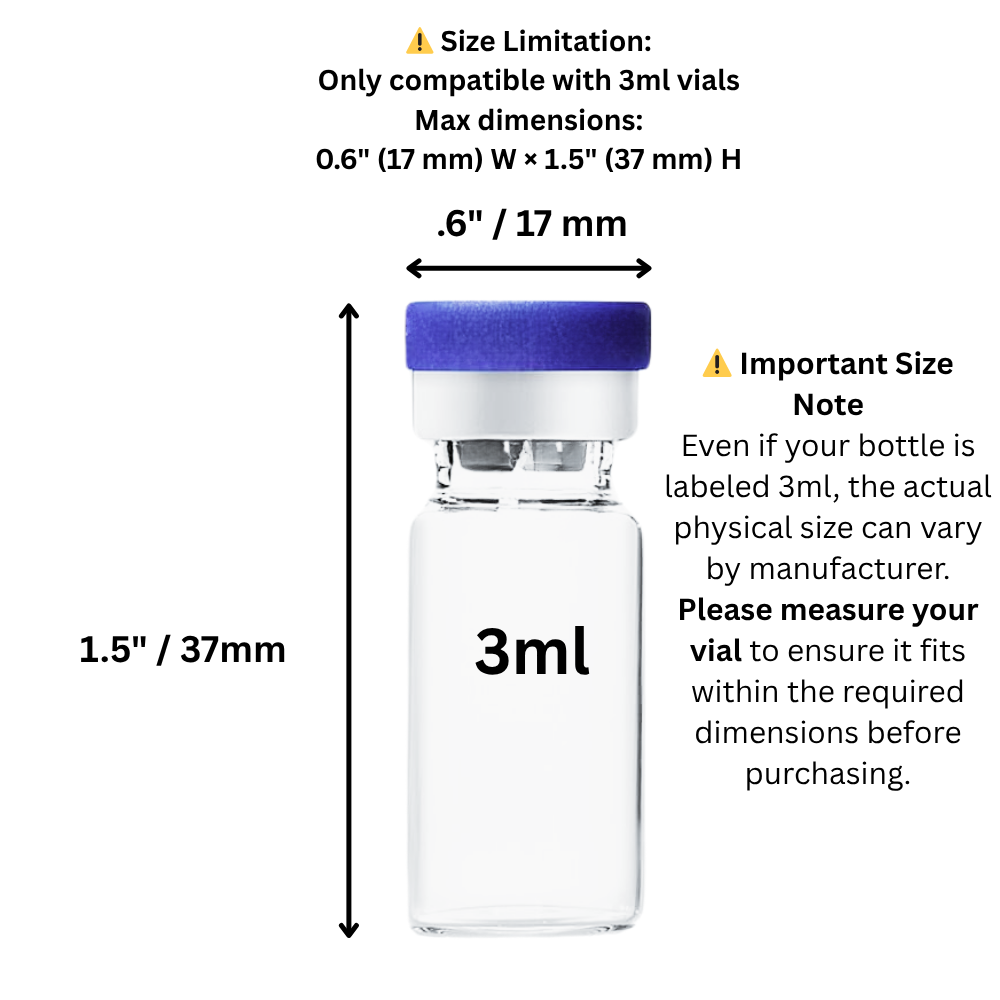
The best setup takes everything #2 does right and adds a home for the whole kit, sized to your vials instead of to a foam block. In the PeptideCase™ builder you start with an empty case, tap "Add item" and choose 10 mL vials (the common size for compounded tirzepatide), 3 mL vials or pens, then add syringes, alcohol pads and a BAC water bottle. Each item becomes fitted pockets or an open bay sized for that many, every space has a finger scoop, and shorter items stand on a raised floor so vial tops line up at the rim. Auto-arrange packs it into the most compact layout, and a locking latch keeps it shut in the fridge and in a bag.
The habit that matters most with a weekly vial, putting it back in the same place every time, is easier when your entire kit lives in one organized case. Design your tirzepatide case →
Tirzepatide Storage: Key Rules
- Follow your label. Storage temperature and any out-of-fridge allowance come from your product label, pen leaflet or pharmacist. Prefilled pens and compounded vials can have different instructions.
- A case is not a cooler. It protects and organizes. It can sit in your fridge or ride inside a cooler bag; it doesn't keep anything cold itself.
- Date every vial. Write the date you first opened it on the vial and follow your label's in-use instructions.
- Keep backups separate. Unopened vials go in their own section or case so you never open a new one by accident.
- Carry on, never check. When you travel, keep tirzepatide in your carry-on with its labeled packaging and any documentation.
- Never leave it in a parked car. Take the case with you.
Make your own custom tirzepatide case
Most ready-made cases are built for 3 mL vials, so a 10 mL tirzepatide vial either won't fit or ends up in a pen pocket that doesn't hold it. In the PeptideCase™ builder you start with an empty case, tap "Add item" and choose exactly what your kit needs: 10 mL vials (with enough pockets for the vial in use and your backups), 3 mL or other size vials if your pharmacy uses them, pens and pen cartridges if that's your format, plus syringes, alcohol pads (flat or standing) and a BAC water bottle. Auto-arrange plots the most compact layout and shows the exact length, width and height, so you can check it against your fridge shelf and your cooler bag. Pick Black or RGB Metallic, Wide or Deep, and add a name or icon to the lid in a second color. Custom cases are printed to order in the US. Build a case for your vials