
Whatever GLP-1 vials or pens you keep, a storage case has three jobs: protect the glass from drops and knocks, keep the vials organized and out of the light, and fit wherever your label says they belong, whether that is a shelf or the fridge. The case you choose either delivers all three or cuts corners on at least one.
Here are all 10 common storage approaches, ranked worst to best. The #1 spot goes to a custom case you design yourself, sized around exactly what you keep.
Design a GLP-1 case around your kit
Add your GLP-1 vials, pens and supplies, and the builder lays out the most compact hard case that holds them all.
#10 — Worst: No Container at All
Bare vials on a fridge shelf. Zero light protection, zero organization, and every fridge vibration or grabbed jar risks a vial tipping over and rolling. The door shelf, where many people default to, is the worst spot of all: it swings and bangs every time the fridge opens, and it is the warmest part of the fridge. This is the least acceptable option for vials that are expensive and hard to replace.
#9 — Insulated Lunch Bag (No Ice Pack)
A soft insulated bag with nothing cold inside does nothing useful for at-home storage. Insulation only slows temperature change; it doesn't create cold. The only legitimate use for an insulated bag is short trips with ice packs included, following your label's storage instructions. Without the cold pack, it's just an opaque bag that provides a false sense of protection.
#8 — Ziploc Bag in the Fridge
Clear Ziploc bags solve exactly one problem: keeping vials together. They block no light, provide no impact cushion, and the vials shift freely on every vibration. One advantage of a Ziploc over no container at all: the bag provides slight spill containment and makes it easier to pull the whole GLP-1 kit out of the fridge at once. Still a poor long-term solution.
#7 — Insulin Pen Carrying Case
Marketed directly at GLP-1 users because so many GLP-1 products come as pens. Neoprene or fabric soft cases with pen-sized pockets are everywhere. The problem for vial users: these cases are designed for rigid pens, not fragile 3 mL or 10 mL glass vials. The pockets don't adapt to different vial sizes, and soft-case construction offers no impact protection if the bag is dropped.
#6 — Small Cooler Bag with Ice Pack
For travel, this is better than nothing, and it is the right tool when your label says to keep things cold on the move. The limitations at home: ice packs need refreshing, the bag takes up fridge space inefficiently, and there's no organization for multiple vials. This belongs in the travel toolkit, ideally with a hard case inside it, not as primary home storage.
Pro Tip: If you keep more than one kind of GLP-1 vial, label every vial clearly with what it is and the date you opened it, and keep each type in the same pocket every time. Color-coded caps make it even faster to grab the right one.
Color-code your vials
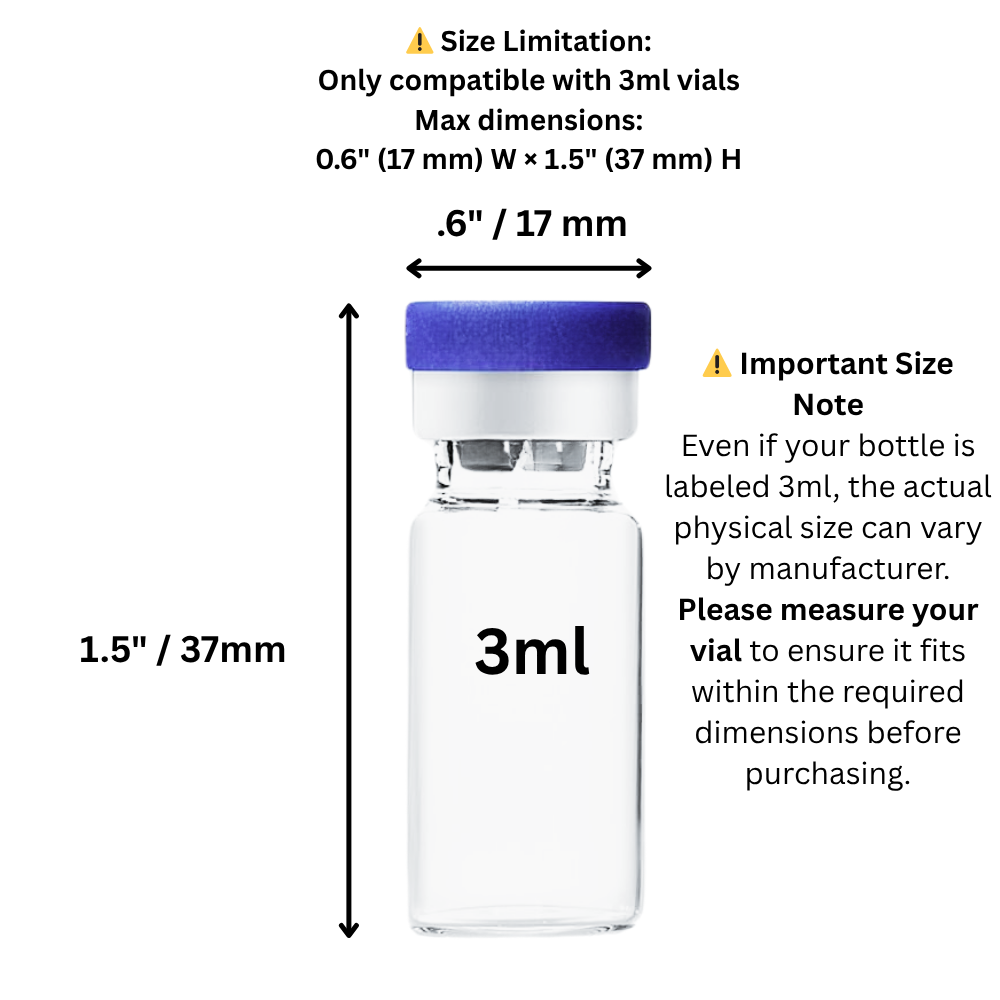
Custom snap-on caps for 3 mL or 10 mL vials, with a cap color plus an icon or letters. Sets from 25 caps.
#5 — Repurposed Small Toolbox or Craft Box
Latching plastic boxes — the kind sold for fishing tackle or craft supplies — can work surprisingly well if they're opaque. They latch shut, stack, and can fit multiple vials. The downside is that nothing holds the vials in place (they rattle), and the compartments are sized for fishing lures or beads, not 10 mL vials. Worth trying if you already own one; not worth buying specifically for GLP-1 storage.
#4 — Clear Hard-Shell Travel Container
Hard case with clear panels. Better than soft cases for impact, worse than opaque cases for light. If your GLP-1 vials are amber glass, a clear case is more forgivable; if they're clear glass, you're relying entirely on the fridge being dark when the door is closed. Fine for travel; not ideal as a permanent home for clear vials.
#3 — Opaque Hard-Shell Case (Generic)
Opaque, rigid, latched. This covers the core needs: the case keeps vials out of the light and stops them escaping, while temperature is whatever your shelf or fridge provides (no case changes that). Still missing: separate slots to stop vial-on-vial contact, and organized compartments for pads and other supplies. A legitimate solution for someone keeping a single GLP-1 vial type with few accessories.
#2 — Foam-Cut Pelican-Style Case
A properly foam-fitted hard case with individual slots for each vial is excellent. No movement, no contact between vials, and the hard shell handles drops. The gap between this and #1 is integration and effort: cutting foam neatly is tedious, and a DIY foam case usually has no designated space for syringes or alcohol pads, so those end up loose in the fridge or in a separate container.
#1 — Best: A Custom Case You Design Yourself (PeptideCase™ Builder)
Most GLP-1 vials come in 3 mL or 10 mL sizes, and many people also keep a pen or pen cartridges. In the PeptideCase™ builder you add exactly those items (3 mL vials, 10 mL vials, a peptide pen or injector pen, pen cartridges, syringes, alcohol pads or a BAC water bottle) and each one becomes fitted pockets or an open bay sized for that many. The tallest item sets the case height, and shorter vials stand on a raised floor so every vial top lines up at the rim. Every storage space has a finger scoop.
Auto-arrange packs it all into the most compact layout, so the case takes as little fridge shelf as possible, and the builder shows the exact length, width and height before you order. Design your GLP-1 case.
Pro Tip: Keep your GLP-1 case on a middle shelf toward the back, never on the door. The door shelf swings, bangs and warms up every time the fridge opens; a closed case on a stable shelf stays put and stays out of the way of food.
GLP-1 Storage Requirements: Follow Your Label
Storage temperatures and in-use periods differ from product to product, so follow the storage instructions on your product label or from your pharmacist or provider. That is the only reliable source for your specific vial or pen.
What a case adds is everything around that: vials that can't tip or roll, labels that stay dry and readable, nothing in the light, and one kit you can lift out of the fridge in one move. Remember the case is a protective organizer, not a cooler. It doesn't keep anything cold on its own, but it can sit in your fridge at home or inside a cooler when you travel.
Make your own custom GLP-1 storage case
A ready-made case makes you fit your kit to it. The builder does the opposite. Start with an empty case, tap "Add item", and pick what you actually keep: 3 mL vials, 10 mL vials, a peptide or injector pen, pen cartridges, syringes, alcohol pads (flat or standing), or a BAC water bottle. Choose how many of each and the planner lays them out in the most compact arrangement automatically.
You see the case size, height and contents with a top view, a lid view and a 3D view you can open, unlatch and drag to turn. Pick Black or RGB Metallic, a Wide shape (hinge on the long side) or Deep shape (hinge on the short side), and one or two latches. Want room for a small digital thermometer? Add the temperature sensor item, as a clip-in window in the lid or a socket inside the case. Your case is printed to order on our own print farm in the US.