
Small 3 mL glass vials need two things from a storage case: to be kept out of light, which many vial labels ask for, and to be kept from breaking. Most containers people reach for do one of those jobs, or neither. A good case does both, and keeps your vials organized in the fridge or a bag at the same time.
Here are the 10 storage cases and containers most commonly used for BPC-157 vials, ranked worst to best on light blocking, vial security and fridge fit.
Design a case around your vials
Add your 3 mL vials and supplies, and the builder lays out a closed hard case with a fitted pocket for every vial.
#10: Worst: Clear Glass or Plastic Container (No Light Blocking)
Any transparent container, whether clear food storage, a glass jar or a see-through pill organizer, provides zero light protection. Every time the fridge door opens, the light shines straight onto your vials. If your label says to protect the contents from light, a transparent container is functionally the same as no container at all.
#9: Ziploc Bag (Even Opaque)
An opaque (dark-colored) zip bag does block some light, which is why it ranks above a clear container. But a bag offers zero structural protection for glass. These vials are usually small 3 mL vials, which are more fragile than 10 mL vials. Inside a bag, they shift, roll and knock into each other every time something in the fridge moves. Glass-on-glass contact is how chips and cracks happen.
#8: Aluminum Foil Wrapping
Foil blocks light completely, which is its one real advantage. The practical problems: foil tears with repeated handling, every vial has to be unwrapped and rewrapped each time you use it, there's no organization (which of these foil lumps is which?), and it looks like a fridge experiment. Effective for light; impractical for everyday use.
#7: Dark Amber Glass Jar
A sealed amber glass jar filters UV and part of the visible spectrum, which is why pharmaceutical makers use amber glass for light-sensitive products. The catch is partial protection: amber glass cuts UV well, but a lot of visible light still gets through. It's a good extra layer inside an opaque case, not a standalone solution, and it does nothing to stop vials knocking together.
#6: The Shipping Box Your Vials Came In (Foam Insert)
Your vials arrived in it, they fit perfectly, and the cardboard blocks light. For a short stretch, this is a legitimate solution. The problem is moisture: cardboard in a refrigerator absorbs humidity, softens and loses its shape, and the foam insert slides around once the box weakens. If your vials will be in the fridge for more than a short while, you need something more durable before the cardboard gives out.
Pro Tip: Keep only the vial you're using in your everyday case and store the spares together in a second closed case. Fewer vials coming in and out of the fridge means fewer chances to drop one, and the spares stay organized and out of the light.
#5: Opaque Pill/Medication Organizer
Opaque pill organizers with several compartments are a workable short-term option for 3 mL vials. They block light, add some organization and are compact. The limitations: pill compartments are rarely sized for 3 mL vials, so vials sit loose in oversized cells, and with no padding they can tip and rattle. Adequate for a short time; not ideal for a kit you'll keep for months.
#4: Opaque Hard-Shell Box (Generic)
A solid improvement: a latching hard shell, full light blocking and a rigid structure that won't compress. Vials can't escape, and the box doesn't care about fridge humidity. What's missing is fitted pockets (vials still slide around inside) and organized space for the rest of the kit, such as a BAC water bottle, syringes or alcohol pads. A good general-purpose option for someone not ready for a purpose-built case.
#3: Small Pelican-Style Case (No Foam)
Hard-shell, waterproof, fully opaque and tough enough to travel. A standard Pelican-style case without foam is a big step up from a generic box: the build quality is higher, the seal is tighter and it handles drops better. Without foam inserts, though, your vials still slide around in transport and every time the case moves. Good enough for most home storage; needs inserts for serious travel.
#2: Pelican-Style Case with Custom Foam
Add properly cut foam to a Pelican-style case and you have outstanding vial storage: vials held still in individual slots, total light blocking, impact resistance and a tight seal. The only things separating this from #1 are the effort of getting the foam right and the lack of organized space for everything else you carry. Pick-and-pluck foam also tends to leave ragged pockets that don't hold small vials perfectly upright.
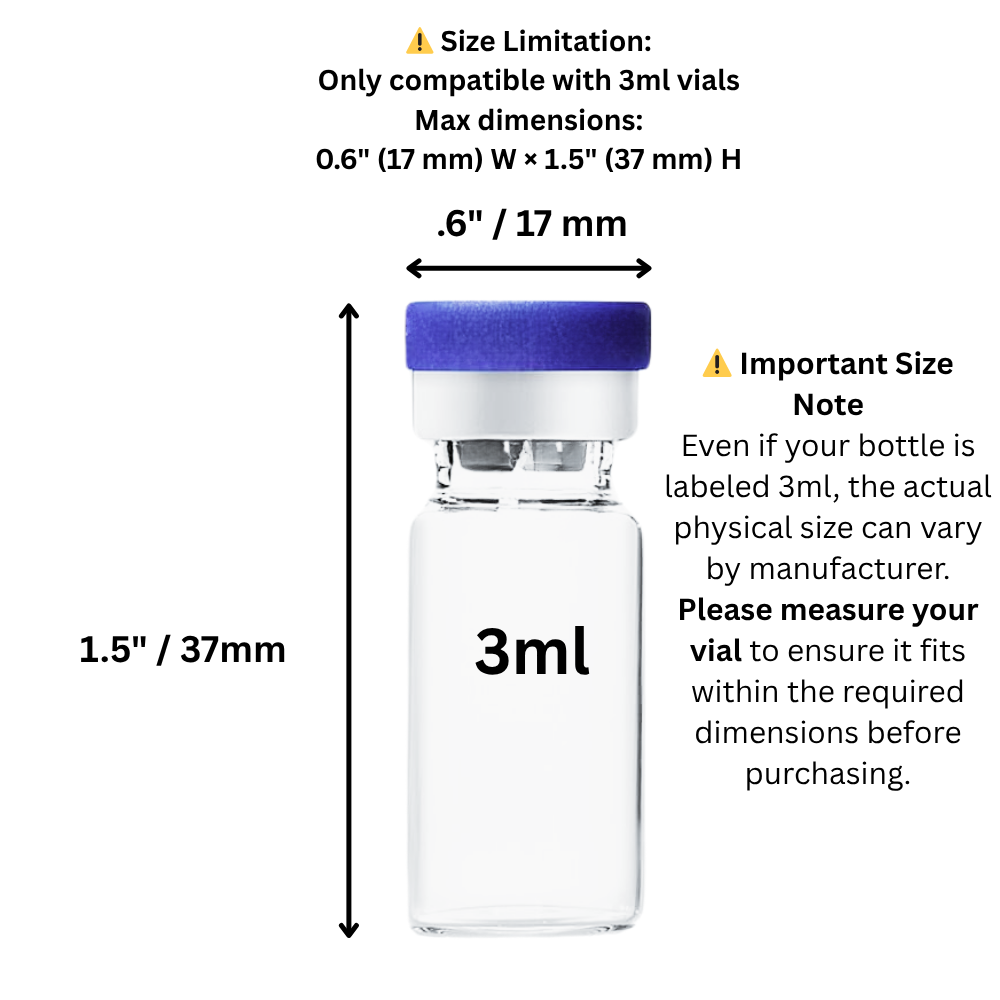
#1: Best: A Custom Case You Design Yourself (PeptideCase™ Builder)
The best case for your vials is one built around them. In the PeptideCase™ builder you start with an empty case, tap "Add item" and pick what you carry: 3 mL vials, 10 mL vials, peptide vials, plus a BAC water bottle, syringes and alcohol pads if you keep them together. Every item becomes fitted pockets or an open bay sized for that many, so nothing rattles, and the closed hard shell keeps everything out of sight and out of the light.
The tallest item sets the case height, and shorter vials stand on a raised floor so every vial top lines up at the rim. Every storage space has a finger scoop, so pulling one vial out of the fridge doesn't mean tipping the whole case. Auto-arrange finds the most compact layout, which matters when fridge shelf space is tight. Take the case out, use what you need, put it back. Every time.
Pro Tip: If you keep BPC-157 vials alongside a second kind of vial, give each kind its own pockets: one in-use vial of each, plus a spare of each. Label every vial, or color-code them with custom caps, so you never grab the wrong one. Running out because you forgot to reorder is more disruptive than most storage mistakes.
Color-code your vials
Custom snap-on caps for 3 mL or 10 mL vials, with a cap color plus an icon or letters. Sets from 25 caps.
Light and Your Vials: What a Case Can and Can't Do
What a case can do is simple: when it's closed and its walls are solid, light can't reach the vials, and fitted pockets stop them from breaking. What a case can't do is change the storage instructions for what's inside. Follow the storage instructions on your product label or from your pharmacist or provider for temperature and light. A hard case is a protective organizer, not a cooler: it can sit on a fridge shelf or go inside a travel cooler, but it doesn't keep anything cold by itself.
Make your own custom case for your vials
A ten-slot ready-made case is either too big or too small for most people, because nobody's kit is exactly ten identical vials. A custom case fixes that. Add the number of 3 mL vials you actually keep, a couple of 10 mL vials if you have them, and the supplies that go with them, such as a BAC water bottle, syringes and flat or standing alcohol pads. Need room for something else? Add a custom space and type in its width, depth and height.
The builder shows the case length, width and height, what it holds, and a top view, a lid view and a 3D view you can open, unlatch and drag to turn. Choose Black or RGB Metallic, a Wide or Deep shape, and one latch or two. Add one or two lines of text, an icon or your own SVG logo to the lid so the case is easy to spot in a shared fridge. It's printed to order in the US, at exactly the size shown.