
Search for a peptide storage temperature chart and you'll find dozens of them, mostly copied from each other, often contradicting each other, and none of them written for the exact product in your fridge. Formulations differ, makers differ and pharmacies differ. A generic chart can't know what yours needs.
So this page does something more useful. It gives you a storage chart you fill in from your own labels, shows where the right numbers actually come from, and lays out the fridge and travel setup that keeps every vial protected, organized and easy to find. The temperature itself always comes from one place: the storage instructions on your product label or from your pharmacist or provider.
Turn your vial chart into a case
Add each vial size and supply you keep. The builder gives every one a fitted pocket and plans the most compact case for your fridge.
How to Use This Chart
Print the chart below or copy it into a note on your phone. Fill in one row per vial the day it arrives:
- What the vial holds: the name exactly as it appears on the label.
- Storage instructions: copied word for word from the label or pharmacy sheet, not from memory and not from a website.
- Light and freezing notes: anything the label says about protecting from light or not freezing.
- Dates: the date it arrived, the date you opened it, and the date printed on the label.
- Where it lives: its spot in your case, and its cap color if you color-code.
Keep the chart on the fridge door or in your phone notes, and update it every time a vial comes or goes.
Your Vial Storage Chart
| Vial | Storage instructions (from label) | Light / freezing notes | Opened | Date on label | Spot in case / cap color |
|---|---|---|---|---|---|
| Vial A | Copy from label | Copy from label | Write the date | Copy from label | Pocket 1 / blue |
| Vial B | Copy from label | Copy from label | Write the date | Copy from label | Pocket 2 / green |
| Vial C | Copy from label | Copy from label | Write the date | Copy from label | Pocket 3 / black |
| Backup vial | Copy from label | Copy from label | Unopened | Copy from label | Back row / same color as its match |
The point of the last column is simple: when every vial has a fixed spot and a color, you never have to read tiny print in a cold fridge to find the right one.
Where the Right Storage Temperature Comes From
| Source | What it tells you |
|---|---|
| Product label | The storage instructions for that exact product, plus the date it should be used by. |
| Package insert or info sheet | More detail: light, freezing, what to do after opening. |
| Pharmacy label | For compounded or dispensed products, the pharmacy's own instructions and date. |
| Your pharmacist | Answers to "what if" questions: left out, frozen, power cut, travel. |
| Your provider | Anything specific to your prescription. |
If two sources disagree, ask your pharmacist. If you can't find any instructions at all, ask before you store it, not after.
Storage Conditions at a Glance
| Condition | What to do | What a hard case adds |
|---|---|---|
| Temperature | Follow your label. Check the fridge with a thermometer, not the dial. | Nothing by itself: a case is an organizer, not a cooler. It sits in the fridge. |
| Light | Follow any light note on the label. Keep vials off the door and out of clear bags. | A closed case keeps vials out of direct light when the fridge opens. |
| Freezing | Keep vials off the back wall and away from the cooling plate. | Keeps vials grouped in one spot you chose, not drifting to the back. |
| Knocks and drops | Don't store vials loose on a shelf or in a drawer. | A fitted pocket for every vial: no rolling, no glass touching glass. |
| Grabbing the wrong vial | Label every vial; consider colored caps. | Fixed positions, so each vial is always in the same pocket. |
| Travel | Carry on, never check. Cooler bag and ice packs if your label calls for cold. | Protects the glass inside the cooler bag and keeps the kit together. |
| Power outage | Keep the fridge closed; check our power outage guide and ask your pharmacist. | Everything is in one case, ready to move to a cooler fast. |
Quick Reference Rules
If you remember nothing else, remember these:
- Your label wins. Not a chart, not a forum, not a friend's product.
- Measure the fridge. A cheap fridge thermometer tells you what the dial can't.
- Main shelf, not the door, not the back wall. The door swings and warms; the back can freeze.
- Keep vials in a closed case, not a clear bag or loose on the shelf.
- One home per vial. Same pocket, every time.
- Write the date you open each vial on its label the same day.
- For trips, carry on and pack the closed case in a cooler bag with ice packs if your label calls for cold.
Color-code your vials
Custom snap-on caps for 3 mL or 10 mL vials, with a cap color plus an icon or letters. Sets from 25 caps.
Why Storage Matters More Than You Think
Most storage problems aren't dramatic. A vial rolls off a shelf and chips. A vial ends up behind the leftovers and sits in the door for a week. Two similar vials get swapped because the labels rubbed off. A trip goes fine until the bag gets checked at the gate.
Every one of those means a replacement, a call to the pharmacy and a gap you didn't plan for. None of them has anything to do with a chart. They come down to whether each vial has a protected, labeled, fixed place to live, at home and on the road.
That's why the best storage upgrade most people can make isn't a new fridge; it's a case built around the vials they actually keep. For more fridge ideas, see our fridge organization guide.
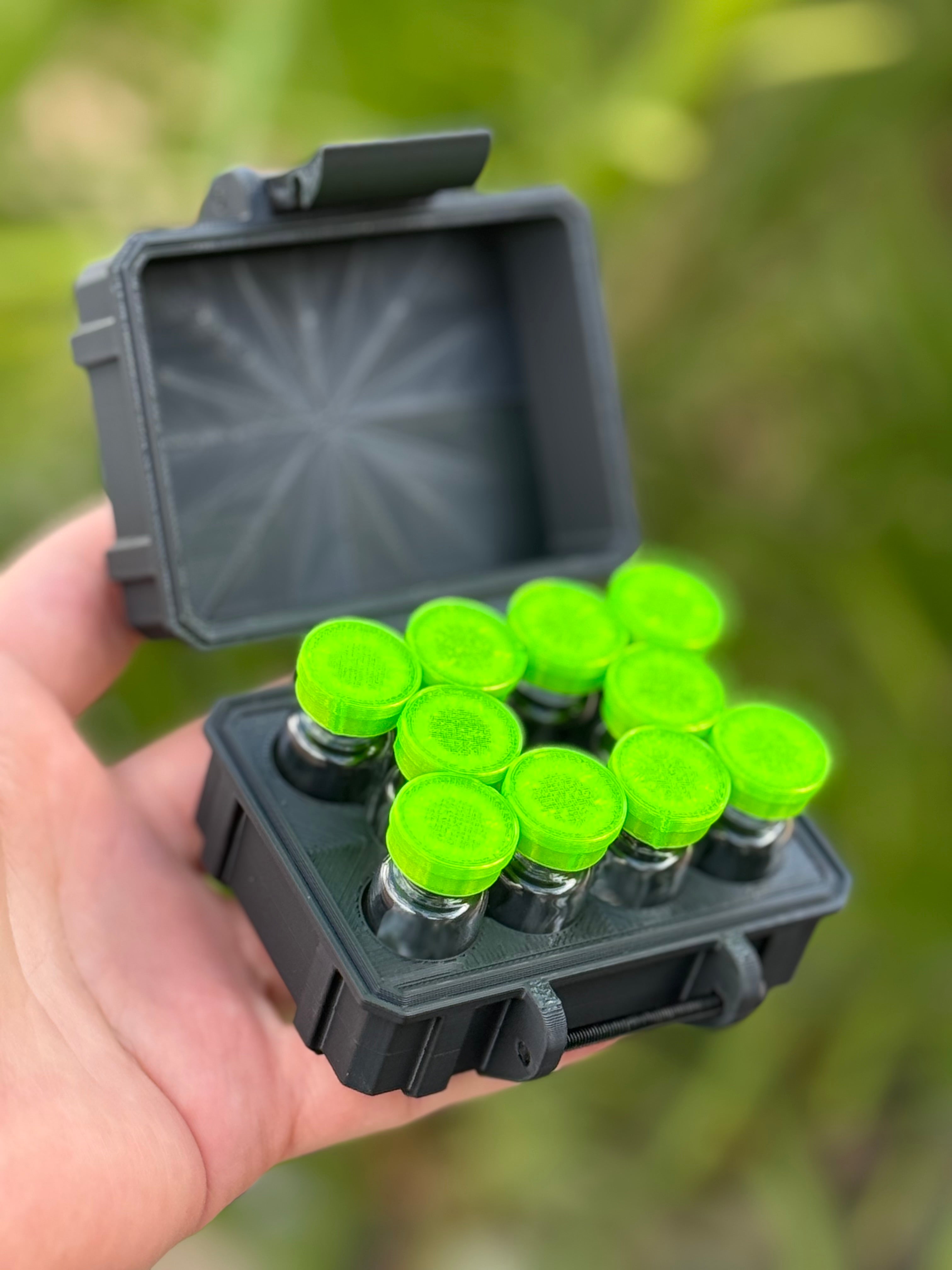
Make your own custom vial storage case
Your chart lists exactly what you keep, so design the case from the same list. In the PeptideCase™ builder you start with an empty case, tap "Add item," and pick each thing and how many: 3 mL or 10 mL vials, peptide vials, TRT vials, glutathione vials, other size vials, syringes, alcohol pads, a BAC water bottle, pens or pen cartridges. Every item becomes fitted pockets or an open bay sized for that many.
The tallest item sets the case height, and shorter vials stand on a raised floor so every top lines up at the rim, which makes the "spot in case" column easy to keep. Each space has a finger scoop. Auto-arrange finds the most compact layout and shows the exact size, so you know it fits your fridge shelf. Pick Black or RGB Metallic, then add text or an icon to the lid if you like. Want to watch the fridge? Add a socket inside the case or a clip-in lid window for a small digital thermometer.