
Why Organization Actually Matters
It's tempting to think of vial organization as housekeeping: nice to have, but not important. That's wrong. A disorganized kit creates specific, real problems: vials you can't identify, dates you can't confirm, supplies you can't find and glass that gets broken.
Take the most common failure: the mystery vial. You open the fridge and find a vial with no label, or a label you can barely read, opened on some date you can't remember. You can't safely use a vial you can't identify, so the honest options are to ask your pharmacist or provider or to replace it. Either way, it cost you.
Now scale that up. Someone keeping three or four different vials has several opened dates, several label instructions and several refill schedules to track. Without a clear system, the mental load becomes unsustainable, and mistakes are a question of when, not if. Clean organization removes that risk. Every vial in its own spot. Every date visible at a glance. Every vial clearly identified. You go from "I think this is the right one" to "I know it is."
Design a case that organizes your whole kit
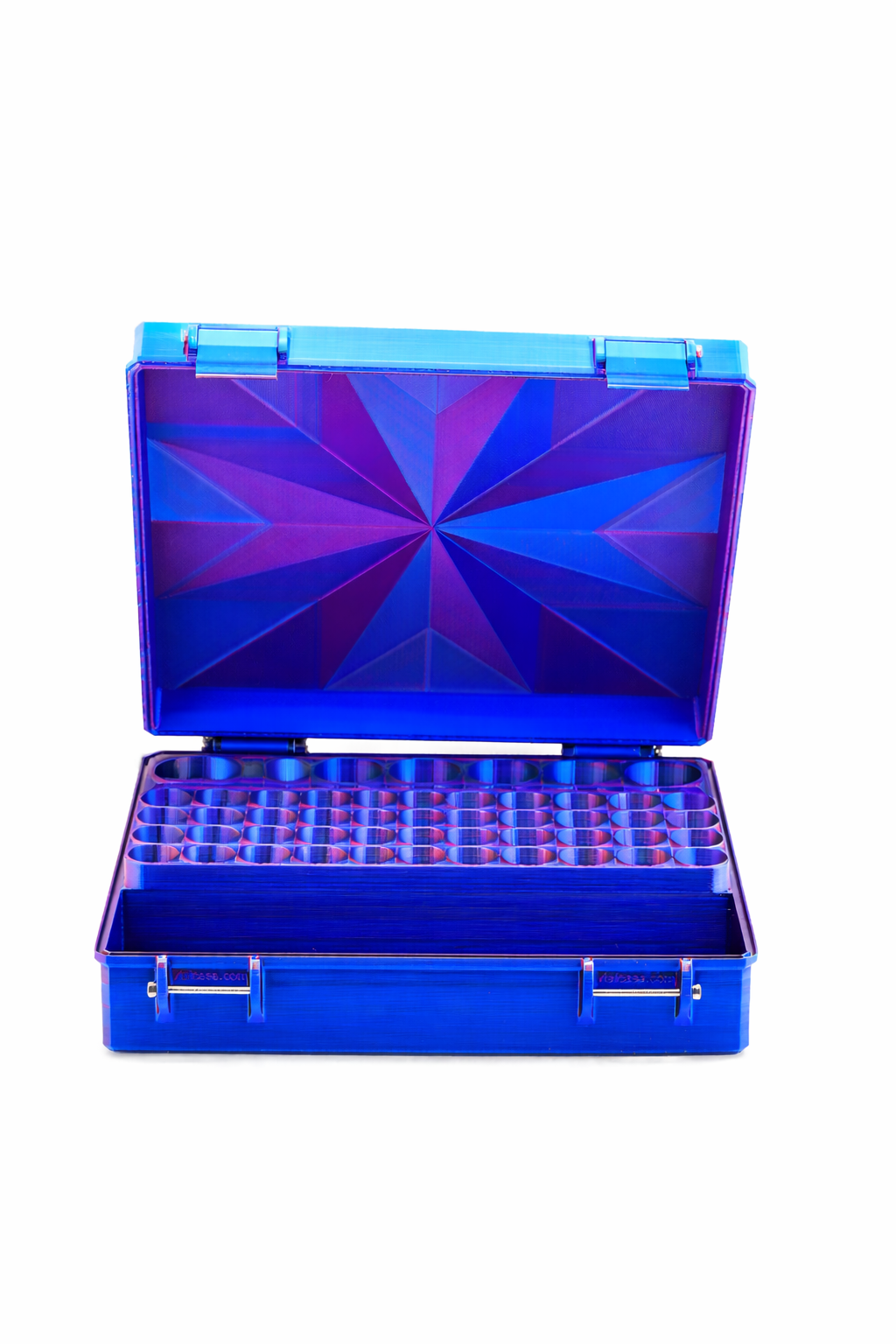
Add every vial and supply you keep. The builder gives each its own pocket or bay and plans the most compact case for your fridge shelf.
The real cost of disorganization: A vial you can't identify or date is a vial you have to replace. A vial that rolls off a shelf is a vial you have to replace. Organization is a money and safety issue, not just an aesthetic one.
The 5 Most Common Vial Organization Problems
Before building a system, it helps to diagnose what's broken. Most people run into some combination of these five:
- Unlabeled or poorly labeled vials. You can't remember which vial is which, or the marker has faded, or you labeled the vial but not the date. The fix is the same label, applied every time, not just when you remember.
- No clear opened-date tracking. You know you opened a vial sometime last month, but not when. If your label's instructions depend on that date, you're guessing.
- Vials sitting among food. Vials next to condiments, a vial rolling to the back of a shelf, a sterile water bottle wedged between containers. You hunt for them every time, and they get knocked around and lit up with every door opening.
- Supplies scattered. Syringes in one drawer, alcohol pads in another, vials in the fridge. Every use starts with a scavenger hunt, and that friction makes it easy to skip steps.
- No system for unopened backups. Your spare vials are somewhere, maybe a drawer, maybe jumbled in with the ones in use. Without a clear split between "in use" and "in reserve," it's easy to open a new vial before finishing the old one.
The Clean System: Everything Has a Home
The organizing principle is simple: every item in your kit has one designated location, and it always goes back there. No temporary spots, no "I'll put it away properly later." Here's how to set it up:
Zone 1: Vials in use, in the fridge. This is your case, on a main shelf (not the door). It holds the vials you're currently using. Nothing else goes in it: not unopened backups, not empty vials, unless you've given them their own pocket.
Zone 2: Unopened backups. Spare vials live in a separate container, a second case or a marked spot, stored the way their label says. They're clearly separated from Zone 1 so you never open one by accident. Mark the container with what's inside and the dates on the labels.
Zone 3: Supplies. Syringes, alcohol pads and a sharps container live in one consistent place: a drawer, a small organizer box or, best of all, their own trough in the same case as the vials. You never hunt for them.
Zone 4: Labels and paperwork. Label tape, a fine-point marker, a printed copy of each label's storage instructions and any prescription paperwork live together. When a new vial arrives, everything you need to label and log it is in one place.
The one-touch rule: When you finish with any item (a vial, a syringe, a wrapper), put it where it belongs immediately. Don't set it down "for now." The one-touch rule is what makes the system maintain itself instead of needing a weekly cleanup.
The Labeling Method That Prevents Wrong-Vial Moments
Labeling is the highest-impact habit in any vial system. A good label tells you everything in three seconds. An unlabeled vial tells you nothing.
A complete label for any vial in use should include:
- What it is: the name exactly as on the product label, or a clear short version
- Date opened: the day you first used it
- Date on the label: the use-by date printed by the maker or pharmacy
- Whose it is: initials, if more than one person shares the fridge
Write it on white label tape with a fine-point permanent marker and wrap it around the vial. The white tape gives the ink a clean background. Circle the most time-sensitive date or write it in a different color so it stands out.
Colored caps make the system even faster: give each vial type its own cap color and you can pick the right one from above without reading anything. For tape types, label makers and multi-user setups, the complete vial labeling guide covers every scenario.
Color-code your vials
Custom snap-on caps for 3 mL or 10 mL vials, with a cap color plus an icon or letters. Sets from 25 caps.
Fridge Organization: Zones and Rotation
Your fridge is the most important storage space in your whole setup. How you use it matters.
- Main shelf, interior. This is where your case lives. Away from the door, which swings and warms with every opening, and away from the back wall and cooling vents, which can run very cold.
- Consistent positioning. The case always goes in the same spot. You never search for it, and everyone else in the house knows not to move it.
- Nothing stacked on top. Stacking puts pressure on the case and makes it harder to lift out cleanly. Keep the space above it clear.
- Backups nearby, but separate. Unopened vials go in their own labeled container on the same shelf or a designated nearby spot, stored as their label says.
Rotation principle: when you open a new vial of the same thing, the older opened vial stays at the front and gets finished first. It's the same first-in, first-out rule pharmacies use.
For more on fridge setup, see the fridge organization guide.
The Weekly 2-Minute Kit Check
Once it's set up, the system mostly runs itself. The only upkeep is a quick weekly check:
- Open the case and scan every vial. Look for any vial getting close to the date on its label, and plan to finish or replace it.
- Check the vials themselves. Cracks, chips, loose or damaged caps, faded labels. If a vial doesn't look the way its label describes, set it aside and ask your pharmacist or provider.
- Check your backups. Note which vials are running low and whether you need to request a refill now rather than the day you run out.
- Check your supplies. Enough syringes and alcohol pads for the week? Restock before you run out.
That's the whole check. Two minutes, once a week, prevents almost every surprise.
When to do it: Pair it with an existing weekly habit, such as Sunday evening when you plan the week, or the day you take out the trash. Attaching a new habit to an old one makes it stick.
Organizing for Multiple Users (Partners, Clinics)
When two or more people use the same storage space (partners, household members, a small clinic), a system that relies on one person's memory stops working. Add these to the base system:
- Color-coding by person. Different colored label tape or cap colors for each person's vials removes any doubt about whose is whose, especially when two people keep the same product.
- Separate slots or separate cases. Each person gets dedicated pockets, or their own case if one isn't big enough. Shared slots without clear separation are a reliable source of confusion.
- A card inside the case. A small index card listing each person's vials, opened dates and label dates. Handy in clinics where staff rotate, or households where one person tracks everything.
- Never share or swap vials. Even when two people keep the same product, each person's vials stay separate and labeled.
For clinics with high vial turnover, a formal log is worth the time: a notebook or shared spreadsheet with vial name, patient or user ID, date opened and label date gives you the record an informal system can't.
Your Case as the Foundation of the System
Every part of this system is easier, and some parts only work, with a case built for vials. Here's why the case is foundational rather than optional:
- It makes Zone 1 physical. Without a case, "vials in use" is an idea. With a case, it's a place vials go into and come out of, and putting them back becomes automatic.
- It handles light by default. A closed hard case keeps vials out of direct light every time the fridge opens, which matters when labels say to protect from light.
- It stops glass touching glass. Fitted pockets keep vials apart so they can't knock together when the fridge is rearranged, the most common cause of breakage.
- Slots prompt organization. When every pocket has a purpose, you decide deliberately what goes where, which is the first step in labeling and tracking.
- It travels without changes. The same case that organizes your fridge carries your kit on a trip, already organized and protected. For temperature on the road, it goes inside a cooler bag with ice packs; the case itself is not a cooler.
Build your own custom organizer case
The clean system works best when the case matches your kit exactly, and that's what the PeptideCase™ builder is for. Start with an empty case, tap "Add item," and pick every item and how many: 3 mL or 10 mL vials, peptide vials, TRT vials, glutathione vials, other size vials, syringes, alcohol pads (flat or standing), a BAC water bottle, pens or pen cartridges, or a custom space you size for a label roll or a log card. Each item becomes fitted pockets or an open bay sized for that many, so Zones 1 and 3 share one case.
The tallest item sets the height, and shorter vials stand on a raised floor so every top, and every cap color, lines up at the rim where you can see it. Every space has a finger scoop. Auto-arrange finds the most compact layout and shows the exact size for your fridge shelf. Add your name or an icon to the lid so each person's case is easy to spot.