
Two Vials, One Routine: Why Storage Gets Harder
A single vial is easy to keep track of. Two vials that look almost identical, handled on the same days and stored in the same spot, are where most storage problems start. The usual trouble isn't exotic: a vial knocked over in the fridge door, a vial left out on the counter, or the wrong one picked up because both are small, clear and unlabeled.
Add backup vials, a BAC water bottle and a box of syringes, and a two-vial kit quickly becomes six or seven items that all need a fixed home. The fix is the same every time: a hard case with a fitted pocket for each item, clear labels, and a spot in the fridge or drawer that never changes.
Design a case for your two-vial kit
Add both vials, your backups and supplies. The builder fits each one into its own pocket and shows the exact case size before you order.
Temperature: Follow Your Label, Not a Blog Post
Follow the storage instructions on your product label or from your pharmacist or provider, not numbers from a forum or a blog. If your two vials came with different instructions, follow each one separately rather than assuming they match.
It also helps to be clear about what a case does and doesn't do. A storage case is a protective organizer, not a cooler. It keeps vials upright, separated and easy to find, and it can sit inside your fridge or inside a cooler bag, but it doesn't keep anything cold on its own. If you want to see what's happening on the shelf, a small digital fridge thermometer next to the case tells you more than guessing.
Protecting Both Vials From Breakage and Light
Glass vials break in boring ways. They roll off a shelf, tip over in the door when someone grabs the milk, or knock into each other in a bag. A case with a fitted pocket for each vial stops all three: each vial stands on its own, can't roll, and doesn't touch its neighbor.
Keep the case off the fridge door. The door gets swung, bumped and slammed far more than any shelf, and anything standing loose there is the first thing to fall. A middle shelf, toward the back, is the calmest spot in most fridges.
If your product label says to protect the contents from light, keep the vials in their carton or in a closed container between uses rather than loose on an open shelf, where the fridge light hits them every time the door opens. Either way, the simplest habit is to put each vial straight back where it belongs as soon as you're done.
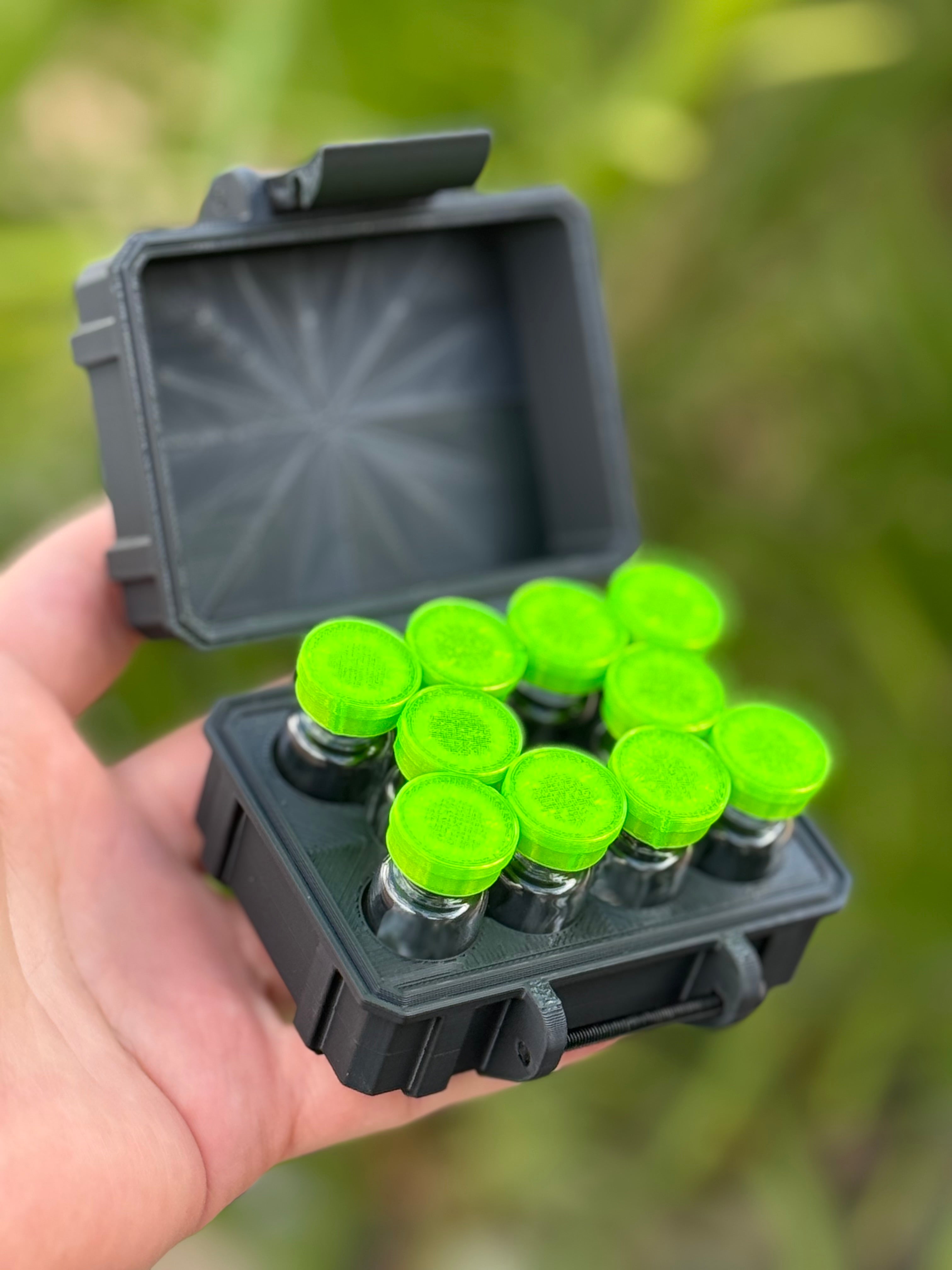
Organizing Your Two-Vial Kit
When two vials sit side by side and get used on the same mornings, organization is what stops you grabbing the wrong one. A practical system:
- Fixed pockets. Give each vial its own position in the case and always return it to the same one. Left pocket for one, right pocket for the other, every time. Never pile vials on top of each other or leave them loose in the fridge door.
- Label name and date opened. A short abbreviation and the date you first opened the vial, written on the label or a strip of tape, lets you grab the right one at 6 a.m. without thinking.
- Supplies in the same case. Keep syringes and alcohol pads in the case with the vials, so taking it out of the fridge gives you everything at once instead of a hunt through drawers.
- Backups apart. Keep unopened backup vials in a different part of the case, or in a second case, so you never open a new one by accident.
Color-Coding With Custom Caps
Labels work when you read them. Colors work even when you don't. If you keep two vials that look the same, giving each a different cap color makes the difference obvious at a glance, even half-asleep. Custom vial caps come in 3 mL or 10 mL sizes, with a cap color plus an icon or one or two letters in a mark color, in sets from 25 caps in steps of 5, and you can put several designs in one set.
Color-code your vials
Custom snap-on caps for 3 mL or 10 mL vials, with a cap color plus an icon or letters. Sets from 25 caps.
Fridge Organization for a Two-Vial Kit
A case turns a scatter of small items into one object that has a home. Pick a spot on a middle shelf, toward the back, and keep the case there every time. Everyone in the house learns that the case is not to be moved or stacked on, and you always know where your vials are.
Before you order any case, measure that spot. A case that's too tall for the shelf gap or too wide for the space beside the leftovers ends up in the door, which defeats the point. The builder shows the exact length, width and height of your design, so you can check it against the shelf before you buy.
Traveling With Two Vials
Two vials travel just as easily as one if they're packed as a kit rather than loose:
- Carry on, don't check. Checked bags get thrown around and sometimes lost, and you can't check on them during the trip. Keep the case in your carry-on or personal item.
- Hard case inside a cooler bag. If your label calls for refrigeration, pack the hard case inside an insulated cooler bag with gel ice packs. The case protects the glass; the cooler handles temperature.
- Keep the original labels. Travel with vials in their labeled packaging where you can, plus any prescription or documentation, and check your airline's and destination's current rules before you go.
- Check the hotel fridge. Some in-room fridges run warmer or colder than you expect. A small thermometer placed inside on arrival tells you whether to ask for a different fridge.
For more on screening, see our guide to traveling with peptides through TSA, and our peptide travel checklist for a full packing list.
What to Look For in a Case for Two Vials
- A fitted pocket for every vial, including backups, so nothing rattles or rolls.
- Room for the extras you actually keep together: a BAC water bottle, syringes, alcohol pads.
- A latch that stays shut when the case is carried at an angle or tipped in a bag.
- A size that suits where it lives: your fridge shelf at home and your carry-on when you travel.
- Vial tops you can reach. If the vials are deep in foam, you'll pull them out by the cap and fumble them.
Make your own custom case for a two-vial kit
Stock cases make you pick between too few slots and a lot of empty foam. In the PeptideCase™ builder you start with an empty case, tap "Add item" and choose exactly what this kit needs: two peptide vials or 3 mL vials (plus however many backups you keep), a BAC water bottle, syringes and alcohol pads. Each item becomes a fitted pocket or an open bay sized for that many, and every storage space has a finger scoop. The tallest item sets the case height, and shorter vials stand on a raised floor so every vial top lines up at the rim. Auto-arrange packs it all into the most compact layout and shows the case size, with a top view, a lid view and a 3D view. Pick Black or RGB Metallic, Wide or Deep, and add your initials or an icon to the lid in a second color if you like. It's printed to order in the US. Design your two-vial case