
GLP-1 has become one of the most common reasons people end up with vials and pens in the fridge, and with that comes a storage question: what should a case for GLP-1 vials actually do? This list ranks the ten features that matter most, from the basics to the details that make a case pleasant to use every day. It's about the case, not the medication; for anything about the contents, follow your product label and your pharmacist or provider.
One thing to know up front: a vial case is a protective organizer, not a cooler. It doesn't keep anything cold. It keeps vials and pens from breaking, rolling and getting lost, inside the fridge or inside a travel cooler.
Design a case that fits your GLP-1 vials
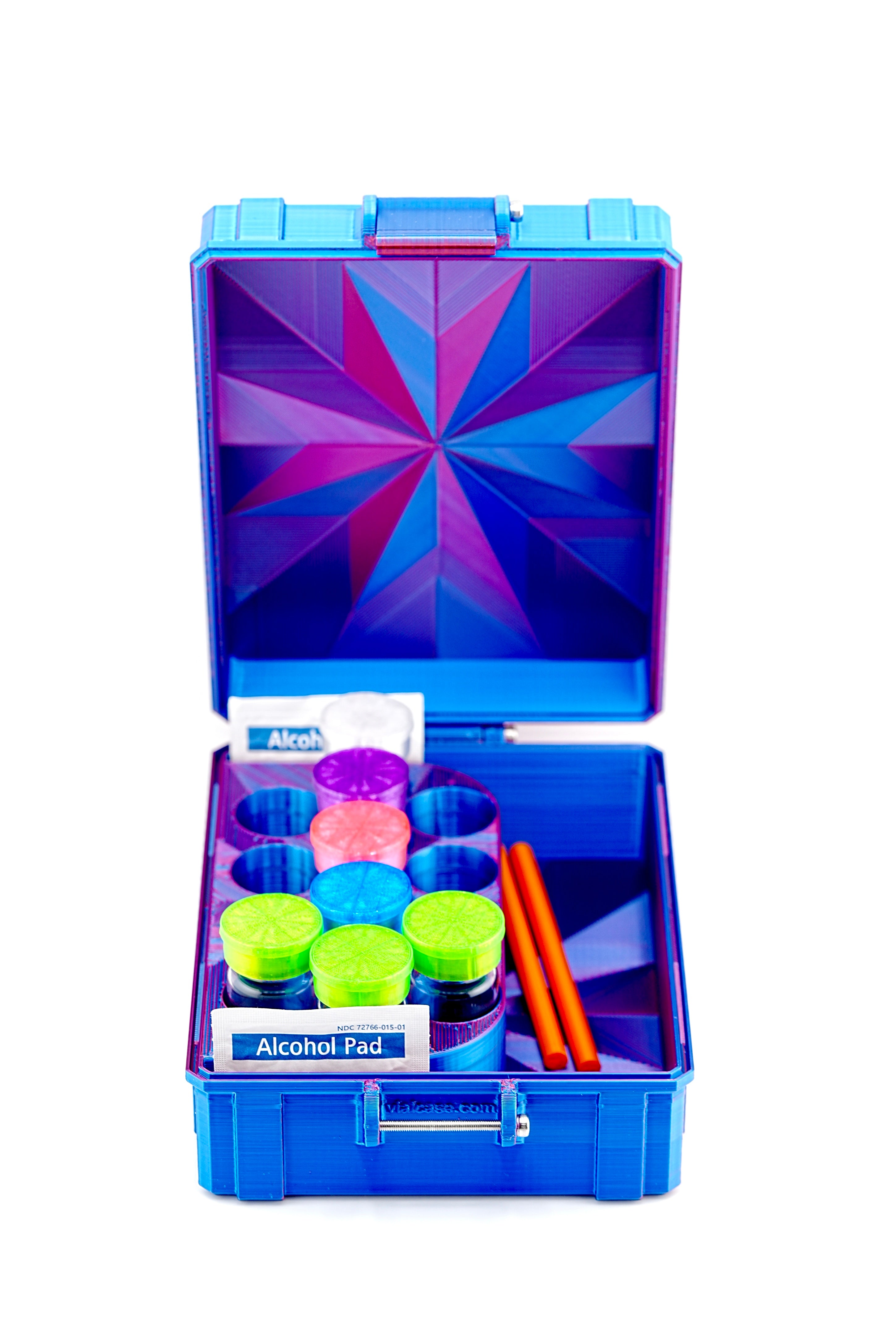
Add your 10 mL vials, pens and supplies, and the builder lays out a hard case with a fitted space for each.
The Top 10 Features, Ranked
#1: Pockets That Fit 10 mL Vials
Compounded GLP-1 often comes in 10 mL vials, roughly 23 mm across, and most ready-made peptide cases only have 3 mL slots. A 10 mL vial won't go in a 3 mL slot, and a 3 mL vial rattles in a 10 mL one. The first feature to check is pockets sized for the vials you actually have. See 3 mL vs 10 mL vials.
#2: Room for Pens and Cartridges
If you use pens, they need their own long, fitted spaces. A pen laid across vial slots rolls around and can knock the vials.
#3: Spaces for Your Supplies
Syringes, alcohol pads and a BAC water bottle often live with GLP-1 vials. A good case has a space for each, so you're not digging through drawers.
#4: A Closed, Solid Shell
Many labels say to keep the contents in their carton or protect them from light, and the fridge light comes on every time the door opens. A case with solid walls and a lid that closes fully makes that automatic. Clear lids and mesh panels don't.
#5: A Latch That Stays Shut
The case should click closed and stay that way when it's squeezed in a bag or knocked on a shelf. A case that pops open in transit is worse than no case.
#6: A Hinge Built for Daily Use
You'll open the case often. Thin pins and glued hinges are where cheap cases fail first.
#7: Compact Enough for a Fridge Shelf
Household fridges are crowded. The case should be no bigger than your kit needs, so it fits an interior shelf, away from the door, without evicting the groceries.
#8: Sized to Fit Your Travel Cooler
If your label calls for cold when you travel, the case goes inside a cooler. Measure the cooler's interior and make sure the case, and a gel pack, fit inside it. Keep everything in your carry-on, with original labeled packaging and your paperwork, and check current TSA rules. For cooler picks, see our travel cooler guide.
#9: Easy to Grab One Vial
When a short vial sits deep next to a tall bottle, you end up tipping the case to reach it. The best cases line every top up at the same height and leave room for your fingertips.
#10: Easy to Identify
In a shared fridge, a case with a name or an icon on the lid is easy to spot and easy for everyone else to leave alone. Inside, labeled vials and color-coded caps let you find the right one instantly.
Color-code your vials
Custom snap-on caps for 3 mL or 10 mL vials, with a cap color plus an icon or letters. Sets from 25 caps.
Make your own custom GLP-1 vial case
A case you design yourself ticks every box on this list, because it starts from your kit. In the PeptideCase™ builder you start with an empty case, tap "Add item" and choose 10 mL vials, 3 mL vials, a peptide pen, an injector pen or pen cartridges, plus syringes, alcohol pads or a BAC water bottle, and how many of each. Every item becomes fitted pockets or an open bay sized for that many, and every storage space has a finger scoop (features 1 to 3 and 9).
The tallest item sets the height and shorter vials stand on a raised floor so every top lines up at the rim. Auto-arrange finds the most compact layout, and the builder shows the exact length, width and height for your shelf and cooler (7 and 8). The print-in-place snap hinge and locking latch cover 5 and 6, with a 5-knuckle hinge and two latches on big cases, and an optional lid design with text, an icon or your own SVG logo covers 10.