
Start With the Label
Every question about temperature, how long an opened vial can be used, or how the contents are prepared has one right answer: the storage instructions on your product label, or what your pharmacist or provider tells you. This guide doesn't replace that. It covers everything around it: keeping glass vials from breaking, keeping them out of light, organizing a supply of spares, and packing them for trips.
One thing to keep straight from the start: a vial case is a protective organizer, not a cooler. It doesn't keep anything cold. If your label calls for the fridge, the closed case lives on a fridge shelf. If you're heading out for the day, the case goes inside a cooler.
Design a travel-ready vial case
Add your vials and supplies, and the builder lays out a hard case with a fitted pocket for each, sized to fit your cooler.
Light: Why a Closed Case Matters
Many vial labels say to protect the contents from light, and the places vials tend to end up, like bathroom counters, windowsills and open fridge shelves, are some of the brightest spots in a home. Amber glass filters part of the light but lets plenty through.
The simple fix is a case with solid walls and a lid that closes fully. Keep the vials inside it whenever you're not using them, and keep the case away from windows. Clear organizers and mesh pouches look tidy but don't do this job.
Planning Space for Spares
Many people buy several vials at once and keep the spares on hand for a while. That's where storage gets messy: an in-use vial, a handful of unopened spares, a BAC water bottle and some supplies, all rolling around a fridge shelf or a drawer.
Plan the space before it becomes a problem:
- Count everything. In-use vials, spares, bottles and supplies, so the case has a pocket for each.
- Separate in-use from spares. Either give spares their own row of pockets or keep them in a second closed case, so you aren't handling every vial each time you open the case.
- Follow your label for spares too. Unopened vials may have different storage instructions from opened ones; check both.
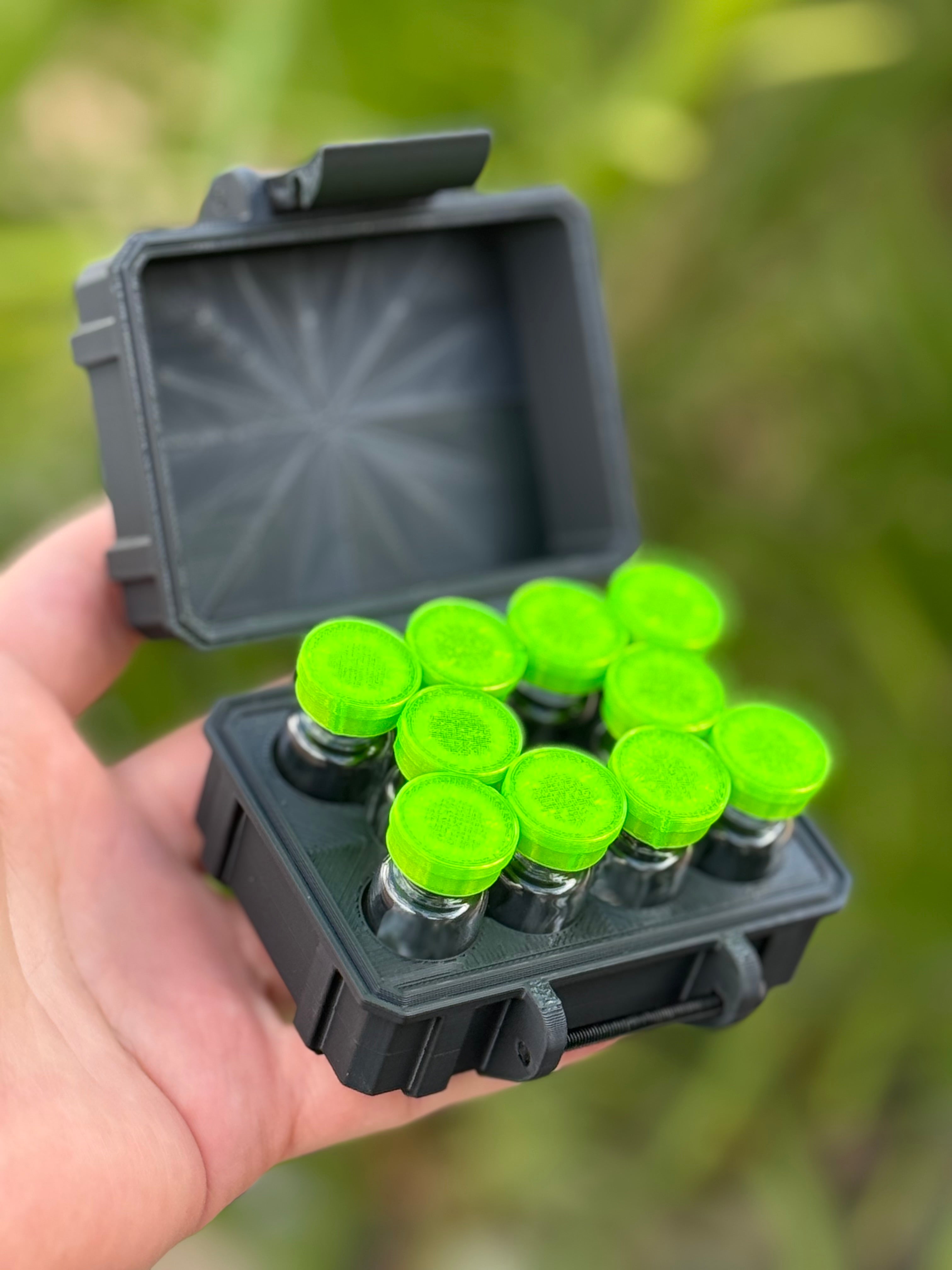
Labeling and Organization
Unopened vials all look alike, and once a vial has been opened there's no telling from the outside when that happened. Label every vial with the date you opened it on a small label or a strip of medical tape, and follow your label or pharmacist for how long an opened vial can be used. Keep each vial in the same pocket every time, so a gap tells you instantly that something hasn't been put back.
If you keep more than one product, color-coded caps make the difference obvious at a glance, even in a dim fridge.
Color-code your vials
Custom snap-on caps for 3 mL or 10 mL vials, with a cap color plus an icon or letters. Sets from 25 caps.
Beach Days, Hot Cars and Summer Trips
Summer trips are exactly when vials end up in the worst places. A parked car can get dangerously hot inside within minutes, and a beach bag in direct sun isn't much better. A few rules:
- Never leave vials in a parked car. Take them with you.
- Use a cooler if your label calls for cold. Pack the closed case inside an insulated cooler with a gel pack, with a layer between the vials and any frozen pack.
- Keep the case in the shade. Even inside a bag, direct sun heats everything up.
- Pack only what you need. Leave the spares at home in their own case instead of carrying your whole supply to the pool.
Flying and International Travel
- Carry on, don't check. Cargo holds get very hot or very cold and checked bags go missing.
- Use a hard case. It protects the glass in a packed bag, and an organized case is quick for an officer to inspect.
- Keep supplies in their original packaging. Original labeled packaging and your prescription or paperwork remove most questions at screening.
- Check the rules for your destination. What you can bring varies by country and changes over time. Check your airline's and your destination's current rules yourself before you pack, and leave anything at home that isn't allowed there.
For TSA screening specifics, see our guide to traveling with peptides through TSA, and for flights abroad, our international travel guide.
Check Your Vials for Damage
Before you use a vial that has traveled or been knocked around, look at the vial itself: cracks or chips in the glass, a crimp cap that has loosened or lifted, or a stopper that looks pushed in, torn or out of place. If the container is damaged, or anything about it looks wrong, set it aside and ask your pharmacist or provider before using it. Fitted pockets in a hard case are what keep this from happening in the first place.
What a Storage Case Should Do
- Block light with solid walls and a lid that closes fully.
- Hold every vial apart in fitted pockets, so nothing rattles or chips.
- Fit your whole supply, in-use vials and spares, plus bottles and supplies.
- Travel well: a hard shell, a latch that stays shut and a size that fits inside your cooler.
- Keep the fridge organized, separate from food and other products.
Make your own custom travel case for your vials
A case you design yourself can be sized for a beach bag or for your whole supply, or you can make one of each. In the PeptideCase™ builder you start with an empty case, tap "Add item" and pick what goes in and how many: 3 mL vials, peptide vials or other size vials, a BAC water bottle, syringes, and alcohol pads, flat or standing. Every item becomes fitted pockets or an open bay sized for that many, and every storage space has a finger scoop.
Auto-arrange packs it all into the most compact layout, and the builder shows the exact length, width and height, so you can check it fits inside your travel cooler. Choose Black or RGB Metallic, Wide or Deep, and one latch or two; big cases get a 5-knuckle hinge and two latches automatically. Add a temperature sensor item if you want a clip-in window in the lid for a small digital thermometer. It's printed to order in the US, at exactly the size shown.