NAD+ Precursors vs. Injectable NAD+: Different Storage, Different Stakes
Not all NAD+ products are created equal — and they have very different storage requirements. Understanding the distinction matters before you organize anything:
- Oral NAD+ precursors (NMN, NR): These are capsule or powder supplements. NMN (nicotinamide mononucleotide) and NR (nicotinamide riboside) are stable at room temperature when properly sealed. Store in a cool, dry location away from heat and humidity — a cabinet or drawer, not the bathroom. Some users refrigerate NMN powder for extended shelf life, but it's not required. No cold chain, no vials, no reconstitution.
- Injectable NAD+: A completely different animal. Injectable NAD+ comes as a lyophilized powder or pre-dissolved solution in sterile vials. It requires refrigeration, is light-sensitive, and has a short use window once reconstituted or opened. This is the format that belongs in your peptide case alongside your other injectable compounds.
The growth of IV NAD+ clinics over the past several years has normalized injectable NAD+ as a recovery and longevity tool. As self-injection protocols have become more accessible, injectable NAD+ has moved into home use alongside peptide stacks — which is exactly where the storage complexity begins.
Injectable NAD+ Storage Requirements
Injectable NAD+ behaves similarly to peptides but with some important distinctions:
- Lyophilized powder: Refrigerate at 2–8°C. Unlike many peptides that can be frozen for long-term storage, NAD+ powder is often supplied with a refrigerate-only recommendation. Check your supplier's guidance — some formulations tolerate -20°C, others don't.
- Reconstituted NAD+: Refrigerate immediately after reconstitution. Use within 14 days. This is a shorter window than most peptides, making it critical not to reconstitute more than a two-week supply at a time.
- Light sensitivity: NAD+ is notably photosensitive. The molecule degrades under UV exposure and prolonged visible light. Store reconstituted NAD+ in an opaque container or case — never leave a vial on a countertop in daylight.
- Temperature stability: Injectable NAD+ is more sensitive to temperature fluctuations than most peptides. Keep it in the most thermally stable part of your fridge (middle shelf, not the door). A dedicated peptide case in the main fridge compartment provides better temperature consistency than loose vials on a shelf.
Pro Tip: NAD+’s 14-day reconstituted window is your constraint for planning dosing frequency. At typical subcutaneous doses of 25–100mg, a 500mg vial reconstituted in 5ml gives you 10–20 doses — easily used within 14 days on a daily or every-other-day schedule. Plan your reconstitution to match your consumption rate exactly.
Common Biohacking Stack Combinations with NAD+
NAD+ injectable is rarely run alone. The biohacking community has converged on several common stack combinations, each with its own storage logistics:
- NAD+ + BPC-157: Recovery and cellular repair stack. NAD+ supports mitochondrial function and energy production; BPC-157 accelerates tissue healing. Compatible storage: both refrigerate, both light-sensitive, both have similar shelf lives reconstituted.
- NAD+ + CJC-1295 + Ipamorelin: Energy, sleep quality, and body composition. The GH secretagogue pair adds to NAD+’s mitochondrial effects. Three vials to manage, all with similar refrigeration requirements.
- NAD+ + GHK-Cu: Anti-aging focus. GHK-Cu promotes collagen synthesis and cellular regeneration; NAD+ addresses the mitochondrial side of aging. A clean two-compound pairing for longevity-focused protocols.
- Full longevity stack: NAD+ + BPC-157 + CJC/Ipa + GHK-Cu: The comprehensive biohacking setup. Five or more active vials at any given time, each with its own concentration, reconstitution date, and expiry. This is where an organized multi-slot case transitions from a nice-to-have to a genuine operational necessity.
The Storage Challenge of a Full Biohacking Stack
Running 5–8 injectable vials simultaneously creates organizational complexity that grows non-linearly. It’s not just "more vials" — it’s more reconstitution dates, more expiry windows, more light-exposure events per fridge opening, more chances for mix-ups, and more variables to track mentally.
Here’s what a typical full stack looks like in practice:
- NAD+ vial — reconstituted 4/10, expires 4/24, 50mg/ml
- BPC-157 vial — reconstituted 4/5, expires 5/3, 500mcg/ml
- CJC-1295 no DAC vial — reconstituted 4/12, expires 5/10, 2mg/ml
- Ipamorelin vial — reconstituted 4/12, expires 5/10, 2mg/ml
- GHK-Cu vial — reconstituted 4/1, expires 4/29, 1mg/ml
- BAC water — opened 4/1, expires in 28 days
Six vials, six different reconstitution dates, six different expiry windows. If they’re loose in the fridge, you’re hunting and reading labels every single dose session. If they’re in a dedicated multi-slot case with each compound in its assigned position, you grab the right vial on muscle memory and verify with a glance.
Building Your Biohacking Fridge Setup
A purpose-built biohacking fridge setup has three zones:
- Active vials case: Your primary peptide case holds all currently reconstituted vials. This is what you open at every dose session. Middle shelf of the fridge, away from the door. Opaque case protects everything from light exposure regardless of how often the fridge is opened.
- Reserve / lyophilized stock: Unreconstituted backup vials stored either in the freezer (most peptides) or a dedicated refrigerator section. Clearly separated from active vials — you never want to accidentally draw from a powder vial.
- Supplies drawer or pouch: Syringes, alcohol swabs, sharps container, BAC water. Keep this adjacent to your peptide case so your full dose setup is in one location.
The key principle: every item in your protocol has exactly one home. When you finish a session, everything goes back to its designated location. The system only works if it’s consistent.
Pro Tip: If you run NAD+ daily and other peptides less frequently, consider a two-case system: a small case for your daily NAD+ that lives at the front of the fridge for easy access, and a larger multi-slot case for your full peptide protocol. Reducing the number of times you open the main case reduces light exposure and contamination events for your longer-lived peptides.
Traveling with a Full Stack: Flying with 6 Vials vs. 2
The complexity difference between traveling with 2 peptides and traveling with 6 is significant. With 2 vials, a standard pill case and a cold pack is manageable. With 6 vials — including NAD+ with its shorter shelf life and higher light sensitivity — improvised travel storage starts creating real risks.
- All vials in carry-on only. Temperature swings in cargo holds can reach -20°C or +40°C. Injectable NAD+ and peptides cannot survive this.
- Hard-shell case essential. Six glass vials in a zip-lock bag in your backpack will not survive TSA screening, overhead bin shifts, or a bag drop. A crush-resistant case is the only safe option.
- Cold pack duration matters. NAD+’s temperature sensitivity means you need an adequately sized cold pack for your total travel time door-to-hotel-fridge. A small gel pack for a 6-hour travel day is not the same as what you need for a 14-hour international transit.
- Hotel fridge verification. Check the fridge on arrival. Hotel mini-fridges vary from 2°C to 12°C. A fridge running at 12°C is borderline for peptides and problematic for NAD+. If yours is unreliable, request a replacement room or use your insulated case with fresh ice from the ice machine.
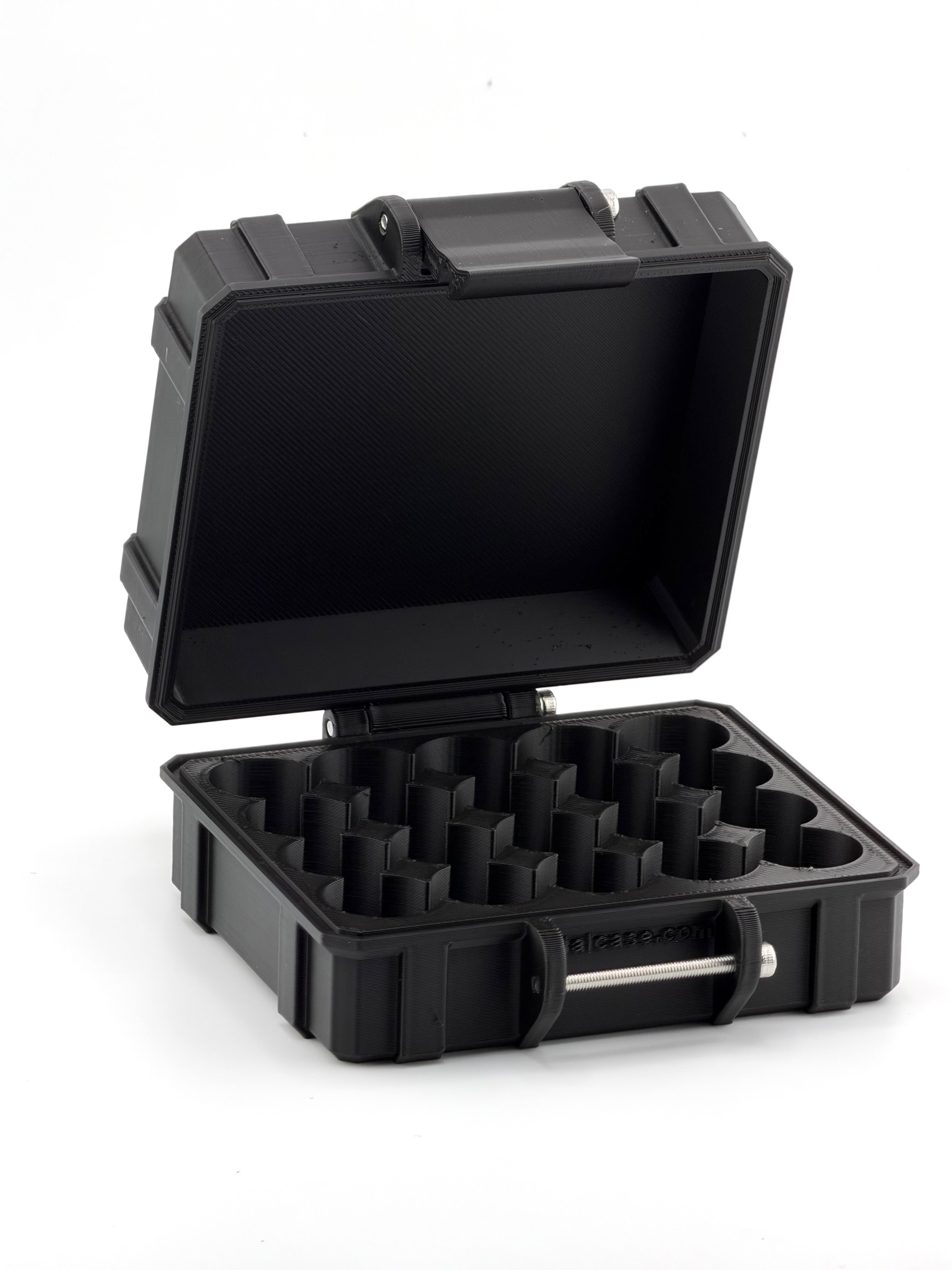
A purpose-built vial case consolidates all six vials into one organized, crushproof, opaque unit that handles every step of this transit checklist in a single container.
The ROI of a Peptide Case for a Full Biohacking Stack
The math on protecting a full stack is straightforward. A single injectable NAD+ vial costs $30–80. A BPC-157 vial: $30–60. A CJC/Ipa pair: $40–80. A GHK-Cu vial: $20–50. A full month’s stack at wholesale research prices can easily total $150–300 — and that’s before considering clinic-sourced compounds.
One degraded NAD+ vial from improper storage or a travel mishap costs more than a quality peptide case. One mix-up between vials due to poor organization at best wastes a dose and at worst creates a genuine health issue. The case isn’t a luxury for people running full biohacking stacks — it’s the storage infrastructure that makes the protocol viable.