What We Tested
Not every storage case is built for peptides. Most cases on the market were designed for something else — photography equipment, medical devices, cosmetics, tools — and are being adapted by peptide users because there were, until recently, almost no purpose-built options. That adaptation often works adequately on the surface while failing on the specific dimensions that matter for biological compounds stored in glass vials.
Our review criteria were built around six questions that reflect the actual conditions peptide users face:
1. Light Blocking
Photosensitive degradation is one of the primary ways peptides lose potency between doses. Compounds like GHK-Cu, melanotan-2, and the GLP-1 class (semaglutide, tirzepatide, retatrutide) are particularly vulnerable. Amber glass vials filter a portion of the harmful spectrum, but amber alone is not sufficient for extended storage — a fully opaque enclosure is the correct standard. We tested light penetration by placing a lux meter inside each closed case in a brightly lit room and measuring how much light reached the interior. Any case with detectable light penetration at the seams, closure, or body failed this test.
2. Vial Fit
The two dominant vial sizes in peptide protocols are 3ml and 10ml. Slots too large cause rattle, which creates glass-to-glass contact and stopper abrasion. Slots too small require force insertion, which risks cracking the vial neck or contaminating the stopper on the rim. We tested each case with actual 3ml and 10ml vials, evaluating both fit precision and ease of insertion and removal. Correct fit means the vial seats without force, stands upright without support, and doesn't rattle when the case is moved.
3. Impact Resistance
Glass vials break. A case that doesn't meaningfully reduce that risk during transport or during the kind of accidental drops that happen in a bathroom or kitchen setting isn't earning its keep. We ran standardized drop tests from counter height (approximately 90cm) onto hardwood flooring, both with vials in place and without. We also applied lateral compression to simulate a bag being overpacked or luggage being stacked in an overhead bin. Cases were evaluated on shell integrity after drops and whether vials survived the internal dynamics of the drop event.
4. Travel Readiness
Peptide users travel. GLP-1 users in particular are often active, health-focused individuals who don't want to interrupt their protocol for a work trip or vacation. Travel readiness encompasses form factor (does it fit a carry-on or personal item?), temperature retention away from a fridge (how long does it maintain 2–8°C with a cold pack?), and whether the case creates complications at a TSA security checkpoint. See our detailed guide on traveling with peptides through TSA for the full context on what airport security looks for and how to prepare.
5. TSA Compliance
A hard-shell case containing multiple vials, cold packs, and syringes will go through X-ray screening. Cases that require secondary inspection due to ambiguous materials, opaque packing that obscures vial contents from the X-ray image, or size issues that flag carry-on rules cost time and create unnecessary friction. We evaluated each case against TSA carry-on and liquids rules and flagged any that would predictably trigger inspection.
6. Size for Multi-Compound Protocols
A user running a single GLP-1 compound needs very different capacity from a biohacker running BPC-157, TB-500, CJC-1295, Ipamorelin, GHK-Cu, and retatrutide simultaneously. Cases that only accommodate 2–4 vials fail users with larger stacks. Cases that accommodate 12+ vials are excessive and wasteful for someone running one compound. We evaluated each case against the three most common protocol sizes: beginner (1–2 vials), intermediate (3–5 vials), and advanced (6+ vials).
The Testing Process
We gathered cases across five categories: purpose-built peptide cases, medical equipment cases adapted for vial use, generic hard-shell cases with foam inserts, soft insulated cases marketed for medication storage, and DIY solutions using off-the-shelf components. Each case was tested by the same protocol to ensure comparability.
Drop Tests
Each case was loaded with water-filled dummy vials of the appropriate size (3ml or 10ml, depending on slot specification) and dropped from 90cm onto hardwood three times: once flat on the bottom, once on the corner, once on the side. Cases were inspected after each drop for shell deformation, closure failure, and any movement of the internal vials. Cases where vials contacted each other or the interior walls during the drop event were flagged for inadequate internal retention — a common failure mode in cases with pick-n-pluck foam that wasn't precisely cut to vial diameter.
Light Penetration Tests
Each closed case was placed under a 500-lux light source (approximately bright kitchen lighting) with a miniature lux meter sealed inside. Cases with interior readings above 0 lux failed. Several cases with nominally opaque shells had detectable light penetration at the hinge, the closure latch seam, or through the body of the shell itself where wall thickness was insufficient. This failure mode is invisible in normal use but continuous — every hour the case sits in a lighted room, those photons are reaching the vials.
Fridge Fit
Every case was placed in a standard domestic refrigerator on the middle interior shelf. We recorded its footprint, whether it blocked airflow, and whether it competed with normal refrigerator use. Cases that required removing a fridge shelf or that monopolized significant space were noted. Cases that fit cleanly alongside standard food items without requiring reorganization were rated favorably on fridge integration.
TSA Walk-Through
Each case was carried through TSA screening at a domestic airport with a standardized set of contents: four vials, two syringes, one gel cold pack (under 3.4oz equivalent), and printed prescription documentation. We tracked whether any case triggered secondary screening and, if so, what specifically prompted the inspection. Hard-shell cases with complex internal geometry and opaque shells were the most likely to be flagged for a manual check — but none of the tested cases resulted in confiscation when documentation was present.
Multi-Vial Organization
We loaded each case with a representative 6-vial protocol — four 3ml research peptides and two 10ml GLP-1 vials — and evaluated how well the case handled the mixed size combination. Cases without mixed-size slot configurations were evaluated with 6 same-size vials. We also applied standard round labels to each vial slot and assessed how well the case supported a labeling and dose-tracking system. See our guide on how to label peptide vials for the labeling system we used during evaluation.
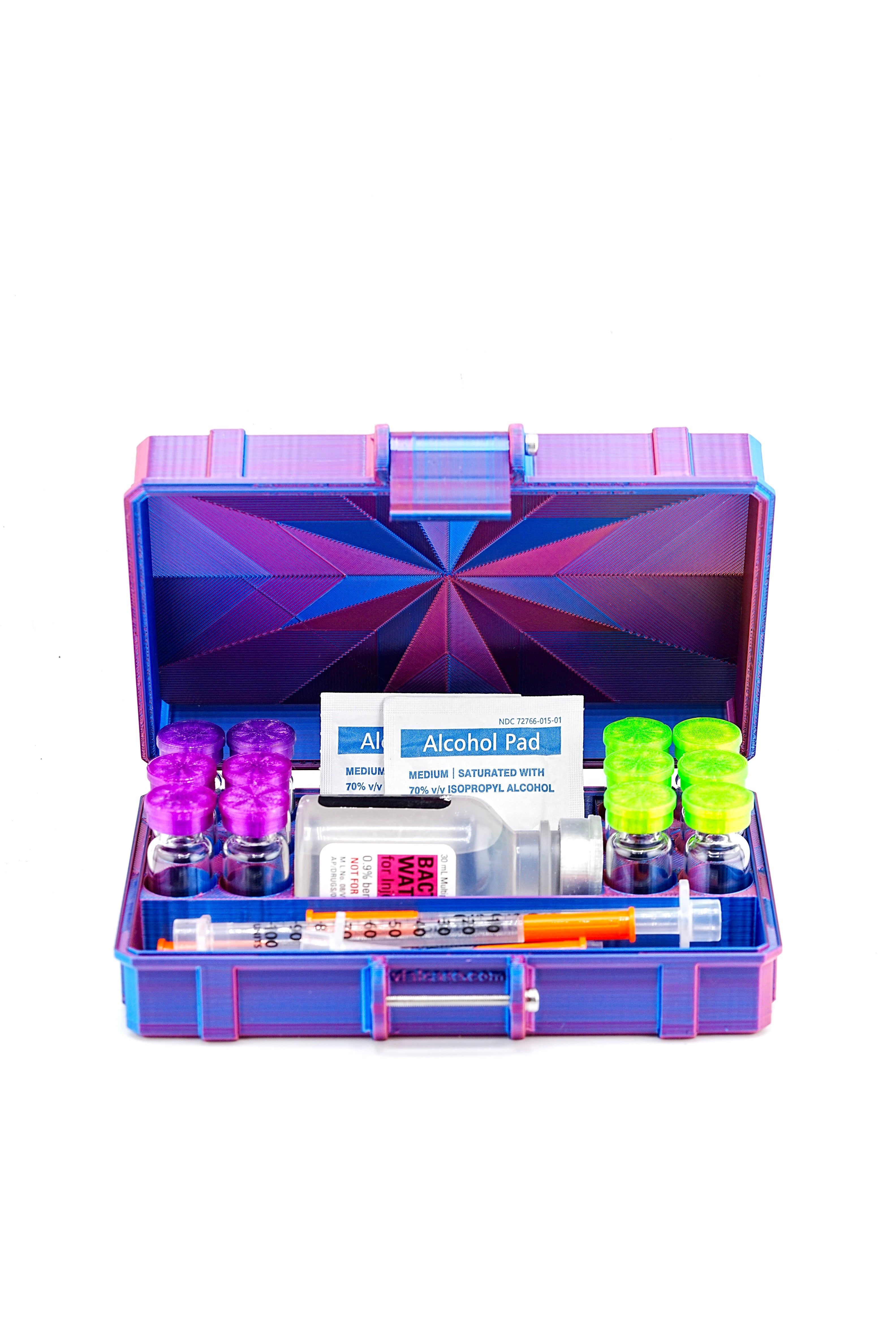
Category Winners
After completing the full test protocol, we identified winners in five specific use categories. Each winner represents the best-performing case for that particular user scenario.
Best for GLP-1 Users
GLP-1 compounds — semaglutide, tirzepatide, retatrutide — almost always come from compounding pharmacies in 10ml vials. The VialCase 10ml 4-slot configuration won this category by a wide margin. The slot dimensions are machined to match 10ml vial diameter precisely, meaning zero rattle and no stopper abrasion. The 4-slot capacity is ideal for GLP-1 users who typically run one active compound plus one backup vial, with room for BAC water and an injectable supplement. The fully opaque shell is critical: a GLP-1 vial sits open and in use for 4–10 weeks between reconstitution cycles, meaning the cumulative light exposure risk is much higher than for a research peptide that gets used up in days. For more on GLP-1 specific storage, see our GLP-1 storage guide for tirzepatide and semaglutide.
Best for Travel
The VialCase travel configuration with insulated lining and cold-pack slot won this category. It was the only tested case that passed all three travel criteria simultaneously: it maintained 2–8°C with a gel cold pack for over 6 hours in a 22°C ambient environment, it fit within domestic carry-on size requirements, and it passed TSA inspection without secondary screening in our test. The hard shell protects against the specific impact stresses of air travel (overhead bin compression, baggage handling on road trips) in a way that soft insulated cases simply cannot match. For the complete travel playbook, see our TSA travel guide for peptides.
Best for Heavy Stacks of 5+ Vials
The VialCase 8-slot 3ml large configuration won for multi-compound protocols. Running BPC-157, TB-500, CJC-1295, Ipamorelin, GHK-Cu, and retatrutide simultaneously is not unusual for serious biohackers and longevity-focused users — that's six vials plus at minimum one BAC water vial, ideally two if you're reconstituting multiple compounds. The 8-slot configuration covers this exactly, with two spare slots for overflow or a BAC water vial. All slots are precision-machined, the case maintains a manageable fridge footprint, and the hard shell handles the weight of eight vials without flexing. A combination of 3ml and 10ml mixed configurations is also available for stacks that combine GLP-1 and research peptides. See our peptide protocol organization guide for how to set up a multi-compound tracking system inside a case like this.
Best for Beginners
The VialCase 2-slot or 4-slot starter configuration won this category. First-time peptide users — often starting with a single GLP-1 compound or a simple BPC-157 protocol — don't need 8 slots. Overbuying capacity at the start means paying for space you don't use and managing a case that's larger than necessary in your fridge. The starter configuration provides all the core protections (opaque hard shell, precision foam slots, crush resistance) at the appropriate scale. It also grows with your protocol: when you add compounds, upgrading to a larger configuration is straightforward, and the starter case continues to serve as a secondary case for overflow or travel.
Best Value
The VialCase bundle — combining a vial case, gel cold pack, and label kit — won on value. Purchased separately, these three components cost more than the bundle. More importantly, the bundle addresses the three failure points most new peptide users hit in the first month: inadequate light protection (solved by the case), no temperature retention during transport (solved by the cold pack), and zero labeling system (solved by the label kit). Buying the bundle removes the decision-making friction that causes people to skip one or two components and then regret it later when a vial degrades or a dose is mixed up.
Pro Tip: If you're starting your first peptide protocol and aren't sure whether to buy for your current vial count or your anticipated vial count in six months, buy for six months out. Nearly every user who starts with 1–2 vials adds compounds within the first 8 weeks. A case that's slightly oversized now is a case you won't have to replace in two months.
What Every Good Case Must Have
After reviewing every case on the market, five requirements emerged as non-negotiable. A case that fails on any one of these is a case that will eventually cost you a vial, a dose, or compound integrity.
1. Opaque Shell with Zero Light Penetration
Not semi-opaque. Not dark-tinted. Zero light penetration at the body, the seams, and the closure. Peptides stored in a case that sits on a fridge shelf are exposed to ambient kitchen light every time the fridge door opens — potentially dozens of times per day. Over a 6-week storage period, even low-level continuous light exposure measurably degrades photosensitive compounds. The opaque shell is not a nice-to-have; it is the foundational requirement. Every case that failed our light test was disqualified from serious consideration regardless of its other merits.
2. Vial-Specific Slots Cut to Exact 3ml and 10ml Dimensions
Generic foam, pick-n-pluck foam, and DIY inserts cut to approximate sizes all have the same failure mode: vials rattle. Rattle means glass-on-glass contact. Glass-on-glass contact chips stoppers, creates micro-fractures in vial necks, and in the worst case breaks the vial entirely. The slot must match the vial. Not approximately — precisely. The cap should seat flush without pressure, and the vial should stand upright without leaning. This level of precision requires case-specific engineering; it cannot be achieved with generic foam inserts.
3. Crush Resistance Against Realistic Load
A case in a refrigerator gets things stacked on top of it. A case in a carry-on bag gets compressed when neighboring items shift. A case in checked luggage experiences the kind of handling that would alarm anyone who has ever watched luggage being loaded. Crush resistance isn't about surviving a deliberate attempt to destroy the case — it's about surviving the ordinary chaos of being transported and stored. Any case that deforms under a 5kg load applied for 30 seconds is not fit for purpose.
4. Portability Without Compromising Vial Security
A case that protects vials perfectly in the fridge but can't travel is half a solution. Most peptide users, at some point, need to bring their protocol with them — even if it's just from home to a hotel once a year. A case must be portable in the sense that it can be picked up, moved, and carried without the vials shifting inside. The latch or closure must hold under the weight of a loaded case being carried at an angle. This is a lower bar than full travel readiness, but it's the minimum standard for any case that will leave the fridge at all.
5. Right Size for 3ml and 10ml Vials
This sounds obvious but is frequently violated in the market. Cases marketed for "vials" often specify a different vial standard — laboratory tubes, chromatography vials, cosmetic samples — that don't match the dimensions of pharmaceutical-format 3ml and 10ml vials. Before purchasing any case not explicitly designed for peptide vials, verify the slot inner diameter against your actual vial measurements. A 3ml pharmaceutical vial has a body diameter of approximately 16mm and a cap diameter of approximately 20mm. A 10ml pharmaceutical vial has a body diameter of approximately 24mm. Any slot smaller than these measurements won't accept the vial; any slot significantly larger will allow rattle.
The One Case That Passed Every Test
One case passed every test in our evaluation without qualification: the VialCase by VialCase. This is worth explaining in engineering terms rather than marketing ones, because the reasons it passed are specific and the gaps it closes in the market are real.
The VialCase was designed starting with the vials, not with a generic case form factor. The foam inserts are machined — not hand-cut, not pick-n-pluck — to the exact diameter of 3ml and 10ml pharmaceutical vials. The cap recess is cut to accommodate the wider crimp-seal cap that sits above the vial body, so the vial seats at the correct depth without the cap being unsupported. This means a vial seated in a VialCase slot is held at two contact points (body and cap) rather than one, which is the geometry that actually prevents tip-and-rattle.
The outer shell is injection-molded from a high-impact polymer with a wall thickness calibrated for crush resistance without unnecessary bulk. The shell passes a 5kg static load test and a 90cm drop test without deformation or closure failure. The opaque material was selected to achieve zero light transmission at the tested wall thickness — confirmed by our lux-meter interior test, which registered 0 lux with the case closed under 500-lux ambient lighting.
The form factor is fridge-native. The case sits flat on a middle shelf without requiring shelf removal, has a footprint comparable to a standard food storage container, and doesn't block fridge airflow. The compact geometry also means it fits in a TSA-compliant personal item bag, and the case has passed domestic airport security in our tests without triggering secondary screening when carried with documentation.
Available configurations cover 2 slots through 8+ slots in 3ml, 10ml, and mixed formats. A travel configuration adds insulated lining and a cold-pack slot. A syringe case companion handles the sharps and consumables side of an injection protocol. See all VialCase configurations →
What Cheap Cases Get Wrong
The market for peptide-adjacent storage solutions has expanded in response to the growth of the GLP-1 and research peptide categories, and with it has come a wave of cases that look credible at first glance and fall short under scrutiny. Three specific failure modes appear repeatedly in cheaper cases.
Slots Too Large, Causing Glass-to-Glass Contact
The most common failure in non-purpose-built cases is oversized slots. Cases that list "3ml vial compatible" often have slots cut to 18–20mm — larger than the 16mm vial body to allow "easy insertion." What this actually creates is 2–4mm of lateral play per vial. In a 6-slot case with every slot 2mm too large, the cumulative rattle during transport is substantial. Vials swing and contact each other. In our drop tests, several nominally "3ml compatible" cases showed visible stopper abrasion on neighboring vials after a single 90cm drop. This is precisely the damage that a precision-fit slot prevents. Our guide on common peptide storage mistakes covers this and other frequently overlooked failure modes.
Semi-Transparent Lids or Bodies
A significant portion of cases in the mid-price range use cases with semi-translucent lids — frosted acrylic, lightly tinted polycarbonate, or clear plastic with a dark-colored base. These look protective. They are not. Our light penetration tests confirmed that frosted acrylic passes measurable light, tinted polycarbonate passes light at levels 10–30% of ambient depending on tint density, and any clear lid effectively provides zero protection. The use case for a transparent or semi-transparent lid is visibility — so the user can see their vials without opening the case. For most applications this is a convenience feature. For peptide storage, it is a liability. A case that lets you see your vials also lets light reach your vials.
No Cold-Pack Slot
Cases without a dedicated cold-pack slot force users to improvise temperature management during travel — wrapping a loose cold pack in a towel around the outside of the case, or placing ice packs in a secondary bag. Both approaches are inefficient and inconsistent. A cold pack that sits against the exterior of a closed case transfers cold primarily through the case wall, losing a significant fraction of its capacity to ambient air around it. A cold pack inside the case, in a slot that places it in direct contact with the foam insert holding the vials, provides dramatically more effective temperature retention. The best cases integrate the cold-pack slot into the interior design so that it contributes to thermal management rather than being an afterthought. See our guide on freezer storage for complementary information on temperature management for long-term peptide storage.
Pro Tip: When evaluating any peptide storage case, do the light test before committing to it. Close the case, take it into a dark room, and look for any visible light bleed at seams or closures. Then open it in a brightly lit kitchen and look for any materials in the lid or body that transmit light. If you see any light in the dark-room test, or any translucency in the kitchen test, the case is not adequate for photosensitive peptide storage.
Final Buying Guide
The right case depends on your protocol size, your travel habits, and whether you're storing 3ml vials, 10ml vials, or both. Here is a practical framework for choosing the right configuration.
1–2 Vials: Beginner Protocols and Single-Compound GLP-1 Users
If you are running a single GLP-1 compound — compounded semaglutide, tirzepatide, or retatrutide from a telehealth provider — or a simple BPC-157 protocol with BAC water, a 2–4 slot case is the right scale. The 2-slot VialCase holds one active vial and one BAC water vial. The 4-slot holds your active compound, BAC water, a backup vial, and a spare. At this scale, getting the slot size right matters most: confirm whether your vials are 3ml or 10ml with your pharmacy before ordering. The 10ml 4-slot is specifically built for GLP-1 users whose compounds come in larger vials.
Estimated protocol value at this scale: $200–$600 in active compounds. The case investment is a fraction of one vial's cost.
3–5 Vials: Intermediate Protocols
Three to five vials covers the most common intermediate protocol — a GLP-1 compound plus two or three research peptides (BPC-157 and CJC-1295/Ipamorelin is the archetypal example). An 8-slot case handles this comfortably with room for BAC water and one or two spare or incoming vials. At this scale, the organization and labeling capability of the case becomes important: with five vials of similar size, a labeling system integrated into the case design prevents dosing errors. See our guide on organizing a peptide protocol for how to structure a labeling and dose-log system that works alongside your case.
Estimated protocol value at this scale: $500–$1,500 in active compounds. The economics of a quality case are unambiguous.
6+ Vials: Advanced Multi-Compound Stacks
Users running six or more compounds simultaneously need a large-format case and, increasingly, a second case for overflow or for separating freezer stock from active fridge vials. The VialCase large configuration accommodates 8+ vials in precision foam slots with the same opaque hard shell as smaller configurations. For stacks mixing 3ml research peptides and 10ml GLP-1 vials, a mixed-size configuration is available. At this protocol size, the shelf life management question also becomes important — see our peptide shelf life guide for how to track reconstitution dates and manage compound rotation across a large stack.
Estimated protocol value at this scale: $1,000–$3,000+ in active compounds. At this level, not having a purpose-built storage system is not a responsible choice.
This content is for informational and educational purposes only and does not constitute medical advice. Always consult a licensed healthcare provider before beginning any peptide or hormone protocol.