Why "Best" Depends on Your Protocol
Walk into any peptide forum and ask which case is best, and you'll get ten different answers — because everyone's running a different protocol. A person using a single vial of semaglutide per week needs maybe four slots and a compact profile that fits in a purse. Someone stacking BPC-157, TB-500, CJC-1295, ipamorelin, and PT-141 simultaneously needs twenty or more slots, clear organization by compound, and enough room for BAC water and syringes.
Choosing based on size alone is the wrong frame. The right frame is: what does my protocol actually require today, and where will it be in six months? Most people underestimate how quickly a one-peptide protocol becomes a four-peptide protocol once results start coming in. Buy ahead of where you are, not behind it.
That said, buying a massive case when you genuinely only use one compound is just bulk for no reason. The goal is a case that's matched to your reality — organized, compact for the load it carries, and durable enough to survive daily use or travel. That's what this guide is designed to help you find.
What Every Great Peptide Case Must Have
Before getting into specific products, here are the six features that every serious peptide case needs to check. These are non-negotiables — a case that fails on any one of them is the wrong case, regardless of price.
1. Hard Shell Construction
Soft pouches and zipper bags offer zero crush protection. Glass vials don't survive being squeezed by a laptop, sat on in a bag, or tossed in an overhead bin. A hard shell — polypropylene, ABS plastic, or similar rigid material — is the baseline for any case you're going to carry or travel with. This isn't a premium feature; it's the floor.
2. Fully Opaque Walls
Light degrades peptides. UV exposure is particularly damaging to photosensitive compounds like BPC-157, melanotan II, and most GH secretagogues. Clear cases look nice on a shelf but functionally undermine the whole point of a storage solution. The interior of your case should see zero ambient light when closed. Opaque all the way around — not just on top.
3. Vial-Specific Molded Slots
A foam insert with circular cutouts isn't a slot. A real peptide case has precision-molded slots sized to grip 3ml or 10ml vials by their shoulder, holding each one upright and separated. Vials that rattle together chip glass, knock off stoppers, and mix up compounds when your label system isn't perfect. Tight slots prevent all of that.
4. Correct Dimensional Fit for 3ml and 10ml
The two dominant vial sizes in peptide use are 3ml (the standard for most lyophilized research peptides) and 10ml (standard for GLP-1 medications like semaglutide and tirzepatide). These are not interchangeable in terms of slot size. A 10ml vial in a 3ml slot won't fit. A 3ml vial in a 10ml slot will rattle and tip. Know your vials; buy the case matched to them, or buy a dual-size case if you use both.
5. Secure, Positive-Click Latch
A case that pops open in your bag has failed at its most basic job. The latch needs to close with a positive click, resist accidental opening, and stay shut under the kinds of pressure a bag endures during a commute or flight. Magnetic closures and friction-fit lids are not good enough for a case containing glass vials and controlled-temperature biologics.
6. Compact Enough to Actually Use
A case you leave at home because it's too bulky to carry is useless. The best case is one that fits into your daily routine — gym bag, travel bag, fridge shelf. Bigger capacity is valuable up to the point where the case stops going with you. Keep that balance in mind: capacity must serve portability, not defeat it.
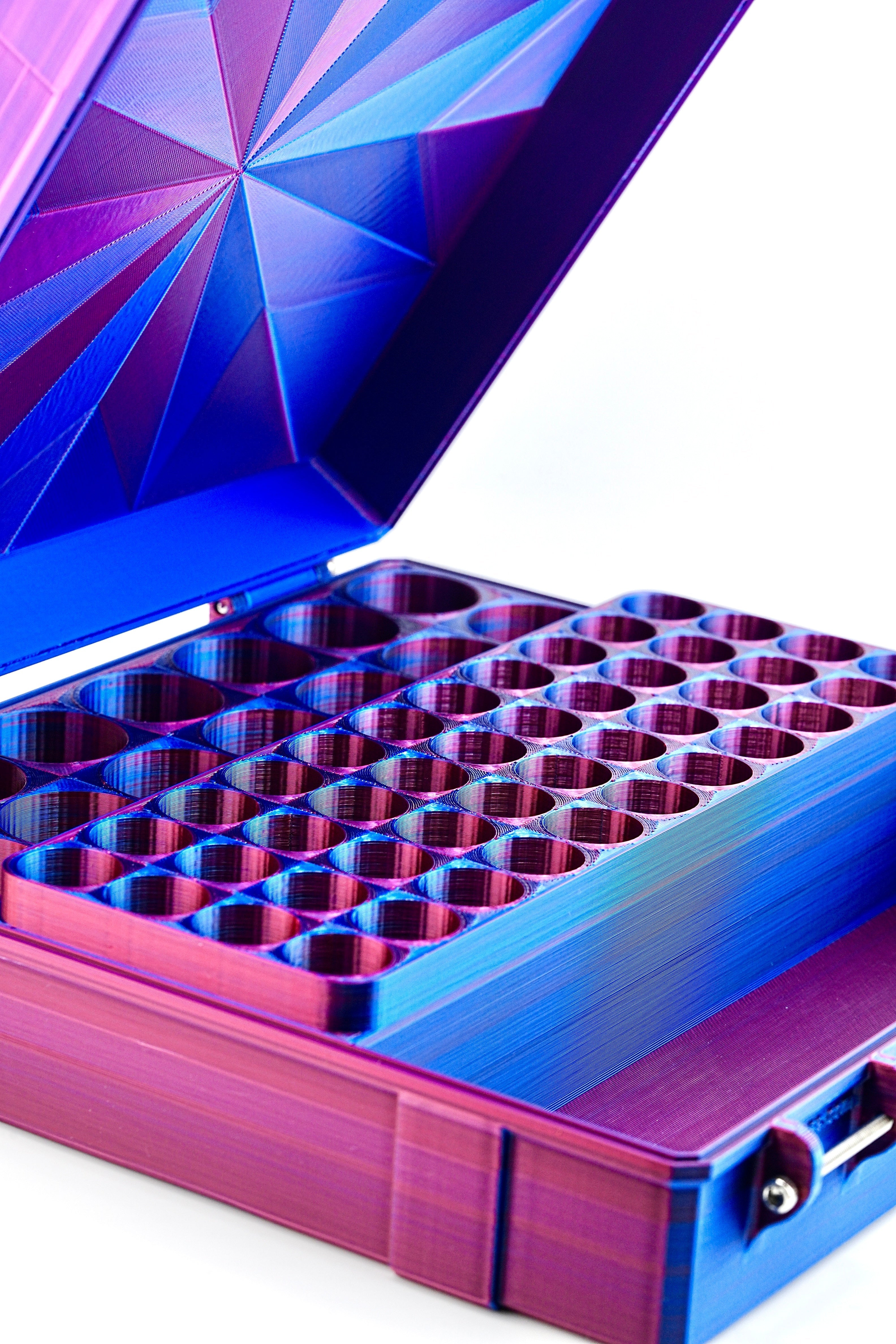
The 5 Best Peptide Cases in 2026 — Ranked by Use Case
Best for Beginners / 1-2 Vials: VialCase 10-Slot Compact ($13.99)
If you're just getting started — one peptide, maybe a vial of BAC water — the VialCase 10-Slot Compact is the right entry point. Ten slots sounds like more than a beginner needs, but that's intentional. You'll grow into it. Right now you have one compound; in three months you might have four. This case handles that growth without needing a replacement.
The compact footprint keeps it portable — it slips into a gym bag or purse without adding meaningful bulk. The hard shell is polypropylene, the interior is fully opaque, and the slots are precision-molded for 3ml vials. At $13.99, it's the lowest-risk entry into purpose-built peptide storage.
Best for: first-time peptide users, GLP-1 pen users who keep one or two backup vials, anyone wanting to dip into proper storage without committing to a larger case.
What it doesn't do: 10ml vials won't fit. No integrated syringe compartment. If you're already running three or more compounds, start with the next step up.
Best for a GLP-1 Protocol: VialCase 10-Slot with Extra Storage ($29.99)
GLP-1 protocols have specific needs: typically one or two 10ml vials of the active compound, a vial of BAC water for reconstitution, and enough organized space to keep everything labeled and accessible. The VialCase 10-Slot with Extra Storage at $29.99 is designed around exactly that use case.
Ten slots covers most GLP-1 users running semaglutide, tirzepatide, or retatrutide — you get enough room for current vials, backup vials, and your reconstitution supplies. The extra storage compartment is sized for alcohol wipe packets and small accessories, so the kit stays self-contained. Hard shell, opaque, positive-click latch. Fridge and freezer compatible.
Best for: semaglutide users, tirzepatide users, retatrutide users, anyone on a single-compound GLP-1 protocol who wants organized storage without excess bulk.
What it doesn't do: Not ideal if you're running multiple peptides in addition to a GLP-1. At that point you want the 12-slot all-in-one.
Best All-in-One: VialCase 12-Slot All-in-One ($36.99)
This is the case most multi-peptide users end up on. The VialCase 12-Slot All-in-One at $36.99 combines 12 precision-molded 3ml vial slots with dedicated compartments for insulin syringes and alcohol pads. Everything for a complete injection kit lives in one organized hard-shell case.
The design is deliberately self-contained. You're not pulling vials from one case, syringes from a separate pouch, and alcohol wipes from your bathroom drawer. Open one case, do your injection, close it, put it back. That's the workflow this case is built around. It's also the best travel option for multi-compound users — everything TSA needs to see is organized and accessible in a single container.
Best for: users running 3-8 peptides, anyone traveling with their stack, people who want their full injection kit in one place.
What it doesn't do: The 12 slots are sized for 3ml vials. If your protocol mixes 3ml research peptides with 10ml GLP-1 vials, you'll need separate storage for the 10ml vials.
Best for 10ml Vials (GLP-1 / TRT): VialCase 13-Slot 10ml ($49.99)
If your protocol centers on 10ml vials — semaglutide, tirzepatide, HCG, or TRT compounds — the standard 3ml cases won't work. The VialCase 13-Slot 10ml at $49.99 is built specifically for the larger vial format.
Thirteen slots accommodate a serious GLP-1 stack — enough room for the active compound, multiple backup vials, BAC water, and still have slots to spare for HCG or additional compounds. The extra storage compartment handles syringes and accessories. At 10ml scale, vials are heavier and more expensive, which makes case quality even more important. The hard-shell construction here protects a meaningful investment per vial.
Best for: GLP-1 users sourcing their own compounded medication in 10ml vials, TRT users storing multiple compounds, HCG users, anyone whose primary vial format is 10ml.
What it doesn't do: 3ml vials will be loose in 10ml slots. This is a dedicated 10ml case, not a universal one.
Best for Large Stacks: VialCase 20-Slot with Syringe Storage ($25.59)
Twenty vial slots is a serious capacity number. The VialCase 20-Slot with Syringe Storage at $25.59 is for users running complex, multi-compound protocols — eight or more peptides simultaneously, users who keep active vials and backup vials organized in the same case, or anyone who buys in larger quantities to minimize reorder frequency.
At $25.59 for 20 slots, this is also the best value-per-slot in the VialCase lineup. The syringe compartment runs alongside the vial section, keeping your injection kit fully integrated without adding external accessories. Hard shell, opaque, secure latch — same construction standards as the rest of the lineup.
Best for: advanced users running 8+ peptides, bulk buyers, users who keep both active and reserve vials in one case, high-volume travelers.
What it doesn't do: Larger than the compact options, so less suited to minimalist daily carry if you're only running one or two compounds.
Pro Tip: The best peptide case is the one you use every day. A $5 generic Amazon case that leaves your vials rattling loose defeats the entire purpose of organized storage. Spending $14-50 on a purpose-built case protects compounds that cost $50-200 per vial. The math is always in favor of buying the real thing.
What We Looked for in Each Case
Every case in this guide was evaluated against the same four criteria. Here's how that scoring works in practice:
Drop Protection
A hard-shell case should survive a drop from counter height without cracking or allowing internal vials to shift enough to break. We look for wall thickness, latch security, and internal slot snugness. A vial held firmly in a well-molded slot has dramatically less impact force transmitted to it than a vial loose in a foam-lined box.
Light Blocking
We close the case and look for light leaks — especially around the latch and hinge. Any case with visible light penetration fails this test for photosensitive peptides. All cases in this guide pass. This eliminates the majority of "peptide cases" sold on Amazon, which use translucent or semi-opaque shells that let in meaningful UV.
Slot Security
Vials should require deliberate effort to remove but should come out cleanly without sticking. We test by inverting a loaded case — vials should stay in their slots under gravity. Slots that let vials fall out when tilted are disqualifying. Slots that grip so tightly they risk chipping glass rims during removal are also suboptimal. The sweet spot is firm retention without force.
Value
Cost per slot is the most honest metric for comparing cases of different sizes. A $50 case with 20 slots ($2.50/slot) is better value than a $20 case with 4 slots ($5/slot). We factor in case quality, material grade, and included accessories (syringe storage, extra compartments) when evaluating value. All five cases in this guide represent strong value at their respective price points.
Cases to Avoid
The peptide storage market has a significant number of inadequate products. Here's what to steer clear of:
Generic Amazon Cases with Wrong Slot Sizes
The most common failure mode. A case labeled "vial storage" that uses foam inserts or generic circular cutouts won't hold 3ml or 10ml peptide vials correctly. The slots are either too wide (vials tip and rattle) or too narrow (vials get stuck, which risks chipping the glass rim on removal). Slot precision matters; generic cases don't have it.
Soft Zipper Pouches
Zero crush protection. A syringe or another object in the same bag compresses against the pouch and the vials inside it. Glass breaks. These cases also offer no light blocking when unzipped, and many have translucent panels that let UV through even when closed. The only scenario where a soft pouch is acceptable is as a secondary layer inside a hard-shell case — never as the primary container.
Medication Travel Bags
Designed for insulin pens and prefilled syringes, not loose vials. The internal organization is usually configured for cylindrical pen-style medication, which means 3ml vials end up horizontal, unsecured, and exposed to light through the insulated lining. The insulation is also a false friend — without an active cold pack, an insulated bag maintains temperature for perhaps 30-60 minutes before it becomes a greenhouse effect, actually raising internal temperature above ambient.
3ml vs. 10ml: Matching Your Case to Your Vials
Understanding vial size conventions is essential to buying the right case. The short version:
3ml vials are the standard format for most lyophilized research peptides — BPC-157, TB-500, CJC-1295, ipamorelin, PT-141, GHK-Cu, and most others. When you order a peptide from a research supplier, it almost certainly comes in a 3ml vial. This is the format most peptide cases are optimized for.
10ml vials are standard for GLP-1 medications (semaglutide, tirzepatide, retatrutide) when sourced as compounded medication, as well as for HCG and many TRT compounds. The vials are physically larger — roughly 58mm tall versus 45mm for a 3ml vial — and require correspondingly larger slots.
If you're exclusively a GLP-1 user: buy the 13-slot 10ml case. If you're exclusively running research peptides: buy any 3ml case that matches your volume. If you're doing both — running a GLP-1 alongside a peptide stack — you need either separate cases for each format or a dual-compartment case with slots for both.
The Peptide Storage Guide goes deeper on format-specific storage requirements if you want the full breakdown.
How Long Should a Peptide Case Last?
A well-made peptide case should last years of daily use, not months. The areas that wear out first are predictable: the latch mechanism (from repeated opening and closing), the slot grip (from frequent vial insertion and removal), and the hinge (from daily flexing). Quality cases use mechanical latches with positive engagement rather than friction or magnetic closures — these have far longer service lives.
At the price points in this guide ($13-50), you're buying purpose-built storage, not fashion accessories. The polypropylene and ABS shells used in VialCase products are the same material families used in laboratory storage equipment — rated for years of fridge and freezer cycling, impact resistant, and chemically inert. They won't absorb odors, leach into vial contents, or warp under normal refrigerator temperatures.
If a case latch fails or a slot cracks, VialCase stands behind their products. Contact their support team at the address on vialcase.com. The cases are purpose-engineered for this specific use, which means the failure modes are known and the warranty is backed by a company that actually understands the product.
Frequently Asked Questions About Peptide Cases
Is a dedicated peptide case really necessary?
If your peptides are stored in a fridge and never moved, you can technically get away with a repurposed container — a medicine bottle, a kitchen storage box, anything that keeps them dark and upright. But the moment you travel with peptides, commute with them, or have more than three or four vials to track, a dedicated case pays for itself in prevented breakage, prevented mix-ups, and prevented degradation from accidental light exposure. The cost of one degraded vial exceeds the cost of a good case. Do the math once and you'll never store peptides loosely again.
Can I use a regular pill case or pill organizer?
No. Pill organizers are designed for solid tablets, not liquid-filled glass vials. The compartment dimensions are wrong, the material is often translucent (letting in UV), the latching is weak, and there's no mechanism to hold vials upright. A peptide vial on its side accelerates stopper degradation and risks contamination of the lyophilized cake. Use the right tool.
Do peptide cases keep vials cold?
Standard hard-shell peptide cases are not insulated. They protect against light, physical damage, and disorganization — not temperature. For cold-chain maintenance during travel, you need a case plus an ice pack or gel pack. Some insulated travel pouches include a small cold compartment, but for flights longer than two hours, you want dedicated gel packs alongside your case. See our travel guide for the full cold-chain travel protocol.
What's the best case for travel?
For most travelers, the 12-Slot All-in-One ($36.99) is the right answer — it holds vials plus syringes plus alcohol pads in a single hard-shell container that's compact enough for a carry-on pocket and organized enough to pass TSA without questions. If you're traveling with a large stack (8+ vials), the 20-Slot with Syringe Storage gives you the capacity without bulk. For dedicated GLP-1 travelers using 10ml vials, the 13-Slot 10ml case is the answer. The best peptide travel case post goes deeper on this specifically.
Where do you buy peptide cases?
The cases in this guide are available directly from VialCase.com. Buying direct ensures you're getting the current production version of each case, with the correct warranty and return policy in place. Generic cases on Amazon carry none of those guarantees and — as covered above — typically fail the basic quality criteria that make a case worth buying.
The Bottom Line
Here's the decision tree in plain terms: one to two vials, grab the 10-Slot Compact at $13.99. Running a GLP-1 protocol, get the 10-Slot with Extra Storage at $29.99 or the 13-Slot 10ml at $49.99 depending on your vial size. Running a multi-peptide stack, go straight to the 12-Slot All-in-One at $36.99. Running eight or more compounds, the 20-Slot at $25.59 is your pick.
None of these are expensive. The most common regret among peptide users is waiting to buy a proper case — not buying one too soon. Get the one that fits your current stack, gives you room to grow, and get on with your protocol.
Disclaimer: This article is for informational and educational purposes only. PeptideCase does not sell peptides or any pharmaceutical compounds. Product links are to storage and organizational equipment only. Nothing in this article constitutes medical advice. Consult a licensed healthcare provider before starting any peptide protocol.