Why Travel Is the Highest-Risk Moment for Peptides
Peptides are fragile in predictable ways. Heat accelerates degradation — every 10°C rise above the recommended storage temperature roughly doubles the rate of molecular breakdown. Light catalyzes oxidation in photosensitive compounds. Physical shock can crack the stoppers that keep vials sterile. And disorganization turns a multi-vial protocol into a guessing game when you're working from a hotel bathroom without your usual setup.
All four of those risks peak during travel. You're moving from a temperature-controlled fridge into a bag, into a car, into an airport, into a cabin where the overhead bin routinely gets compressed by other bags. You're handing your carry-on to strangers who move it without care. You're working in hotel rooms without your usual refrigerator, with unfamiliar mini-fridges set to unknown temperatures. And if anything goes wrong — a cracked vial, a degraded compound, a missed dose — you're far from home and your usual supplies.
A proper peptide travel case doesn't eliminate all of these risks, but it systematically eliminates most of them. This guide covers exactly what to look for, what to avoid, and which specific cases are worth buying for different travel scenarios.
TSA Rules for Traveling with Peptides
The single most common misconception about flying with peptides is that the 3-1-1 rule applies. It does not. The TSA's 3.4-ounce liquid limit applies to non-essential liquids — toiletries, beverages, and similar items. Medications, including liquid medications and injectables, are explicitly exempt from the 3-1-1 rule. You can carry full-size vials of reconstituted peptide solution in your carry-on without the 3-1-1 restriction.
You are also permitted to carry syringes in your carry-on when traveling with injectable medication. TSA may ask you to declare them at the checkpoint. The standard guidance from TSA is: declare your medication, have it readily accessible for inspection, and be prepared to explain what it is. You are not required to provide a prescription, though having documentation of your medical need can smooth interactions at the checkpoint.
Practically speaking, the best approach at a TSA checkpoint is to have your case organized and easy to open for inspection if asked. A hard-shell case with clearly labeled, organized vials in dedicated slots communicates legitimate medical use immediately. A Ziploc bag of unmarked vials with loose syringes communicates the opposite. Presentation matters at the checkpoint as much as the rules themselves.
For a full breakdown of what to say, how to present at security, and how to handle secondary screening, see our detailed TSA guide for peptide travelers.
The 4 Things That Make a Travel Case Different From a Home Case
A home storage case and a travel case solve different problems. Here's what separates them:
Compact Form Factor
A home case can be as large as your fridge shelf allows. A travel case has to fit in a carry-on, a bag, or a coat pocket — and it needs to do that without taking up so much space that you resent packing it. Travel cases are optimized for capacity-to-size ratio. The goal is the most vials in the least footprint, with nothing wasted.
Temperature Retention
A home case sits in a fridge. A travel case spends hours outside one. While no standard hard-shell case is insulated, a good travel case is designed to pair with gel cold packs — the internal geometry should accommodate a cold pack alongside the vials, and the case should close securely with the pack in place. Some travel cases include a dedicated cold pack compartment. That's a meaningful feature for any trip longer than two hours.
Latch Security
In a bag, a case gets compressed, tilted, and occasionally dropped. The latch on a travel case needs to resist all of that without opening. Friction-fit lids and magnetic closures that feel adequate on a table fail completely under bag pressure. A positive-click mechanical latch is the only acceptable closure mechanism for a case that's going to live in a carry-on or backpack during transit.
TSA-Friendly Presentation
A travel case should communicate "medical equipment" at a glance — organized, labeled, professional. A jumbled assortment of vials and syringes wrapped in packing material raises questions; a purpose-built case with systematic organization answers them before they're asked. The visual impression at a TSA checkpoint or customs desk is a real and meaningful consideration.
How to Keep Peptides Cold on a Flight
The goal during air travel is to keep reconstituted peptides at or below 8°C for the duration of the journey. Here's the practical breakdown:
Gel packs, not ice. Regular ice creates condensation, which can dampen labels and create moisture problems in your case. Gel-based cold packs (the kind marketed for medication travel) maintain 2-8°C for 4-8 hours depending on ambient temperature and pack size. For most domestic flights, a single gel pack tucked alongside your vials in a hard-shell case is sufficient. For international flights of 6+ hours, use two packs or a purpose-built insulated pouch with your hard-shell case inside.
Pre-chill the case. Before packing, put your loaded case in the fridge for an hour. A case that starts cold retains temperature longer than one packed from room temperature, even with identical cold packs.
Avoid the overhead bin for temperature-sensitive peptides. Cabin temperature is generally controlled, but overhead bins can get warmer than the main cabin, especially on full flights where warm air rises from passengers. Keep your peptide case in your personal item under the seat in front of you, not the overhead bin.
What four hours of temperature excursion does. A reconstituted peptide sitting at 25°C (room temperature) for four hours loses meaningful potency — studies on GLP-1 analogs suggest degradation rates that would be commercially unacceptable after 6-8 hours of uncontrolled temperature exposure. Lyophilized (freeze-dried) peptide powder is more forgiving — it can typically tolerate short room-temperature exposures without significant loss — but reconstituted solutions are substantially more vulnerable. Manage your cold chain actively; don't assume it'll be fine.
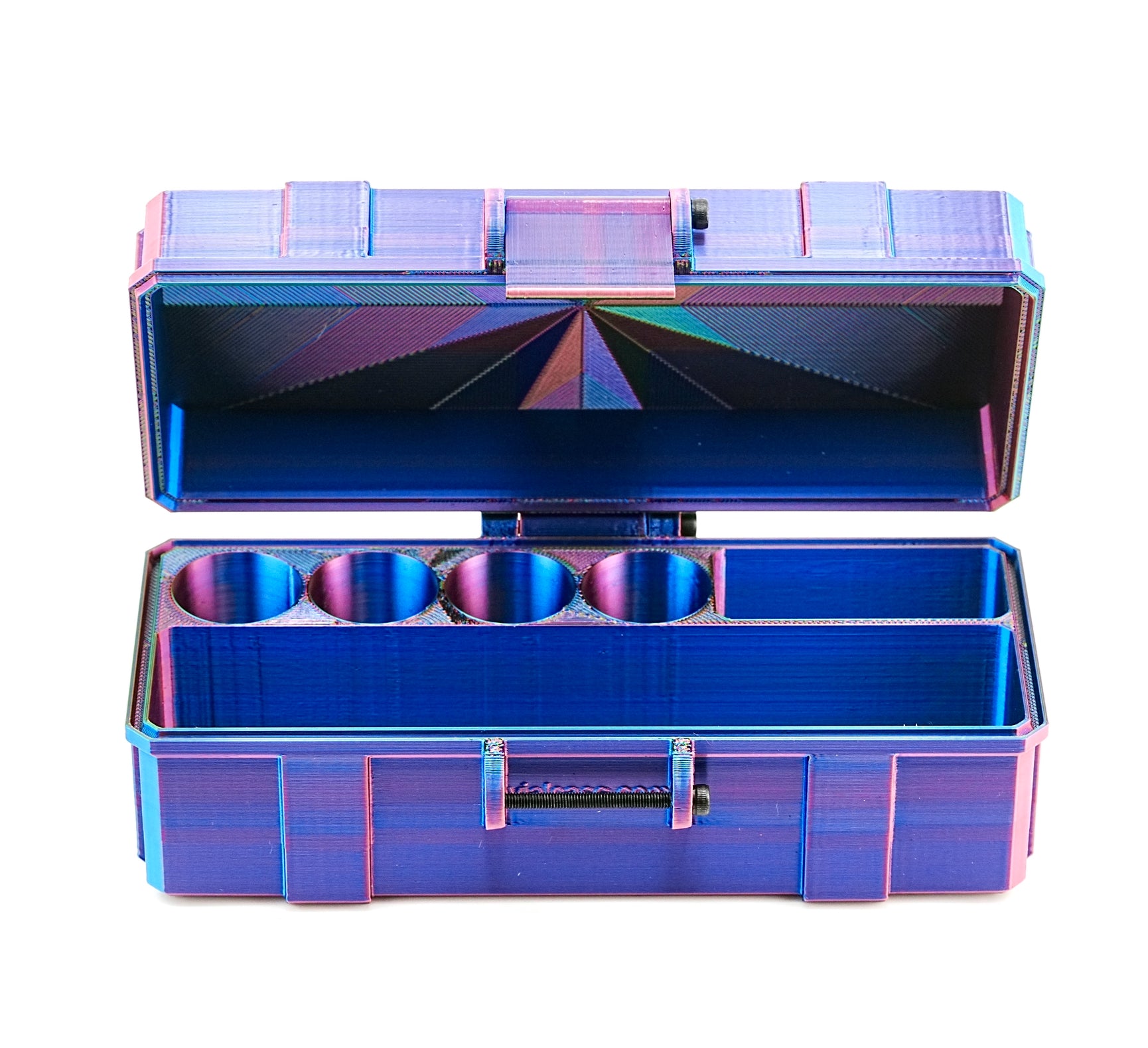
The Best Peptide Travel Cases in 2026 — Ranked
Rank 5: Soft Neoprene Insulin Travel Pouches
Why it fails: These pouches are designed for insulin pens and prefilled syringes, not loose glass vials. The interior organization doesn't secure 3ml or 10ml vials upright — they end up horizontal, rattling against the neoprene. Neoprene itself provides zero UV blocking (it's translucent to light at the wavelengths that damage peptides) and zero hard-shell protection. A bag compression event or a drop will almost certainly result in broken glass. The insulation gives a false sense of temperature security — without an active cold source, the pouch simply traps ambient heat. Avoid entirely for peptide travel.
Rank 4: Generic Hard-Shell Makeup Cases
Why it falls short: These rank above neoprene pouches because at least the shell is rigid. But the interior organization is built around cosmetic products — flat trays, dividers for irregular shapes, nothing sized for cylindrical vials. A 3ml vial laid in a makeup case tray has no lateral support and will chip against adjacent vials during transit. Many makeup cases also have mirrored or translucent lids that allow UV penetration. They're better than nothing for short-duration travel where you're moving one or two vials carefully by hand, but they're not a real peptide case and shouldn't be treated as one.
Rank 3: VialCase 10-Slot Compact ($13.99)
The VialCase 10-Slot Compact at $13.99 earns its spot for travelers who are carrying one or two vials on a short trip. The footprint is genuinely small — it fits in the outer pocket of a carry-on, a coat pocket, or a purse without bulk. The ten precision-molded 3ml slots give you capacity for current vials plus a couple of extras. Hard shell, opaque, positive-click latch — all the fundamentals are there.
Where it ranks third rather than first for travel: no integrated syringe storage, no space for alcohol wipes, and the compact size means no room for a cold pack alongside the vials. For a same-day or overnight trip where you're carrying one or two vials and your syringes are in a separate case, this is a clean, lightweight option. For anything longer or more complex, move up the list.
Rank 2: VialCase 12-Slot All-in-One ($36.99)
The VialCase 12-Slot All-in-One at $36.99 is the best choice for travelers running a standard multi-peptide protocol. Twelve vial slots cover most stacks with room to spare. Integrated syringe storage and an alcohol pad compartment mean the entire injection kit travels in one container. Open the case, do the injection, close it — no secondary pouches, no loose accessories, no digging through a bag.
For TSA presentation, this case is ideal. Everything is organized and visible in seconds. The hard shell protects against overhead bin compression and drops. The positive-click latch stays closed under bag pressure. At $36.99, it's the best balance of capacity, organization, and travel-specific design in the lineup. It ranks second rather than first only because the 20-slot case offers better capacity-to-size ratio for travelers running larger stacks.
Rank 1: VialCase 20-Slot with Syringe Storage ($25.59)
For multi-compound travelers, the VialCase 20-Slot with Syringe Storage at $25.59 is the top pick. Twenty vial slots handles even complex stacks — eight or more active compounds plus backup vials plus BAC water — in a single organized container. The syringe compartment runs alongside the vial section, fully integrated. At $25.59 for this capacity, the value-per-slot is unmatched in the lineup.
What makes it the #1 travel pick specifically: the larger capacity means you're not splitting your protocol across multiple cases during a trip, which is the single most common organizational failure point for traveling peptide users. One case, everything in it, one thing to track, one thing to pull for TSA inspection. The hard shell, opaque walls, and positive-click latch are present at the same build quality as the rest of the lineup. If you're traveling with more than four or five vials, this is the case.
Pro Tip: Always carry peptides in your carry-on luggage, never in checked bags. Aircraft cargo holds are not temperature-controlled — they routinely reach -40°C at cruise altitude and +50°C on hot tarmac during ground delays. Even lyophilized peptides can be damaged by freeze-thaw cycling at these extremes, and reconstituted solutions are destroyed. Checked baggage is not an option for any peptide you care about.
Hotel Storage: What to Do When You Arrive
Getting your peptides safely to the destination is half the battle. The second half is storing them correctly in a hotel room.
The mini-fridge is your first choice — but verify the temperature before trusting it. Hotel mini-fridges vary wildly in their set temperature. Some run at a correct 2-8°C; others run as cold as 0-1°C (risk of freezing reconstituted peptides) or as warm as 12-15°C (risk of degradation). Use a small clip thermometer placed in the fridge before you store your vials. Give it 30 minutes to equilibrate and check the reading. If it's out of range, adjust the dial or use your cold packs as the primary cold source with the fridge as a secondary buffer.
If there's no mini-fridge, your gel packs become the primary cold source. A pre-chilled case with a fresh gel pack maintains adequate temperature for 6-8 hours in most hotel room conditions. For longer stays without refrigeration, request a fridge from the hotel (most business hotels will provide one for medical needs at no charge), or use the hotel bar's ice machine to refresh your cold packs.
Never leave vials near a window. UV exposure from sunlight — even indirect ambient light — degrades photosensitive peptides. A windowsill or desk near a window is one of the worst storage locations in a hotel room. Keep your case closed, stored in the fridge or in the coolest shaded part of the room, away from any light source.
Don't rely on the bathroom counter. Bathrooms heat up significantly during use — showers, steam, hair dryers. A bathroom counter can reach 30-35°C during a shower cycle, which is damaging to any reconstituted peptide left out. Set up your injection kit for the dose, then return the vials to the fridge immediately.
International Travel: Customs Rules for Peptides
Crossing international borders with peptides introduces variables that domestic travel doesn't have. The legal status of research peptides varies by country — some are uncontrolled, some require a prescription, some are outright prohibited. The rules for importing GLP-1 medications differ from research peptides, and customs enforcement varies by country, border agent, and volume.
The core principles that apply in most jurisdictions: personal use quantities (typically a 90-day supply or less) are treated far more leniently than commercial quantities. Declaration is always safer than non-declaration — undeclared items that are found create legal risk that declared items don't. Having documentation of medical use (a prescription, a doctor's letter, clinic records) significantly reduces complications at customs, even when it's not technically required.
For a full breakdown of country-specific rules, declaration procedures, and what to say at customs, see our international peptide travel guide. The short version: research it for your specific destination before you pack, bring documentation, declare when in doubt, and carry personal-use quantities only.
Road Trip vs. Air Travel: Different Risks, Different Setups
Road trips and flights create distinct sets of storage challenges. Understanding which risks apply to your trip type helps you pack appropriately.
Air Travel Risks
The primary risks on a flight are temperature excursion (especially during long flights or connections), physical damage during overhead bin loading, and TSA complications. The solutions: carry-on only, cold pack in your case, positive-click latch, organized presentation. The 12-Slot All-in-One or 20-Slot handles all of this.
Road Trip Risks
On a road trip, the risks are different. Temperature is the dominant concern — a car parked in the sun on a summer day reaches internal temperatures of 60-80°C within minutes. Peptides left in a glove compartment or back seat during a rest stop are being destroyed. Physical damage from road vibration is a secondary but real concern — vials that rattle for hours in an unsecured container develop micro-fractures in the glass that aren't visible but compromise sterility.
For road trips, the priority is keeping your case in the climate-controlled cabin (never the trunk), using a cooler or insulated bag as the primary thermal barrier for long drives, and ensuring your case is secured rather than loose on a seat. The 20-Slot with Syringe Storage fits neatly into most soft-sided coolers. Pre-chill the cooler with a frozen gel pack for 30 minutes before loading your vials.
For short day-trip drives (under two hours, mild weather), your hard-shell case in the passenger cabin is sufficient without active cooling. For anything longer or in hot weather, treat it like a medical cold chain — because it is one.
The Bottom Line: What Case to Buy for Your Trip Type
Here's the fast decision guide:
- Weekend trip, 1-2 vials: VialCase 10-Slot Compact ($13.99) — lightweight, fits in a carry-on pocket, handles small protocols cleanly
- Standard multi-peptide travel, 3-8 vials: VialCase 12-Slot All-in-One ($36.99) — syringes, alcohol pads, and vials in one hard-shell container, best TSA presentation
- Large stack travel, 8+ vials: VialCase 20-Slot with Syringe Storage ($25.59) — best capacity-to-size ratio, single case for a complete protocol
- GLP-1 travel with 10ml vials: VialCase 13-Slot 10ml ($49.99) — sized for 10ml vials specifically, correct fit prevents rattling and breakage
- Soft neoprene pouches / generic makeup cases: Don't use them for peptides. They fail on UV blocking, slot precision, and physical protection simultaneously.
Browse the full lineup at VialCase.com. If you're unsure which case fits your specific protocol, start with the complete peptide case guide which breaks down the decision by stack size and vial format in full detail.
For a complete pre-travel checklist — from packing your case to TSA presentation to hotel setup — see the Peptide Travel Checklist.
Disclaimer: This article is for informational and educational purposes only. PeptideCase does not sell peptides or any pharmaceutical compounds. Product links are to storage and organizational equipment only. TSA and customs rules referenced in this article are based on publicly available information and may change. Nothing in this article constitutes legal or medical advice. Verify current regulations with the relevant authorities before traveling.