Why Vial Size Matters
Walk into any peptide community forum and you'll see the same question pop up every week: "I just got my peptides and they don't fit in my case." The problem is almost always a vial size mismatch. Peptide vials come in two standard sizes — 3ml and 10ml — and they are not interchangeable when it comes to storage cases. A slot machined for a 3ml vial will be too narrow for a 10ml vial, and a 10ml slot will leave a 3ml vial rattling around loose.
Before you buy a case, you need to know exactly what's in your collection. Here's the breakdown.
The 3ml Vial: The Research Peptide Standard
The 3ml vial (sometimes listed as 2ml or 3cc) is the standard container for most lyophilized research peptides. These are the small, slim vials with a rubber stopper and aluminum crimp cap. If you've ever ordered from a research peptide supplier, this is what arrived in the mail.
Peptides that typically come in 3ml vials:
- BPC-157 — the most popular healing peptide, almost always in 3ml
- TB-500 (Thymosin Beta-4) — commonly paired with BPC-157 for recovery
- CJC-1295 — growth hormone releasing hormone, standard 3ml
- Ipamorelin — growth hormone secretagogue
- PT-141 (Bremelanotide) — typically sold in 3ml vials
- DSIP, Epithalon, Selank, Semax — research peptides, all 3ml
The 3ml vial is approximately 16mm in diameter and 35mm tall (not counting the stopper). They're small, fragile, and easy to lose in a drawer — which is exactly why dedicated storage matters.
The 10ml Vial: BAC Water, GLP-1, and Compounded Peptides
The 10ml vial is the larger format, roughly 23mm in diameter and 50mm tall. You'll encounter 10ml vials in several contexts:
- Bacteriostatic water (BAC water) — the solvent used to reconstitute lyophilized peptides, almost always sold in 10ml or 30ml vials
- GLP-1 agonists — some compounded Tirzepatide and Semaglutide comes in 10ml multi-dose vials
- Compounded peptides from pharmacies — compounding pharmacies often use 10ml vials for multi-dose preparations
- Mexican pharmacy peptides — farmacias in Mexico frequently dispense compounded peptides in 10ml vials (more on this below)
Pro Tip: Even if all your peptides are in 3ml vials, you almost certainly have at least one 10ml vial of BAC water. Make sure your storage system accommodates both sizes.
Mexican Pharmacy Vials: What to Expect
If you're buying peptides from pharmacies in Mexico — a practice that has grown significantly as Americans cross the border for more affordable compounds — you'll encounter a different vial landscape than US-based research suppliers.
Mexican farmacias and compounding pharmacies typically use 10ml vials for compounded peptides like Tirzepatide, Semaglutide, and BPC-157 blends. These are multi-dose vials meant to last several weeks. Research-grade peptides from Mexican labs may still come in 3ml vials, but compounded formulations are almost always 10ml.
This matters for two reasons:
- Case sizing — if you're importing from Mexico, you likely need a case with 10ml slots (or a mixed case)
- Travel protection — driving or flying back across the border with glass vials demands crush-resistant storage. A hard-shell case prevents breakage in luggage and provides a professional appearance at customs.
Read our complete guide to flying with peptides for TSA and customs tips.
Mixed Collections: Why Most People Need Both Sizes
In practice, very few people run a protocol that's exclusively one vial size. A typical collection might include:
- 3-4 vials of BPC-157 (3ml) — active and backup
- 2 vials of TB-500 (3ml)
- 1 vial of CJC-1295/Ipamorelin blend (3ml)
- 2 vials of BAC water (10ml)
- 1 vial of compounded Tirzepatide (10ml)
That's 6 vials at 3ml and 3 vials at 10ml. A case designed for only one size won't work. You need either a mixed-size case or two dedicated cases.
How Vial Size Affects Your Case Choice
When shopping for a peptide storage case, match the case to your collection:
- All 3ml vials (research peptides only) — a dedicated 3ml case gives you the tightest fit and most capacity per square inch
- All 10ml vials (compounded/pharmacy) — look for a 10ml-specific case or one with wider bore slots
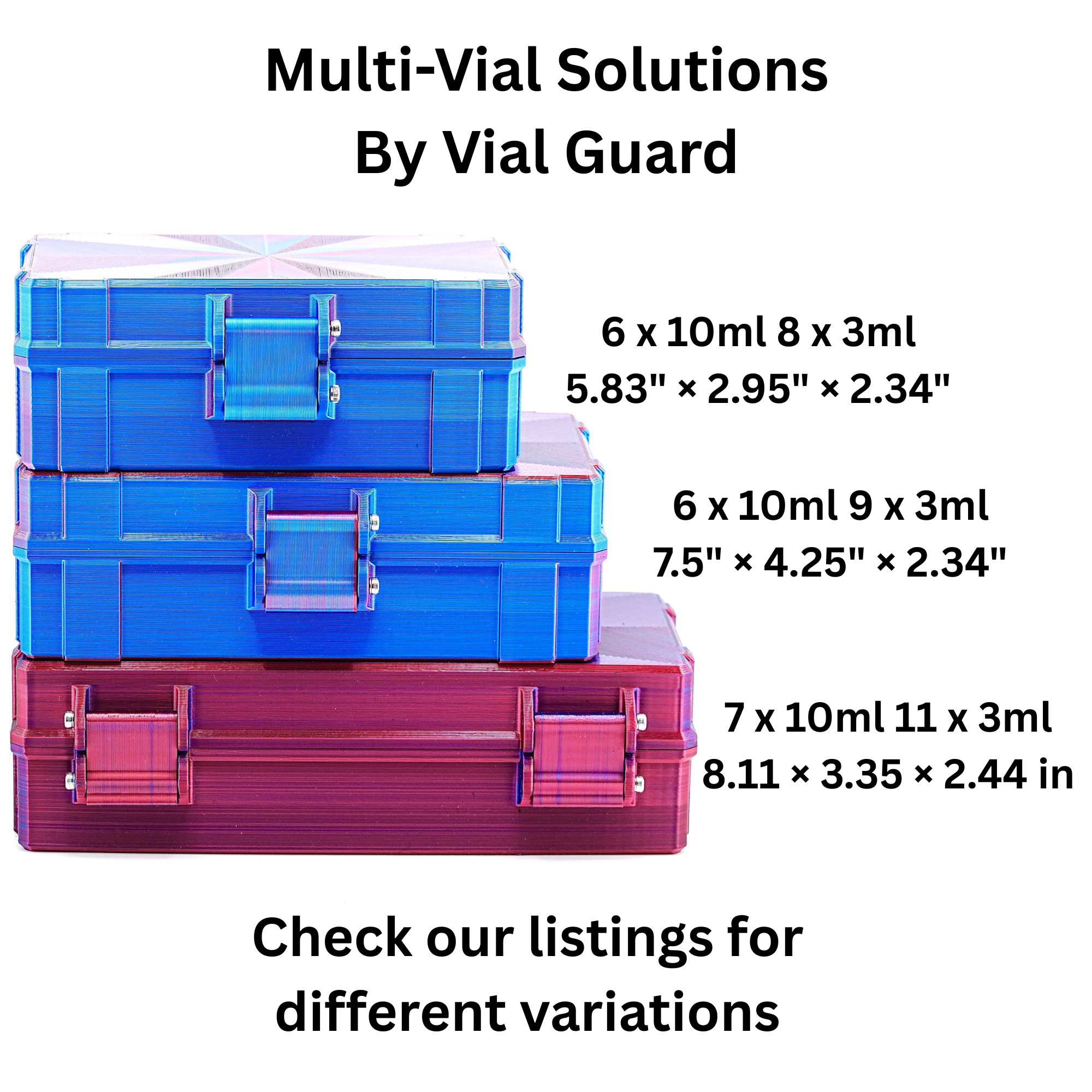
- Mixed collection — the most common scenario. Cases like the Vial Vault Pro 56 offer zones for both sizes
- Bulk buyers importing from Mexico — if you're bringing back 10-20+ vials at a time, consider a larger capacity case (50-100 slot) with a travel-grade shell
Pro Tip: Measure your vials before ordering a case. Grab calipers or a ruler and check the outer diameter. 3ml vials are typically 15-17mm, while 10ml vials run 22-24mm. Some "3ml" vials from overseas suppliers are slightly wider than domestic ones.
Buying the Right Case for Your Protocol
Here's a simple decision tree:
- Count your vials by size — how many 3ml? How many 10ml?
- Plan for growth — if you're adding a GLP-1 or importing from Mexico, account for 10ml vials
- Consider travel — if you fly or cross the border, prioritize hard-shell crush resistance
- Check the slot dimensions — our product pages list exact vial compatibility
Most users find that a mid-range case with 10-20 slots in mixed sizes hits the sweet spot. Power users running stacks of 5+ peptides, or those buying in bulk from Mexico, should look at the Vial Vault Pro 56 or larger capacity options.
Still not sure? Our Peptide Storage Guide walks through the full decision process from temperature to organization to travel.