What Is a Peptide Case?
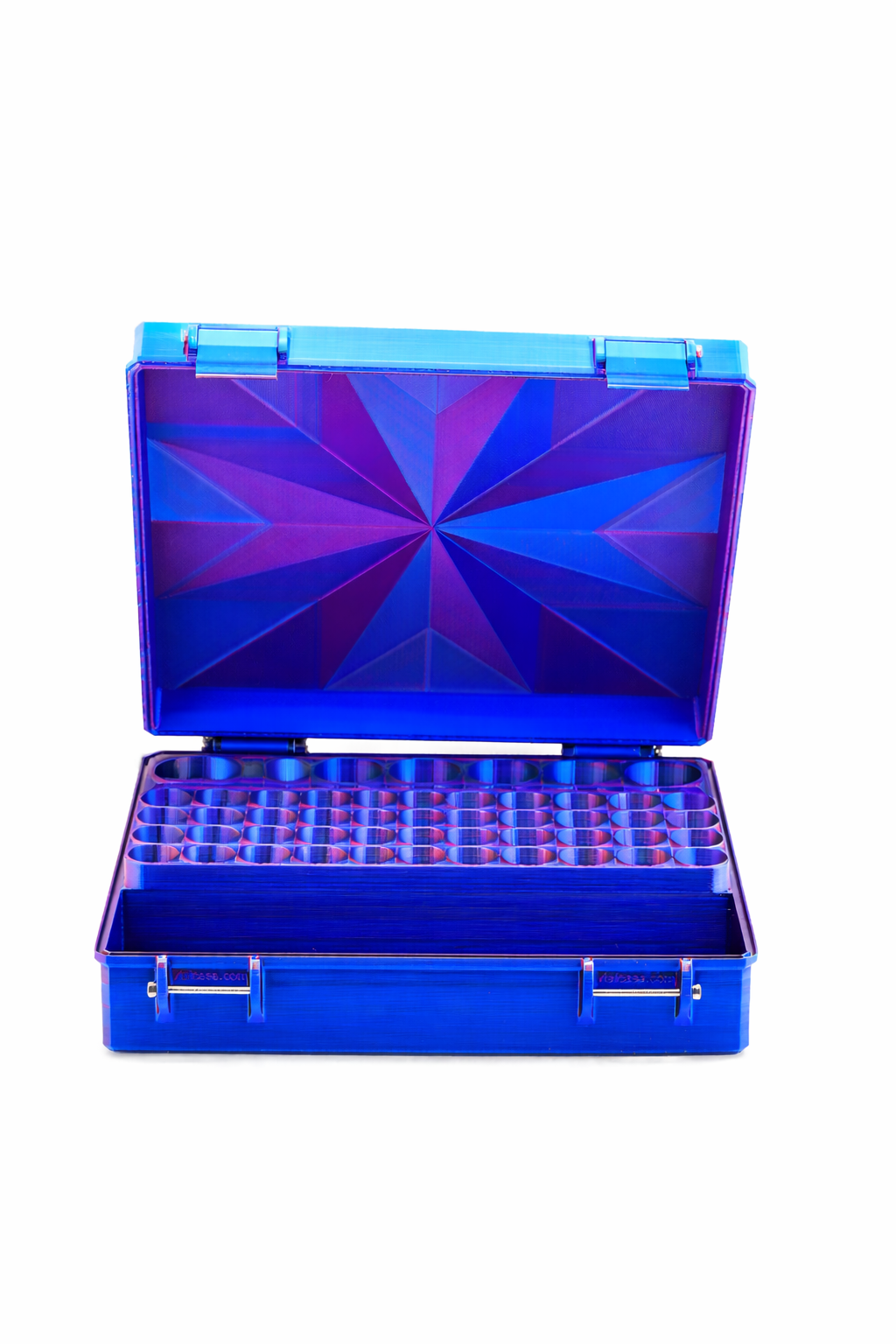
A peptide case is a purpose-built storage solution for peptide vials — the small glass bottles that hold reconstituted or lyophilized (freeze-dried) peptide compounds. Unlike a generic medication case or a foam-lined hobby box, a proper peptide case is engineered specifically for the dimensions, fragility, and storage requirements of 3ml and 10ml borosilicate glass vials.
The distinction matters because peptides are not forgiving. They degrade from heat, light, physical shock, and humidity. A compound that cost you $80-150 can be rendered useless within days if it's stored carelessly. That's not a hypothetical risk — it's a documented reality that experienced users learn about the hard way.
Peptide cases solve four problems simultaneously. They block ambient light that causes photodegradation. They provide a cushioned, form-fitted environment that prevents vial-to-vial contact and breakage. They maintain a stable microclimate that buffers against temperature swings during transit. And they organize multiple compounds in a way that eliminates dosing errors — which, with potent compounds like BPC-157, CJC-1295, or semaglutide, is not a minor concern.
If you're running any peptide protocol — from a simple GLP-1 cycle to a full looksmaxxing stack of five or six compounds — a dedicated peptide case isn't optional. It's the foundation of a responsible protocol.
The 5 Non-Negotiables for Any Peptide Case
Not every product marketed as a "peptide case" meets the minimum standard. These five features are non-negotiable — if a case fails on any one of them, move on.
1. Hard Shell Construction
Glass vials do not survive soft-case compression. A neoprene pouch or fabric roll-up bag offers zero crush resistance. One heavy book placed on top of a soft case, one squish in an overhead bin, one dropped gym bag — and you're cleaning up broken glass and losing compounds worth hundreds of dollars. A rigid hard-shell case absorbs impact and distributes force away from the vials. There is no substitute.
2. Fully Opaque Design
Peptides are light-sensitive. Ultraviolet and even ambient visible light causes molecular degradation in many peptide compounds, including BPC-157, TB-500, Melanotan II, and GHK-Cu. A clear or translucent case, regardless of how well it fits your vials, is not a peptide case — it's a display case. Your peptide case must block 100% of light when closed. Opaque ABS or polypropylene shell, no windows, no mesh panels.
3. Precision-Machined Slot Dimensions
Vials that rattle have already lost. A 3ml peptide vial is approximately 10mm in diameter and 40-45mm tall. A 10ml vial runs closer to 22mm in diameter and 50-55mm tall. Slots designed for these specific dimensions keep each vial upright, separated, and immobile. Generic foam with cut-outs that are even 5mm too wide allows enough lateral movement to chip stoppers, stress glass necks, and crack seals over hundreds of miles of vibration.
4. Temperature Stability
Your peptide case will go in the fridge. It may go in the freezer. The materials must tolerate -20°C without warping, cracking, or losing their structural integrity. ABS plastic handles this well. Some EVA foam cases work but become brittle at freezer temperatures over time. Soft cases with adhesive-bonded layers can delaminate. Confirm the case is rated for cold storage before committing.
5. Secure, Positive-Click Closure
A case that opens under pressure is a liability. Whether it's in a checked bag, a backpack, or a lab coat pocket, the closure must hold under direct force. Look for magnetic latches with a secondary mechanical catch, or snap closures rated for repeated open-close cycles. Zippers fail at stress points. Velcro degrades with cold and humidity. A purpose-built peptide case uses a mechanical latch, period.
3ml vs. 10ml Cases: Which Do You Need?
This is the first branching decision every buyer faces, and getting it wrong means buying twice.
The vast majority of peptide compounds come in 3ml vials. BPC-157, TB-500, CJC-1295, Ipamorelin, Sermorelin, GHK-Cu, Epithalon, PT-141, AOD-9604, and most research peptides are reconstituted and stored in 3ml borosilicate vials. If your protocol includes any combination of these, you need a 3ml peptide case.
The 10ml vial is primarily the territory of GLP-1 compounds — semaglutide, tirzepatide, and retatrutide — which are often dispensed in larger volume vials due to their dosing requirements. Compounded versions typically come in 2-3ml vials, but pharmaceutical-grade and multi-dose preparations frequently use 10ml formats. If you're running a GLP-1 protocol, confirm your vial size before buying.
For most users, a 3ml peptide case covers 80-90% of use cases. The VialCase 12-Slot All-in-One ($36.99) is the benchmark for 3ml storage: hard shell, 12 precision slots, integrated syringe compartment, and alcohol pad storage. If your protocol is entirely GLP-1-based with 10ml vials, the VialCase 13-Slot 10ml ($49.99) is purpose-built for that format.
If you run a mixed protocol — say, a GLP-1 in a 10ml vial alongside BPC-157 in a 3ml vial — you have two options: buy a case for each format, or look for a multi-format case with zones for both sizes. Either approach works; the key is not forcing a 3ml vial into a 10ml slot or vice versa.
How Many Slots Do You Actually Need?
Slot count is where most buyers underestimate. The instinct is to buy for your current protocol. The reality is that peptide collections grow, and buying again in six months costs more than buying right the first time.
Single Compound: 4-10 Slots
If you're running one peptide — one active vial and one or two backups, plus a vial of BAC water for reconstitution — a 4-10 slot case covers you cleanly. The VialCase 10-Slot Compact ($13.99) is the right entry point here. It's a hard-shell case at a price that makes sense for someone testing their first peptide protocol. Fits a gym bag, a desk drawer, or a mini fridge shelf without taking up meaningful space.
Dual or Triple Compound Stack: 10-20 Slots
Running BPC-157 and TB-500 together? Adding a GLP-1 to the mix? You need room for multiple active vials, their corresponding BAC water, and backup vials for each compound. A 10-slot case fills up fast. The VialCase 10-Slot with Extra Storage ($29.99) is the upgrade here — it adds a dedicated compartment for syringes and BAC water that keeps the vial slots available for compounds only.
Full Stack (4+ Compounds): 20+ Slots
A serious looksmaxxing protocol or a comprehensive performance stack running four to six compounds simultaneously requires a minimum of 20 slots. Account for: one active vial per compound, one backup per compound, one or two BAC water vials, and a slot buffer for incoming vials before empty ones are disposed of. The VialCase 20-Slot with Syringe ($25.59) handles this cleanly, with integrated syringe storage that eliminates the need for a secondary case.
Pro Tip: The case that fits your protocol perfectly is the one you actually use consistently. Underbuy on slots and you'll leave vials loose in the fridge. Overbuy and you'll never travel with it. Match the case to your actual rotation, not your theoretical maximum collection.
Material Matters: Why Hard Shell Wins
The peptide case market, if you shop broadly, includes three material categories. They are not equal.
ABS Hard Shell
Acrylonitrile butadiene styrene is the gold standard for peptide cases. It's impact-resistant, maintains rigidity at freezer temperatures (-20°C), is fully opaque, and can be precision-molded into exact vial slot dimensions. ABS is what's used in quality electronics housings, medical device casings, and professional transport cases. It does not flex meaningfully under moderate compressive force, which means your vials are protected even if weight is stacked on top of the closed case. For peptide storage, ABS hard shell is the correct material.
EVA Foam Shell
Ethylene-vinyl acetate foam cases occupy a middle ground. They offer more rigidity than fabric and some compressive resistance, but they are not truly hard-shell. EVA compresses under sustained load — enough to transmit force to glass vials in a full-contact case. At freezer temperatures, EVA hardens and can crack along fold lines over repeated thermal cycling. EVA cases can work for gentle home storage, but they are not appropriate for travel or any situation where external forces may be applied to the case.
Cardboard and Fabric Alternatives
Many people, especially when starting out, use cardboard pharmaceutical boxes, repurposed jewelry pouches, or Ziploc bags. This is not storage — it's gambling. Cardboard absorbs moisture, provides zero crush resistance, and collapses under any weight. Ziploc bags offer no protection from light, impact, or physical shock. A single dropped bag can wipe out a month of compounds in an instant. The cost of proper peptide cases is a fraction of the cost of the compounds inside them. There is no economic case for improvised storage.
Travel vs. Home Storage Cases
The requirements diverge significantly depending on where your peptide case spends most of its time.
Home Storage Cases
Home storage prioritizes capacity, organization, and compatibility with refrigerator and freezer environments. Size and portability matter less. You want maximum slot count, clear internal organization that lets you identify compounds at a glance, and materials that cycle between fridge and counter temperature without deteriorating. Larger multi-zone cases that wouldn't fit in a carry-on are perfectly appropriate here.
Travel Cases for Flights and Commuting
Travel changes the calculus entirely. When you're traveling with peptides, your case faces physical forces that home storage never encounters: overhead bin compression, TSA screening, baggage handling if you're forced to check, road vibration on drives, and the general mechanical stress of being moved repeatedly. A travel peptide case needs to be compact enough for carry-on use, rigid enough to survive compression, and organized enough to pass TSA screening without triggering a secondary inspection. An organized, labeled, purpose-built peptide case looks like a medical device. A bag of loose vials with exposed syringes looks like a problem. The case itself is part of your TSA strategy.
For travel, the form factor matters as much as the slot count. A case that holds 12-20 vials securely in a package the size of a hardcover book is the target. The VialCase 12-Slot All-in-One hits this exactly — it travels without issue and has enough capacity for most protocols. See our full best peptide travel case guide for the complete breakdown.
What to Look For in a Peptide Case: Full Checklist
Run every case you're considering against this list before purchasing. A case that fails two or more of these items is not worth buying at any price.
- Hard-shell construction — ABS or equivalent rigid polymer; no meaningful flex under manual compression
- Full opacity — 100% light blocking when closed; no translucent panels or mesh windows
- Precision vial slots — machined or molded to fit 3ml or 10ml vials specifically, not generic foam cutouts
- Vials held upright — slots keep vials vertical, not horizontal or at an angle
- Vial-to-vial separation — each vial is isolated; no shared foam that allows contact between adjacent vials
- Freezer-rated materials — rated for -20°C without cracking, warping, or losing slot integrity
- Mechanical latch closure — positive-click latch that won't open under compressive force; not Velcro, not zipper alone
- Appropriate slot count for your protocol — current compounds plus backup vials plus growth buffer
- Integrated syringe/accessory storage — at minimum, a compartment for syringes and alcohol pads
- Portable form factor — if you travel, the case must fit in a standard carry-on or backpack without requiring reorganization
Top Peptide Cases to Buy in 2026
Based on material quality, vial fit precision, capacity, and value, here are the peptide cases worth buying in 2026 — all from VialCase, which makes the only purpose-built peptide case line that passes every item on the checklist above.
Budget Pick: 10-Slot Compact — $13.99
The 10-Slot Compact is the entry point for serious storage at a price that removes any hesitation. Ten precision 3ml slots in a hard-shell ABS case. Fully opaque. Secure latch. Fridge and freezer compatible. It won't hold a complex multi-compound stack, but for a single peptide protocol with backup vials and BAC water, it's exactly what's needed. Best for: beginners, single-compound users, gym bag carry.
Step-Up: 10-Slot with Extra Storage — $29.99
The 10-Slot with Extra Storage adds a secondary compartment that changes what you can carry. Ten 3ml vial slots plus dedicated space for syringes, BAC water, and alcohol pads. This is the first case that fully eliminates the need for a secondary pouch or loose accessories. Hard shell, fully opaque, freezer-rated. Best for: dual-compound stacks, users who want everything in one organized case.
Best All-Around: 12-Slot All-in-One — $36.99
The 12-Slot All-in-One is the recommended default for most users. Twelve 3ml vial slots, integrated syringe storage, alcohol pad compartment, and hard-shell construction in a travel-ready form factor. The slot count covers most protocols with room for backup vials. The all-in-one layout means nothing is stored separately. Best for: multi-compound stacks, travel, anyone who wants the cleanest possible protocol organization.
GLP-1 Specialist: 13-Slot 10ml — $49.99
The 13-Slot 10ml is purpose-built for GLP-1 users running semaglutide, tirzepatide, or retatrutide in 10ml vials. Thirteen precision-fit 10ml slots in a hard-shell case with supplementary storage. At $49.99 it's the most expensive case in the lineup — and worth every dollar for someone whose protocol depends on correctly stored GLP-1 compounds. Best for: GLP-1 protocol runners, anyone who uses 10ml vials exclusively.
Pro Tip: The best peptide case isn't the most expensive one — it's the one that matches your actual slot count, fits your storage environment, and travels with you without friction. Buy the case you'll actually use, not the one that sounds most impressive. Consistency of use is what protects your compounds.
Frequently Asked Questions
Can I use any hard case for peptide storage?
Technically yes, but in practice, a generic hard case without vial-specific slots will allow lateral movement that chips stoppers and stresses glass. The slot precision of a purpose-built peptide case is not a luxury feature — it's functional protection. Generic hard cases also often have foam that is not rated for repeated freezer cycling.
How do I know if my peptide case is light-blocking enough?
Close the case in a dark room, then open it immediately and check if you can see any ambient light that leaked in. Better test: put your phone's flashlight against the outside of the closed case and check for any glow through the shell. A truly opaque peptide case shows nothing. Any light penetration means your compounds are at risk during daytime storage.
Should I store my peptide case in the fridge or freezer?
Reconstituted peptides (already mixed with BAC water) store at 2-8°C in the fridge for 4-8 weeks depending on the compound. Lyophilized (powder) peptides store at -20°C in the freezer for 12-24 months. Your peptide case goes wherever your vials go. Confirm the case's temperature rating covers your storage protocol. See our full peptide shelf life guide for compound-specific storage durations.
Do peptide cases come with syringes?
No — peptide cases are storage solutions, not kits. You source your own syringes (typically 29-31 gauge insulin syringes for subcutaneous injection). Cases like the VialCase All-in-One include dedicated syringe storage compartments, but the syringes themselves are purchased separately from a pharmacy or medical supplier.
Common Mistakes When Buying Peptide Cases
Avoid these errors that experienced users consistently report:
- Buying for current slot count only — protocols grow. Buy with a 30-50% buffer beyond your current vial count
- Choosing a soft case to save money — the first time a vial breaks, the cost difference disappears; hard shell is not optional
- Ignoring freezer compatibility — if you'll ever store lyophilized peptides long-term, your case must handle -20°C
- Buying a case without syringe storage — then carrying syringes in a separate pouch that gets lost or damaged
- Getting a case with vague slot dimensions — "fits vials" is not a specification; verify it fits your specific vial diameter and height
- Overlooking the closure mechanism — a magnetic-only closure on a travel case is not sufficient; look for mechanical latching
For a broader look at storage failures and how to prevent them, see our guide on the most common peptide storage mistakes.
The Bottom Line
Peptide cases exist on a spectrum from barely-adequate to purpose-built. The difference between them is measured in compound degradation, broken vials, and dosing errors — all of which are preventable with the right case.
For most users, the VialCase 12-Slot All-in-One at $36.99 is the right answer. It covers the typical multi-compound protocol, travels cleanly, organizes syringes and alcohol pads in the same case, and is built from materials that handle freezer cycling without degradation. If you're just starting out with a single compound, the 10-Slot Compact at $13.99 gets you into a real hard-shell case without the cost of the full lineup.
What you should not do is improvise. Every dollar of peptide compound you purchase assumes you have a storage solution that preserves it. A proper peptide case is the cheapest insurance your protocol has.
Disclaimer: This guide is for informational purposes only and does not constitute medical advice. Peptide compounds referenced throughout this article may be subject to regulatory restrictions depending on your jurisdiction. Always consult a licensed healthcare provider before beginning any peptide protocol. PeptideCase sells storage equipment only and does not sell, endorse, or facilitate the purchase of any pharmaceutical or research compound.