What "Peptide Carrying Case" Actually Means
When people search for a "peptide carrying case" or "peptide bag," they usually mean the same thing: something to take their vials with them when they leave the house. But there are two fundamentally different use cases embedded in that one phrase, and confusing them leads to buying the wrong product.
Home storage cases live in your fridge or on a dedicated shelf. They prioritize capacity and organization — how many vials can I store, how well organized is my protocol. They don't need to be portable. They can be larger, heavier, and optimized for static storage rather than daily carry.
Carry and transport cases travel with you. They need to fit inside a bag, withstand movement, protect vials during transit, and be functional in environments outside your home. The priorities are completely different: compact form factor, secure closure that won't pop open during transit, structural protection against impacts, and in many cases, some degree of temperature buffering for reconstituted peptides.
This guide is about the second category — the case you actually carry. And the first thing to understand is that most of what's marketed as a "peptide bag" doesn't meet the requirements of actual carry and transport.
The Problem with Generic "Bags" for Peptides
Type "peptide bag" into any search engine and you'll land on soft-sided options: lunch bags, small soft coolers, neoprene diabetic supply pouches, cosmetic organizers. They're inexpensive, they come in many sizes, and they fail at the core job in similar ways.
No vial-specific slots. A lunch bag has one open compartment. A soft cooler has one insulated pouch. Neither has dedicated positions for individual vials. The result: vials roll around, contact each other, and chip or crack at the rubber stopper. This is how vials break — not from single dramatic drops, but from constant low-level contact during transit. A 20-minute walk from your car to your office with vials loose in a soft bag creates dozens of glass-on-glass impact events. Eventually one of them wins.
Light bleeds through. Soft bags are usually fabric, mesh, or thin neoprene. All of these transmit ambient light. Peptides like BPC-157, TB-500, GHK-Cu, and most GH peptides are photosensitive — sustained light exposure during daily carry adds up over a cycle and accelerates degradation. An opaque hard shell blocks this completely; a neoprene pouch does not.
No structural protection. Set a soft bag down on a hard surface, and the contents absorb the impact directly. Put it at the bottom of a backpack with a laptop on top, and the vials bear the compression. Soft materials have no compressive resistance — they conform to pressure rather than redistributing it. A hard shell deflects and absorbs impacts before they reach the vials inside.
Closures that fail in transit. Zipper pouches open. Velcro closures catch on everything and lose grip over time. A case with a positive-latch closure — one that requires deliberate action to open — stays shut when it's supposed to and opens only when you want it to.
What a True Peptide Carrying Case Must Have
Before reviewing specific products, it helps to define the minimum requirements for a case that's actually suited for carry and transit:
- Hard outer shell. ABS plastic or a rigid composite that won't compress under weight or deform on impact. The shell is what actually protects the glass.
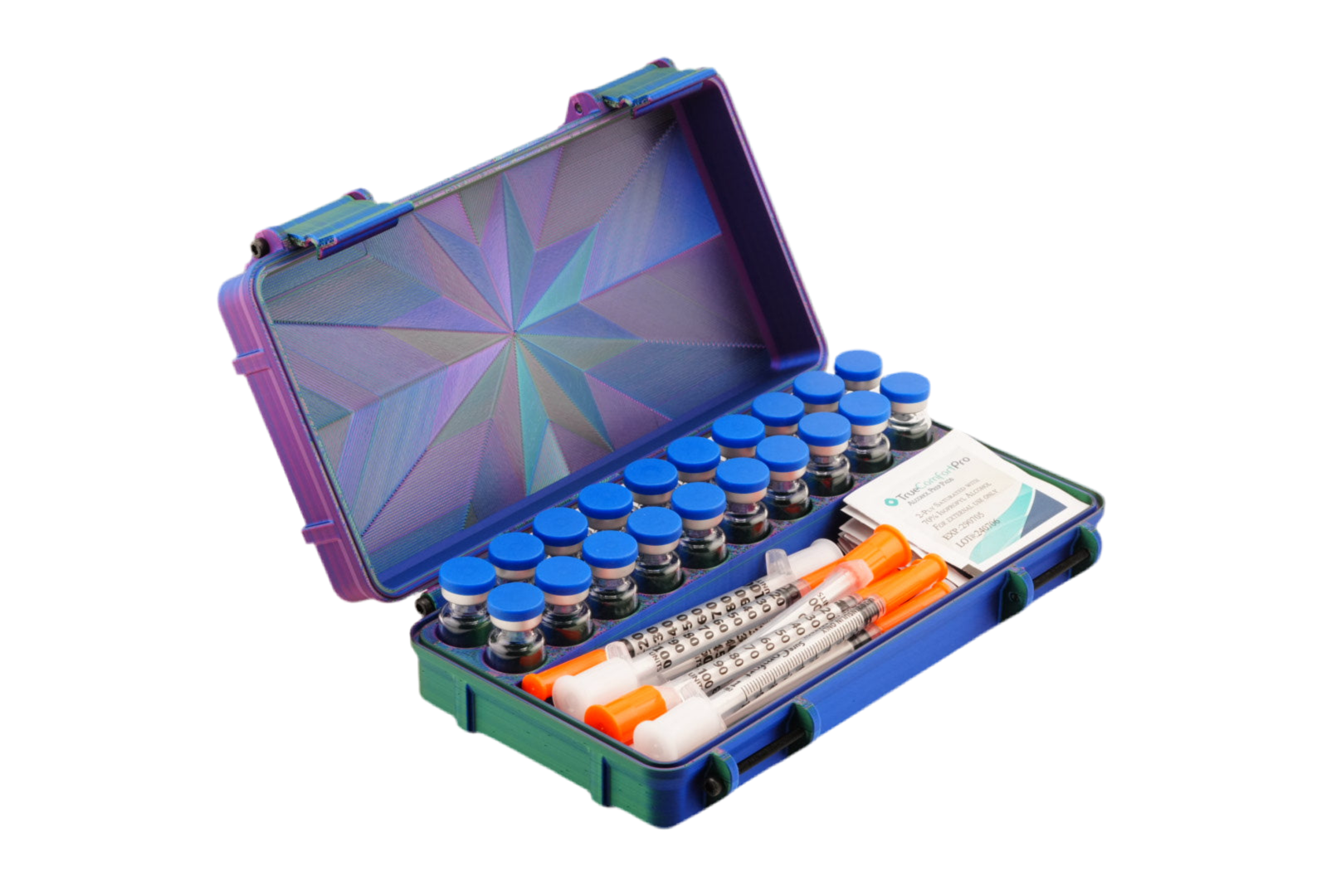
- Vial-specific molded slots. Each vial in its own position, held upright and separated from other vials. No loose movement, no glass-on-glass contact during normal carry.
- Secure latch or closure. Something that doesn't open accidentally. A case that pops open when bumped isn't protecting anything.
- Enough room for daily protocol supplies. At minimum: vials, syringes, alcohol prep pads, and a BAC water vial. Many protocols also need insulin pen needles or needle caps. A carry case that only holds vials forces you to juggle the rest separately.
- A footprint that fits inside your bag. If the case is too large to fit in your daily bag, you'll leave it at home. A carry case that doesn't get carried is useless. Compact form factor is a functional requirement, not an aesthetic preference.
Temperature management is addressed separately below — it's a real concern but the approach depends on how long you're out and what compounds you're carrying.
Bag vs. Case: The Real Difference
The word "bag" implies containment: something is inside it, not exposed. The word "case" implies protection: whatever is inside is protected from the environment, not just enclosed within it.
For peptide vials, containment isn't the goal. You don't need them held in one place while still exposed to light, impact, temperature, and pressure. You need them isolated from all of those things.
This is the structural difference between a bag and a case. A bag is passive — it holds things. A case is active — it protects things. A quality hard-shell peptide case interposes its own structural rigidity between the environment and the vials inside. When you bump into a door frame, the case shell takes the hit. When the bag shifts and compresses against a seat back, the shell redirects that force. When sunlight hits the outside of the case, it stops there.
For glass vials holding compounds that cost $50-$200 each and degrade from light, heat, and mechanical stress, the distinction matters. A bag is appropriate for transporting things that don't need active protection. Your peptides are not those things.
The 3 Most Common Carrying Mistakes
Mistake 1: Loose Vials in a Backpack Pocket
This is the most common one, especially among newer users who haven't lost a vial yet. You stick your two or three vials in the outer pocket of a backpack or gym bag, maybe wrap them in a shirt, and head out. It feels fine until it isn't.
The outer pockets of most bags have minimal padding and no rigid structure. Vials roll, contact each other, and make contact with zippers, keys, and other hard objects. Stoppers chip. Vials crack at the neck. And because you can't see what's happening inside a closed pocket, you don't know there's a problem until you find glass fragments and lost product.
The fix is immediate and inexpensive. A compact vial case with individual slots eliminates glass-on-glass contact entirely.
Mistake 2: Soft Neoprene Pouches
The appeal is understandable: neoprene feels protective, it's flexible, and many neoprene cases are designed specifically for insulin and diabetes supplies. Some even have elastic loops that look like they should hold vials.
The problem is that neoprene compresses. It's a foam material — it has give. That give is what makes it comfortable to hold, and it's also what makes it inadequate for vial protection. If you set a neoprene pouch down on a hard surface, the vials inside contact the hard surface through the compressed foam. If you put it at the bottom of a bag with weight on top, the neoprene doesn't hold the vials away from the pressure source — it becomes part of the pressure pathway.
Additionally, the elastic loops in many insulin pouches are sized for insulin pen cartridges, not 3ml or 10ml research vials. The fit is wrong, which allows movement within the loop — defeating the purpose of having slots at all.
Mistake 3: Oversized Cases You Can't Actually Carry
Some users buy the largest case available because they want capacity and room to grow. Then they discover a 12-slot hard-shell case doesn't fit in their gym bag, so they leave it home and go back to the zip-lock bag. An oversized case that stays on your dresser provides exactly zero protection for vials that leave the house.
Match your carry case to your carry situation. If you go to the gym, measure your gym bag before buying. If you commute with a specific bag or backpack, that's your constraint. The best carry case is the largest one that reliably fits in whatever you actually carry every day.
Pro Tip: If your case doesn't have dedicated slots for each vial, it's a bag with false confidence. One bad bump and loose vials crack against each other or against the case walls. The slot is what protects the vial — not the enclosure around it.
Best Peptide Carrying Cases for Daily Use
Here are the VialCase options matched to the most common daily carry scenarios. All feature hard shells, vial-specific molded slots, and secure closures.
1-2 Vials Daily: 10-Slot Compact ($13.99)
If you're running a single compound — one active vial plus a BAC water vial — the 10-Slot Compact at $13.99 is the most portable option in the lineup. It holds up to ten 3ml vials in individual molded slots and fits in a jacket pocket or the small front pocket of most gym bags.
For someone carrying just the vials they need for that day's injection plus a backup, this is the right size. It's light, unobtrusive, and won't add meaningful bulk to whatever bag you already carry. The hard shell is fully opaque, so light protection is complete. The closure stays shut during normal carry.
The limitation is supply storage — there's no built-in compartment for syringes or alcohol wipes. If you want those with you, you'll need to carry them separately or step up to the all-in-one.
Best for: Single-compound users, daily injection at the gym or office, anyone who wants to minimize what they carry
Full Protocol Carry: 12-Slot All-in-One ($36.99)
For users running a multi-compound protocol who need to bring everything they need to inject — vials, syringes, alcohol pads, BAC water — the 12-Slot All-in-One at $36.99 is the complete carry solution.
Twelve slots for 3ml vials, plus dedicated compartments for syringes, alcohol prep pads, and BAC water. Everything needed for a complete injection in one organized hard-shell case. The form factor is compact enough to fit in most everyday bags — not pocket-sized, but small enough to slot into the main compartment of a backpack or gym bag without issue.
The organization matters as much as the protection here. A complete injection kit in a single organized case means you don't need to think about what you're bringing — you pull the case and you have everything. This is particularly valuable for users injecting at specific times tied to workouts or sleep, where a missing supply means a missed dose.
Best for: Multi-peptide stacks, users who inject away from home regularly, anyone who wants a single case to hold their entire kit
Large Stack Daily Carry: 20-Slot ($25.59)
For users running five or more compounds who need to carry a substantial number of vials without stepping up to a full home-storage case, the 20-Slot case at $25.59 provides the capacity without going oversized.
Twenty individual slots for 3ml vials plus syringe storage covers even complex stacks — BPC-157, TB-500, CJC-1295/Ipamorelin, GHK-Cu, and a GLP-1 compound simultaneously, with room for backup vials. The form factor is larger than the compact options but remains manageable in a standard backpack or gym bag.
This is the right pick for users who've outgrown the 10-slot but don't need the full home-storage solution. It bridges daily carry and mid-range collection storage well.
Best for: 5+ compound stacks, users maintaining backup vials during carry, anyone between a starter case and a large storage solution
GLP-1 and 10ml Vials: 13-Slot 10ml Case ($49.99)
Users carrying semaglutide, tirzepatide, retatrutide, or other compounds in 10ml vials need a different form factor. The 13-Slot 10ml Case at $49.99 provides dedicated slots for the larger vial format that most 3ml cases can't properly accommodate.
Thirteen slots for 10ml vials plus a storage compartment for supplies. If you're managing a GLP-1 protocol alongside other peptides in 10ml format, this is the correct case for the size. Using a 3ml case for 10ml vials results in poor fit, inadequate slot hold, and higher risk of vial movement and contact during transit.
Best for: GLP-1 users, anyone carrying 10ml format peptide vials, users with mixed 10ml stacks
Temperature During Carry: How Long Can Peptides Stay Out?
This is a common source of anxiety that's worth addressing directly. The concern is real, but the math is more forgiving than most people expect.
Lyophilized (powder) peptides are stable at room temperature for days to weeks, depending on the compound. Carrying them in a case during a commute or gym session — even without refrigeration — is not a meaningful degradation event. The problem is sustained heat exposure over many hours, not 30-90 minutes at ambient temperature.
Reconstituted peptides are more temperature-sensitive. Most reconstituted peptides in BAC water are stable at room temperature for 4-8 hours — more than enough for a gym session, commute, or half-day away from your fridge. For a full-day carry, consider whether you actually need the reconstituted vials with you all day or whether you're better off injecting before you leave and carrying dry backups.
For longer carries — a full day of travel, a flight, a multi-stop day — a small gel pack inside the case adds meaningful temperature buffering. Gel packs, not ice. Ice creates condensation that can compromise rubber stoppers; properly-rated gel packs maintain 2-8°C for 4-8 hours without the moisture problem. Some VialCase models have interior geometry that accommodates a slim gel pack alongside the vial slots.
For the full temperature stability breakdown by compound and condition, see our peptide storage temperature chart.
Organizing Your Carrying Case
A carry case works best when it's organized the same way every time. Muscle memory in a multi-slot case means you can find the right vial quickly, even in low-light conditions or when you're fatigued after a workout. Random slot assignment means every use requires conscious thought and increases the chance of grabbing the wrong vial.
Three simple organizing principles for daily carry:
- Assign slots by compound, not by convenience. Pick a slot for BPC-157 and always use it. Pick a slot for BAC water and always use it. Consistency is the system. If you use colored vial caps, assign colors by compound and the visual key extends across all your cases — home storage and carry case use the same color code.
- Keep a rotation order. If you carry multiple vials of the same compound, track which one to use first. Label the oldest vial or position it in the front slot. This prevents the accidental use of a newer vial while an older one ages in the back of the case.
- Replenish after every use. After each injection session, restock the carry case back to full operational status. Replace used syringes, alcohol pads, and any supplies consumed. Check that all vials are capped properly and returned to their slots. An empty syringe compartment on injection day is a frustrating and avoidable problem.
For a more comprehensive guide to protocol organization across home and carry storage, see our peptide protocol organization guide.
When to Upgrade Your Carrying Case
Most people know their current carrying solution isn't adequate — they've just normalized the workaround. Here are the clear signs it's time to upgrade:
- You've had a vial break or chip in transit. This is the clearest signal. One broken vial pays for a quality case many times over at current peptide prices.
- You're using a Ziploc bag, a sock, or a shirt to wrap vials. These are improvised solutions that don't solve the problem — they just make you feel better about it. The vials still move, still contact each other, and still lack light protection.
- You leave your vials at home because carrying them feels like too much trouble. This usually means your current case is too large to carry comfortably, or you're carrying supplies in multiple different bags and it's not worth the hassle. A correctly sized, fully organized carry case solves this — you grab one thing and go.
- You've added compounds to your protocol and your case no longer fits them all. Protocols grow. A case that worked for one or two compounds becomes inadequate when you add a third or fourth. Stepping up case capacity is cheaper than the alternative of leaving compounds out or carrying overflow in a separate bag.
- Your current case opens accidentally in your bag. If you've pulled out your bag and found a case open with vials loose inside, your closure mechanism has failed. Replace the case before you find a broken vial.
The Complete Carry System: Case + Habit
A carry case is a tool, and like any tool it's only as good as how consistently it's used. The best case in the world doesn't help if you forget to put your vials in it, or if you pull a vial out and set it on your gym bag floor while you inject because you don't want to mess with the case.
The goal is a carry habit that's automatic. Your case goes in your bag the same way your phone does — not as an afterthought, but as a standard part of what you pick up when you leave. That habit starts with a case that makes carrying easy: the right size for your bag, the right capacity for your protocol, organized so you can find what you need without thinking about it.
When the case works correctly, you stop thinking about it. It's just there, vials are protected, supplies are ready, and you inject when you need to without the friction of improvised solutions.
For travelers who need to extend this system to flights and extended trips, see our complete peptide travel checklist and best peptide travel case guide for 2026.
Disclaimer: PeptideCase provides informational content about peptide storage equipment only. We do not sell peptides, provide medical advice, or endorse any specific compound or protocol. Peptides are research chemicals in many jurisdictions. Consult a licensed medical professional before beginning any peptide protocol. Nothing on this site constitutes medical, legal, or financial advice.