Why People Search for a "Peptide Bag"
The search term "peptide bag" or "peptides bag" comes from a reasonable mental model. Most people who find themselves running a peptide protocol have some experience with medical or wellness products that come in bags — insulin kits, travel health pouches, supplement carry cases. The image is of something portable, organized, purpose-built for carrying compounds. That instinct is entirely correct.
The vocabulary, though, is getting in the way of finding the right product. When most people type "peptide bag" into a search engine, they're looking for something that will safely carry and store their vials, syringes, BAC water, and alcohol pads in one organized unit. What they find in the "bag" search results — neoprene pouches, fabric rolls, cosmetic bags — are products that carry but do not protect. That's a functional difference that shows up the first time a vial breaks or a compound degrades in transit.
The correct vocabulary is "peptide case." The distinction matters because it changes which products appear, which features to evaluate, and ultimately whether your compounds survive their storage environment.
What a "Bag" Actually Does vs. What Peptides Need
Bags transport. Cases protect. This sounds like a semantic distinction but it's a functional engineering one.
A bag is a flexible container designed to hold objects and make them portable. Its structural integrity is not a design requirement — it's allowed to flex, compress, and conform to external forces because its contents (clothing, groceries, books) are not damaged by those forces. A bag's closure is designed to prevent contents from falling out, not to resist external compressive loads. A bag's walls are not designed to block light, maintain internal temperature, or isolate individual contents from contact with each other.
Peptides require exactly what bags don't provide: structural integrity, light blocking, individual content isolation, secure closure under pressure, and materials that handle fridge and freezer cycling. A 3ml borosilicate glass vial filled with reconstituted BPC-157 needs its container to hold it completely immobile under movement, block UV and ambient light at all times, and withstand being placed in a bag on top of which someone will inevitably rest a water bottle. A fabric bag cannot do any of this. A hard shell case does all of it.
The 5 Types of Bags People Try for Peptides (And Why Each Fails)
Most people experimenting with peptide storage go through a predictable progression of bag-type containers before finding purpose-built cases. Here's the honest breakdown of each one.
1. Cooler Bags and Lunch Bags
The reasoning is sound: peptides need to stay cold, cooler bags stay cold. The execution fails at the vial level. Cooler bags are designed for cans, bottles, and food containers — not for 40mm glass vials with rubber stoppers. There are no individual vial slots, which means vials roll freely inside the bag and impact each other with every step you take. The insulated walls are not opaque to all light frequencies, and many allow visible light through when held up to a window. Most importantly, cooler bags offer no crush resistance. Place a bag on top of a soft cooler bag and you're transmitting external loads directly to loose glass vials. Cooler bags solve the temperature problem in isolation while creating three new problems: vial movement, light exposure, and crush vulnerability.
2. Makeup Bags and Cosmetic Pouches
These are probably the most commonly tried improvised peptide containers. They're the right size, available everywhere, and some have internal pockets that feel like they could work for organization. The failure is structural. Cosmetic pouches are soft-sided by design — the same soft sides that make them flexible and easy to pack make them completely incapable of protecting glass vials from compressive forces. A makeup bag with six vials inside, placed at the bottom of a gym bag, has the full weight of everything above it transmitted to the glass. There are no individual vial slots, so glass contacts glass. Light transmits through most cosmetic pouch materials. These cases fail on every dimension that matters for peptides.
3. Gym Bags and Backpack Pockets
Loose vials in a gym bag pocket is not storage — it's controlled chaos. No insulation, no light blocking, no vial isolation, no crush resistance. Vials bounce against everything in the pocket with every step during a 30-minute commute. The force of each impact is small individually; over hundreds of repetitions it stresses glass stress points, loosens stoppers, and creates micro-fractures that lead to eventual breakage. Backpack pockets are also rarely temperature-controlled, which means reconstituted peptides are warming to ambient temperature with every trip. Using a gym bag or backpack pocket as direct peptide storage is the fastest path to a broken vial or a degraded compound.
4. Insulin Travel Bags
Insulin bags are purpose-built for a different product format — insulin pens, pen needles, and lancets. They're well-engineered for that application and fail for peptides for the same reason a hammer fails as a screwdriver: wrong dimensions for the job. Standard 3ml peptide vials are a different form factor from insulin pen cartridges. Insulin bags are designed for the pen format, which means the internal organization does not accommodate vials upright in individual slots. Many insulin bags include cooling elements that are helpful for insulin but not calibrated to the specific temperature needs of reconstituted peptides. If you're running GLP-1 peptides in pen format, an insulin bag may work short-term. For vial-based peptide protocols, the dimensions are wrong.
5. Fabric Medical Pouches
Fabric medical pouches — the kind used for small first-aid kits or medication rolls — have the right general aesthetic for a peptide kit but fail on the specifics. They're usually too small to hold more than two or three vials plus a syringe, provide no individual vial slots, use fabric walls that don't block light, and close with zippers or Velcro that degrade with repeated cold-environment cycling. The fabric itself absorbs humidity from fridge environments, staying damp against your vials and stoppers. Some users like the compact form factor for single-vial carry; for any multi-compound protocol, they fall short immediately.
What Peptides Actually Need From a Container
Strip the marketing language away and the requirements for a proper peptide storage container are technical and specific. Meeting all five is non-negotiable.
Hard shell for crush resistance. Glass vials cannot survive compressive loads without a rigid wall between the vials and whatever is applying that load. The case walls must not flex meaningfully under manual compression. If you can squeeze the sides and feel them move toward the vials, the case is not protecting your compounds from bag compression or overhead bin loads.
Fully opaque for light blocking. Peptide compounds including BPC-157, Melanotan II, GHK-Cu, PT-141, and others degrade under UV and ambient visible light. The case must block 100% of light when closed. No translucent panels, no mesh sections, no seam gaps at the hinge line. Test by pressing a flashlight against the outside of the closed case in a dark room — if you see any glow, the case is not fully opaque.
Individual slots for vial security. Each vial must be held in its own precision-dimensioned slot that prevents lateral movement. Vials that can move inside the case create glass-on-glass impact risk during transport and vibration-induced stress during storage. Slots sized to the specific diameter of 3ml or 10ml vials eliminate this entirely.
Secure closure that holds under pressure. The closure must hold the case shut under external compressive loads — not just gravity. Zippers and Velcro do not meet this standard. A mechanical latch with a positive-click engagement holds the case shut whether it's upright, sideways, or upside down under load.
Fridge and freezer rated. The case material must handle -20°C without warping, cracking, delaminating, or losing slot precision. ABS and rigid polycarbonate handle this well. Soft materials with adhesive bonds or open-cell foam do not hold up to repeated freeze-thaw cycles over months of use.
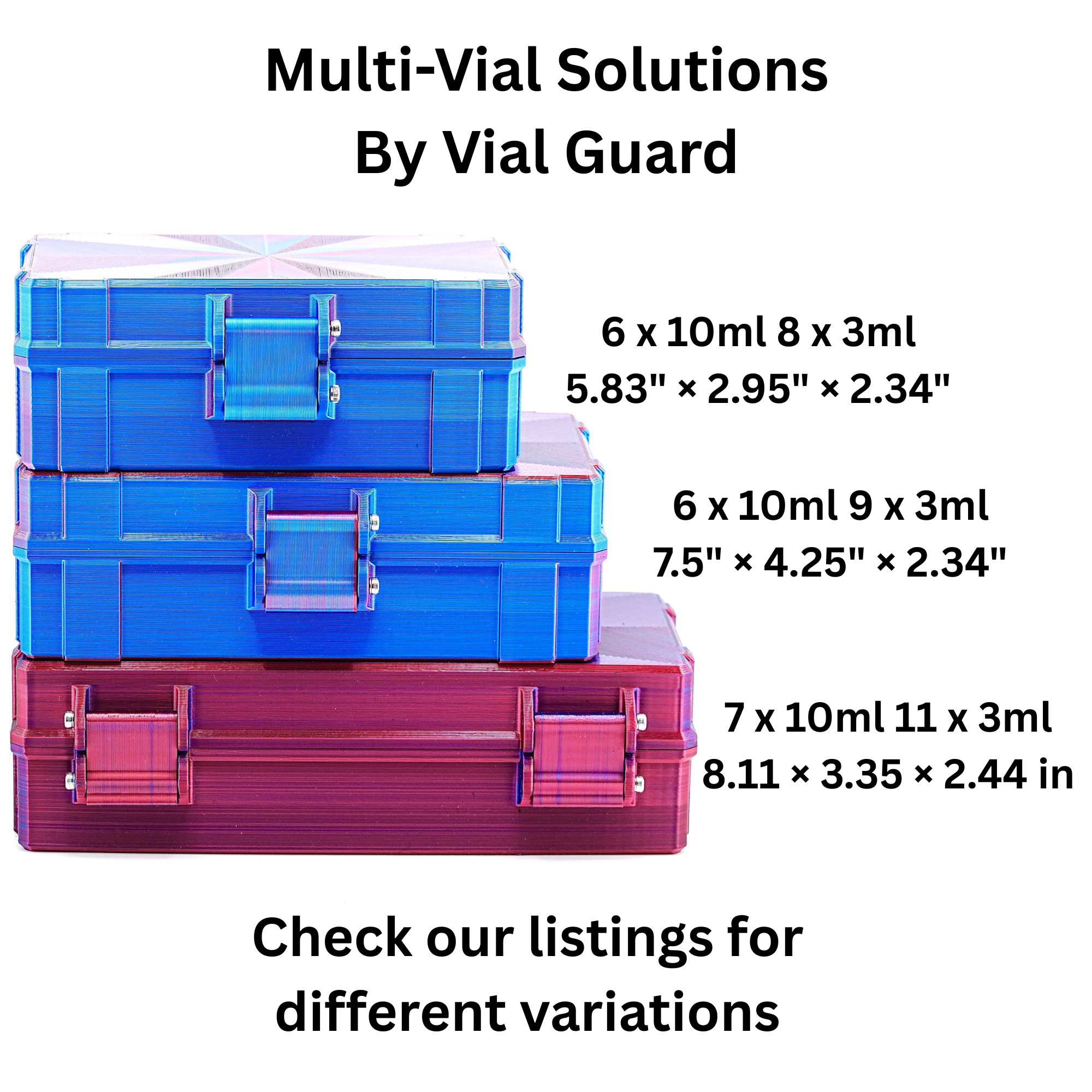
The Bag vs. Case Comparison
Here's the honest side-by-side of how bag-type containers and purpose-built peptide cases compare on the criteria that matter for compound protection.
| Criteria | Bag-Type Container | Purpose-Built Peptide Case |
|---|---|---|
| Crush Resistance | None — soft walls transmit force directly to vials | Rigid ABS shell distributes force away from vials |
| Light Blocking | Partial at best; most fabric transmits ambient light | 100% opaque shell, no light penetration when closed |
| Vial Security | Vials roll freely; glass-on-glass contact during movement | Precision slots hold each vial individually immobile |
| Temperature Control | Cooler bags only; no thermal buffering for standard bags | ABS thermal mass buffers transitions; ice pack compatible |
| Fridge/Freezer Safe | Degrades with repeated thermal cycling; zipper corrosion | Rated to -20°C; ABS maintains integrity across thermal cycles |
| TSA Presentation | Loose vials in a bag trigger secondary screening | Organized case with labeled vials reads as medical equipment |
| Longevity | Zipper wear, fabric degradation, foam compression within 1 year | ABS shell lasts indefinitely under normal storage use |
When a Bag Is OK (and When It's Not)
This isn't a categorical rejection of bags. There is one specific scenario where a bag-type container is the better choice, and several where it's clearly not.
When a Bag Is Acceptable
A soft cooler bag used for short-term transport of reconstituted peptides when temperature control is the primary concern — say, a two-hour drive to a destination where you'll move the vials into a proper case — is a reasonable use of a bag. In this case, the temperature control benefit of the insulated bag outweighs the protection shortfall, particularly if the vials are held in a rigid inner container (like a small hard case) placed inside the cooler bag. The bag handles temperature; the case handles protection. Used together, this is a legitimate solution.
When a Bag Is Not Acceptable
Any scenario where a bag serves as your primary storage solution is wrong. Vials rolling loose in any bag — cooler, fabric, cosmetic, or otherwise — are one trip away from broken glass. Any storage arrangement where light reaches the vials during normal use degrades photosensitive compounds. Any soft container used as the final protection layer in a bag subject to external weight or compression is a compound loss waiting to happen.
Bags also fail at TSA. A bag of loose vials with exposed syringes in a carry-on is a secondary screening scenario that delays your travel and may result in confiscation. An organized, purpose-built peptide case with labeled vials and syringes stored in their designated compartments presents as a medical device case, which is exactly what TSA agents are trained to process without issue. The case organization is part of your travel strategy, not just your storage strategy.
The Hybrid Solution: Use a Case Inside Your Bag
The correct approach for most users who want portability is not a bag instead of a case — it's a case inside a bag. This preserves all the transport convenience of carrying a gym bag, backpack, or travel bag while maintaining the full protection of a hard shell case for the vials inside.
The hard shell peptide case is self-contained protection. It holds the vials immobile, blocks all light, resists compression from objects around it in the bag, and maintains its closure regardless of what gets piled on top of it. The bag carries the case. The case protects the vials. Each does what it's designed to do.
This hybrid model is how experienced peptide users actually operate. The case is the constant — it goes wherever the compounds go, inside whatever carrier is appropriate for the day. A backpack, a gym bag, a carry-on, a messenger bag — the case is always inside one of these, never used as the only transport layer.
Pro Tip: If you're looking for a "peptide bag," what you actually want is a compact hard case that fits inside a bag. The case protects the vials; the bag carries the case. Searching for a bag that does both at once is the wrong framing — no single bag-type product can provide both the structural protection and the portability that separate case + bag provides.
The Real Cost of Using the Wrong Container
The economics of improvised peptide storage are straightforward. A 3ml vial of BPC-157 costs $30–50. A 3ml vial of PT-141 costs $20–40. A 3ml vial of retatrutide costs $80–150. If you're running any combination of three to five compounds with backups, your storage case holds $200–600 in compounds at any given time.
A single cracked vial from bag compression eliminates any cost savings from choosing a free improvised storage solution. A single degraded compound from light exposure — which you may not even know has happened until the compound fails to produce the expected effect — costs you the compound price plus the time of a ruined protocol cycle. A single broken stopper from vial-on-vial contact contaminates the vial and forces disposal of the compound.
The VialCase 10-Slot Compact is $13.99. The VialCase 12-Slot All-in-One is $36.99. These are not significant costs relative to the compounds they protect. The question is not whether you can afford a proper peptide case — it's whether you can afford not to have one.
Recommended Setup by Activity
Different usage patterns call for different case configurations. Here's the recommended setup for the most common scenarios.
Daily Gym Carry
If you're dosing peptides at the gym or carrying them in a daily backpack, the VialCase 10-Slot Compact ($13.99) is the right tool. It holds up to ten 3ml vials in a form factor that fits any backpack side pocket or internal compartment without taking meaningful space. Hard shell, fully opaque, latched. Your bag carries the case; the case protects the vials. Replace the idea of a "peptide bag" with this case inside your existing gym bag and you've solved the problem completely.
Travel and Flights
For travel, the VialCase 12-Slot All-in-One ($36.99) is the standard. It holds twelve 3ml vials plus syringes, alcohol pads, and BAC water in an all-in-one hard shell format sized for carry-on use. The organized layout presents cleanly at TSA. The hard shell handles overhead bin compression. The opaque case handles ambient light during layovers and transit. For most travelers with any multi-compound protocol, this is the correct case. See our full best peptide travel case guide for the complete breakdown.
Full Protocol Home Storage
For home use where you're running a four-to-six compound protocol with regular reconstitution, the VialCase 20-Slot with Syringe ($25.59) provides the capacity you need. Twenty 3ml slots accommodate a full stack with backup vials for each compound and integrated syringe storage. This case lives on your fridge shelf, gets pulled out for dosing, and goes back in. The ABS construction handles the repeated thermal cycling of daily fridge access without degradation. For a comprehensive look at organizing a full protocol, see our peptide protocol organization guide.
Where to Buy the Right Peptide Case
The entire VialCase lineup is purpose-built for peptide vial storage — not adapted from a generic format, not cosmetic cases with rebranding. Every case in the lineup uses ABS hard shell construction, precision-dimensioned vial slots, fully opaque shells, and mechanical latch closures. They're the only cases that pass every functional requirement for peptide storage.
Browse the full lineup at vialcase.com. If you're unsure which case is right for your protocol, the complete buyer's guide covers every decision in detail — vial size, slot count, travel vs. home storage, and material comparisons.
The search for a "peptide bag" ends with a peptide case. Everything you wanted from a bag — portability, organization, a dedicated home for your compounds — a hard shell case provides, with the crush resistance, light blocking, and vial security that bags structurally cannot. Stop searching for the right bag. Buy the right case.
Disclaimer: This article is for informational purposes only and does not constitute medical advice. Peptide compounds referenced throughout this article may be subject to regulatory restrictions depending on your jurisdiction. Always consult a licensed healthcare provider before beginning any peptide protocol. PeptideCase sells storage equipment only and does not sell, endorse, or facilitate the purchase of any pharmaceutical or research compound.