The Core Problem: Glass Vials Are Fragile, Peptides Are Expensive
Start with the math. A 3ml vial of BPC-157 from a reputable research supplier runs $30–50. A vial of retatrutide costs $80–150. If you're running a multi-compound stack with four or five active vials plus backups, you could have $400–800 worth of peptide compounds sitting in your storage case at any given time.
That case will be dropped. Not maybe — will be. It will get compressed in an overhead bin. It will get knocked off a fridge shelf. It will be jostled in a gym bag for a thirty-minute commute five days a week. Every one of those events is a stress test, and the material your case is made from determines whether your vials survive it.
Borosilicate glass — the material most peptide vials are made from — is durable relative to standard glass but completely unforgiving of point-impact forces. A vial that absorbs a direct lateral hit against another vial, a hard surface, or even the interior edge of its own case will crack or shatter. The stopper can be displaced by compressive force even without the glass breaking, contaminating the compound inside. A soft case transmits every one of these forces directly. A hard shell case absorbs and distributes them away from the glass.
This isn't theoretical risk management. It's the most predictable failure mode in peptide storage, and it's entirely preventable with the right case material.
What Hard Shell Actually Means
The term "hard shell" is used loosely in the storage market, so let's establish what it means in practice. A true hard shell case is constructed from a rigid polymer that does not flex meaningfully under manual compression — meaning you can squeeze the sides of the case with moderate force and the walls do not deform toward the vials inside.
The most common materials used in genuine hard shell cases are:
- ABS (Acrylonitrile Butadiene Styrene): The gold standard. ABS is what quality electronics housings, medical device casings, and professional transport equipment use. It's impact-resistant, dimensionally stable across a wide temperature range (-20°C to 80°C), fully opaque, and can be precision-molded into exact vial slot dimensions. For peptide storage, ABS is the correct material.
- Polycarbonate: High-impact strength, slightly more expensive to manufacture, and optically transparent in its natural state (which is why it requires pigmentation to become opaque in hard shell cases). Some premium cases use polycarbonate shells for additional drop resistance.
- Rigid EVA (Ethylene-Vinyl Acetate): The borderline category. At sufficient thickness and density, rigid EVA provides meaningful crush resistance. At standard pouch thickness, it does not. Rigid EVA shells used in quality cases perform adequately; the same material used as a flexible pouch performs like a soft case.
What is definitively not hard shell: neoprene, fabric pouches, flexible plastic bags, thin-walled EVA pouches, mesh cases, and anything that visibly deforms when you press on the sides. These are soft cases regardless of what the product listing calls them.
The 5 Failure Modes of Soft Cases for Peptides
Soft cases don't fail in one dramatic way — they fail in five distinct, compounding ways, each of which is a threat to your compounds on its own. Together they represent a comprehensive storage failure.
1. No Crush Resistance
A neoprene or fabric case sitting in a gym bag provides exactly zero protection against compressive force. Place a water bottle, a set of keys, a laptop, or any other bag contents on top of the case and that weight transmits directly through the soft material to the vials inside. A soft case filled with 3ml vials and compressed by a 500g object is applying that load to glass. The result is cracked stoppers, chipped vial necks, and broken glass. A hard shell case distributes that compressive load across the rigid wall, transferring the force to the edges and away from the vials entirely. This is physics, not marketing.
2. Light Leaks Through Soft Material
Many peptide compounds are photosensitive. BPC-157, Melanotan II, GHK-Cu, PT-141, and several other commonly used peptides undergo measurable degradation when exposed to UV and ambient visible light. Most soft cases — even dark-colored ones — are not fully opaque. Hold a phone flashlight against any neoprene or fabric case and watch the light diffuse through. That's the light your compounds are being exposed to every time your case sits on a lit countertop, in a bag under a window, or in a car on a sunny commute. Hard shell ABS cases are 100% opaque. No light penetration through the shell, period.
3. Vials Shift Inside
A soft case with individual vial pockets may hold each vial in place when the case is stationary. The moment you're moving — walking, driving, in a bag on your shoulder — the soft walls flex with each motion. Vials rock in their pockets, the pocket walls compress and release, and you get glass-on-glass or glass-on-foam impact dozens of times per minute. Over a 30-minute commute that's thousands of micro-impacts against stopper integrity, seal tightness, and glass stress points. A hard shell case with precision-molded slots holds each vial completely immobile regardless of movement. The vial does not shift because the slot is dimensioned to eliminate lateral play.
4. Zipper Failure Over Time
Most soft cases use a zipper as their primary — and often only — closure mechanism. Zippers are not designed for the thermal cycling of regular fridge and freezer use. The repeated cold-to-room-temperature cycles degrade zipper tracks, cause slider corrosion, and eventually result in partial closures that look closed but aren't. A case that partially unzips in a bag, on a fridge shelf, or in transit is a case that can dump its contents. Hard shell cases use mechanical latches — positive-click closures that hold under compressive force and are not affected by thermal cycling. The closure either engages or it doesn't; there's no partial-closure failure mode.
5. Temperature Transmission
A soft case placed on a warm counter heats to ambient temperature within minutes. The same case pulled from a cold bag into a warm car heats just as fast. The soft material offers essentially no thermal buffering — the internal temperature tracks the external environment closely. Hard shell ABS provides modest but real thermal mass that buffers temperature transitions. It won't replace an ice pack for long transport, but it measurably slows the rate at which reconstituted peptides warm during a transition from fridge to bag to destination. Every degree slower the transition, the less thermal stress on your compounds.
What Hard Shell Cases Do Differently
A hard shell peptide case solves each of these failure modes structurally, not through workarounds or add-ons. The rigid walls absorb impact forces and prevent them from reaching the vials. The opaque ABS shell blocks 100% of light from every angle when the case is closed. The precision-molded interior slots hold each vial upright and immobile regardless of external movement. The mechanical latch holds under pressure from every direction and does not fail from thermal cycling.
The internal structure of a quality hard shell peptide case is as important as the shell itself. Each vial slot should be sized to the millimeter for the specific vial diameter it's designed to hold — approximately 10mm for standard 3ml vials and 22mm for 10ml vials. Slots that are even 3–4mm oversized allow enough lateral vial movement to create impact risk during transport. Purpose-built peptide cases from manufacturers like VialCase are designed specifically to these dimensions, which is the functional difference between a peptide case and a generic hard-shell box with foam cutouts.
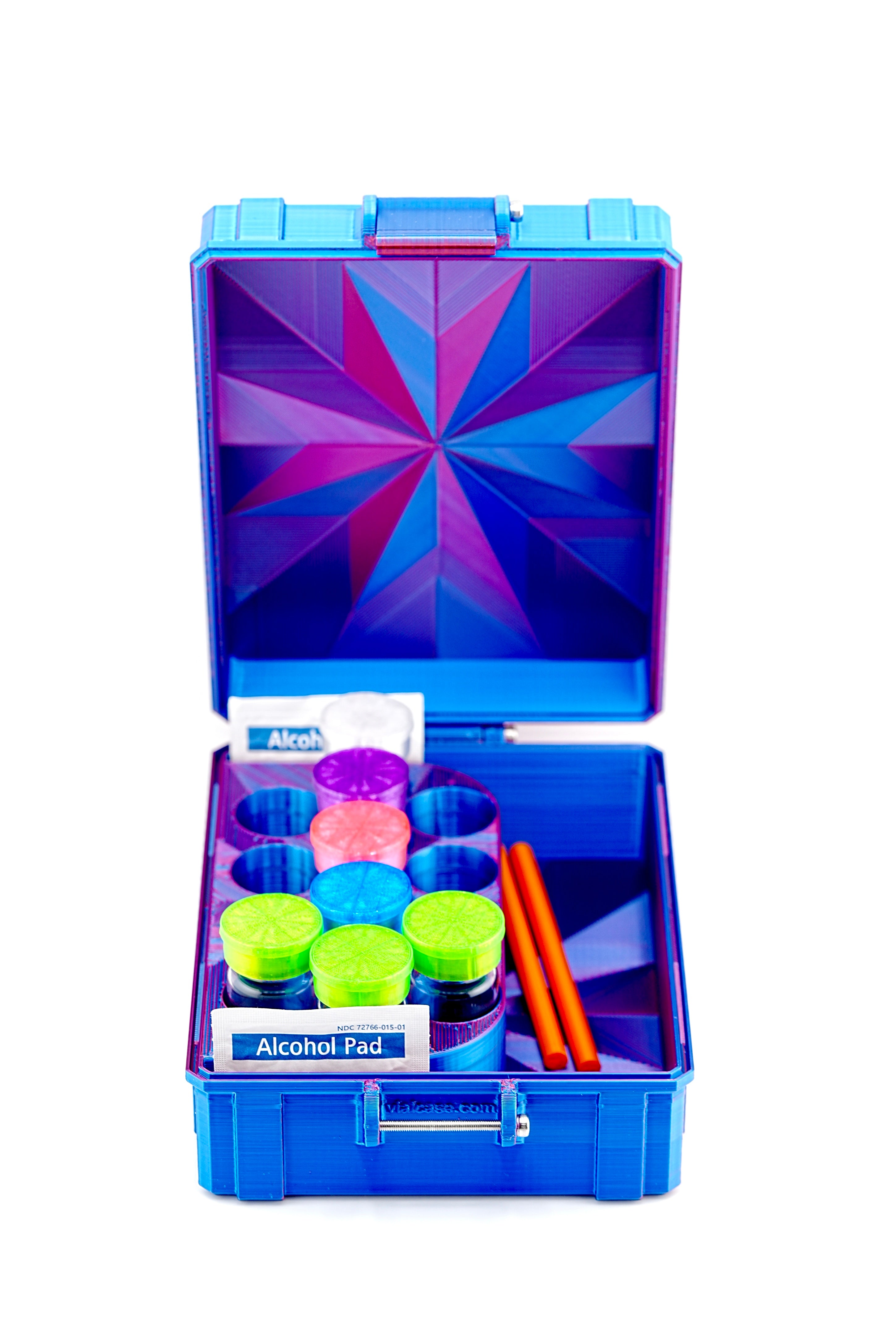
Hard Shell for Drops: Real-World Scenarios
The abstract case for hard shell is compelling, but the real-world scenarios are what make it concrete. Here are three common situations and what happens to your vials depending on the case you're using.
Scenario 1: The Dropped Bag
Your gym bag slips off your shoulder and hits the floor. Inside: six vials of various peptides in a soft neoprene case. The bag hits the floor at roughly 1 meter per second squared. The soft case transmits that impact directly to the vials. If any two vials are in contact at the point of impact, or if a vial hits the side of the case under impact, you have at minimum a chipped stopper and at worst a broken vial. With a hard shell case inside the same bag, the rigid walls absorb the impact and distribute it to the case edges. The vials inside experience a fraction of the impact force. Purpose-built hard shell cases from quality manufacturers are tested for exactly this scenario.
Scenario 2: Overhead Bin Compression
Your carry-on goes into the overhead bin. Someone else's bag gets placed on top of it. Over a two-hour flight, a 5kg bag sits on top of your carry-on, which sits on top of your peptide case. A soft case inside the bag transmits that 5kg compressive load directly to the vials inside. The vials at the top of the soft case, which are directly in the compression path, are under sustained load for two hours. Hard shell cases handle this without any internal load transmission — the rigid top wall takes the compression and holds it without deflecting.
Scenario 3: Knocked Off the Fridge Shelf
A full fridge, a reaching hand, a case on the edge of the shelf. A soft case hitting a tile floor from 1.2 meters has essentially no protection for the vials inside. A hard shell case hitting the same floor has its impact-resistant walls between the floor and the glass. This is the scenario where ABS's impact resistance — the same property that makes it the material of choice for electronics housings and protective gear — pays off most directly.
Hard Shell Cases Ranked for Peptide Use
Not all hard shell cases are equally suited to peptide storage. Here's an honest ranking of the options users typically consider, from least to most purpose-fit.
Generic Hard Plastic (Pelican-Style Cases)
These cases are genuinely hard shell and genuinely impact-resistant. But they are designed for camera equipment, firearms, and industrial tools — not 3ml glass vials. They're oversized for any reasonable peptide collection, heavy enough to matter in a bag, have no vial-specific internal organization, and cost more than purpose-built peptide cases. Their foam inserts require custom cutting, leave excessive vial movement, and degrade at freezer temperatures. Hard shell material, wrong application.
Generic Hard Shell Makeup Cases
The right size, the wrong design. Generic hard shell cosmetic cases look promising on paper — compact, hard shell, latched closure. The problem is the interior: mirror-paneled lids, magnetic closure trays, and elastic loops designed for lipstick, not vials. They offer no individual vial slots, no vial height support, and often have light leaks at the hinge seam. For casual cosmetic storage they're fine. For glass peptide vials, they're inadequate on vial security and inadequate on light blocking.
VialCase 10-Slot Compact — $13.99
The VialCase 10-Slot Compact is the entry point for proper hard shell peptide storage. ABS shell, 10 precision-dimensioned 3ml vial slots, fully opaque, mechanical latch, freezer-rated. It's compact enough for a gym bag or desk drawer, and at $13.99 it removes any economic justification for improvised storage. The slot dimensions are sized specifically for standard 3ml peptide vials, not generic pharmaceutical containers. For a single-compound protocol or someone just getting started, this is the correct first case.
VialCase 10-Slot with Extra Storage — $29.99
The 10-Slot with Extra Storage adds a secondary compartment for syringes, BAC water, and alcohol pads to the hard shell format. Same rigid ABS construction, same precision 3ml slots, same opaque fully-latched closure — with the addition of a dedicated accessory zone that eliminates the need to carry anything loose. For users running two or three compounds who want everything organized in a single hard shell case, this is the logical upgrade from the compact model.
VialCase 12-Slot All-in-One — $36.99
The 12-Slot All-in-One is the best hard shell case for mixed multi-compound protocols. Twelve precision 3ml slots, integrated syringe storage, alcohol pad compartment, all in a hard shell ABS format sized for carry-on travel. It covers the typical four-to-five compound stack with room for backup vials, and the all-in-one layout means no secondary pouches or loose accessories. This is the recommended default for anyone running a serious protocol.
VialCase 13-Slot 10ml — $49.99
The 13-Slot 10ml is purpose-built for GLP-1 users running semaglutide, tirzepatide, or retatrutide in 10ml vials. Hard shell ABS, 13 precision slots dimensioned for 10ml vials, supplementary storage, and full opaque closure. At $49.99 it's the top of the VialCase lineup — and the only purpose-built hard shell option for anyone whose protocol centers on 10ml pharmaceutical vials.
Pro Tip: The squeeze test. Squeeze your current case with both hands and moderate pressure. If the sides flex inward toward the vials, it is not protecting your vials from impact. A true hard shell case will not flex under manual compression. If you can compress the walls, so can a heavy bag sitting on top of it.
Hard Shell for Cold Storage
Peptide storage means cold storage. Reconstituted vials live in the fridge at 2–8°C. Lyophilized peptides go in the freezer at -20°C. Your case needs to handle both environments without degradation — and it needs to cycle between them repeatedly without losing structural integrity or slot precision.
Soft cases fail this test progressively. Neoprene stiffens at freezer temperatures and begins to lose flexibility in its foam structure after repeated thermal cycles. Fabric cases absorb moisture from fridge humidity over time, which degrades stitching and adhesive bonds. Zipper pulls and tracks corrode in cold, humid environments. EVA pouches develop micro-cracks at fold lines after dozens of freeze-thaw cycles.
ABS hard shell cases handle -20°C without any structural change. The polymer maintains its impact resistance, its dimensional stability, and its slot precision across the full temperature range of typical peptide storage. A hard shell case you buy today will function identically in three years of daily fridge-to-counter cycling. The same cannot be said for any soft case material.
The Long-Term Case: Why Hard Shell Lasts Longer
The economics of case selection extend beyond the purchase price. A soft case that degrades within a year of regular use — zipper failing, foam compressing, fabric fraying — needs to be replaced. A hard shell ABS case, properly maintained, lasts indefinitely under normal peptide storage use.
Consider the failure points of each type. Soft cases fail at: zipper tracks (corrosion and mechanical wear), foam (compression and cold-weather cracking), fabric (abrasion, stitching failure, moisture absorption), and adhesive bonds (delamination from thermal cycling). Hard shell cases have none of these failure modes. The shell itself is a single-piece molded polymer with no seams, no adhesive bonds, no fabric components. The only wear point is the latch mechanism, which on quality cases is rated for thousands of open-close cycles.
If you're spending $30–150 per vial on peptide compounds, the case protecting them should last longer than the protocol. Hard shell ABS delivers that longevity. Soft cases, by design, do not.
What Hard Shell Cases to Avoid
Not everything marketed as hard shell meets the standard. Here are the specific red flags to screen for when evaluating any hard shell peptide case.
Thin-Walled ABS
ABS is the right material, but wall thickness matters. A case with 1mm ABS walls provides far less protection than one with 3mm walls. Manufacturers don't always publish wall thickness, which means you need to either test physically (the squeeze test above) or buy from manufacturers with documented construction specs. Cheap hard shell cases that feel hollow or lightweight when empty are typically using sub-standard wall thickness.
Cases That "Look" Rigid But Flex Under Pressure
Some cases are marketed as hard shell but are constructed from rigid-feeling flexible polymers — HDPE or polypropylene at thin gauge — that flex significantly under real compressive loads. A case that passes the finger-squeeze test but flexes under hand-press pressure is not providing meaningful crush protection. Test with both hands applying moderate sustained pressure to the case sides. Any deflection toward the vials is a disqualifying failure.
Cases with Moisture-Absorbing Foam
Hard shell cases with open-cell foam interiors absorb humidity from fridge and freezer environments over time. That moisture stays in contact with your vials, with your stoppers, and with your labels. Over weeks and months, moisture-laden foam creates an environment where stopper degradation accelerates. Look for cases with closed-cell foam or molded plastic interior slots that don't absorb moisture.
The Complete Case for Going Hard Shell
The argument for hard shell peptide cases is not about aesthetics or brand preference. It's about the physics of glass vial protection and the chemistry of peptide degradation. Glass breaks under point-impact forces that hard shell cases prevent. Peptides degrade under light exposure that hard shell cases block. Stoppers shift under compressive loads that hard shell cases distribute away from the vials. Closures fail from thermal cycling that hard shell latches handle without issue.
Every alternative — neoprene pouches, fabric roll-ups, soft-shell EVA cases, generic makeup bags — compromises on at least one of these dimensions. Most compromise on all of them. The compounds inside your case are worth multiples of the case price. There is no rational argument for protecting a $150 vial with a $12 soft case.
For a full comparison of the best hard shell options available, see our complete peptide cases buyer's guide. For protocol-specific storage recommendations, see our guides on the most common peptide storage mistakes and amber vs. clear vials.
Start with the right case. Your compounds depend on it.
Disclaimer: This article is for informational purposes only and does not constitute medical advice. Peptide compounds referenced throughout this article may be subject to regulatory restrictions depending on your jurisdiction. Always consult a licensed healthcare provider before beginning any peptide protocol. PeptideCase sells storage equipment only and does not sell, endorse, or facilitate the purchase of any pharmaceutical or research compound.