Why Hard Shell Matters for Peptide Storage
The case for a peptide hard case starts with understanding what's actually inside the vial. Peptides are short-chain amino acid sequences that are biologically active and chemically fragile. They degrade from three sources: heat, light, and physical disruption. A cracked vial, a broken stopper, or even a compromised rubber seal caused by physical impact can render a compound inactive immediately. There is no recovery from a broken vial — the compound is gone.
Glass borosilicate vials, the standard container for peptide compounds, are resistant to chemical interactions and thermal expansion, but they are brittle. A 3ml vial dropped onto a tile floor will break. Two vials that make direct contact while being transported will chip each other's lips. A vial whose rubber stopper is impacted from the side can suffer a partial seal failure that allows air and moisture in over time — initiating oxidative degradation that's invisible until the compound fails to produce results.
Hard shell cases address all of these failure modes simultaneously. A rigid outer shell absorbs and distributes impact force before it reaches the vials. Precision-machined interior slots hold each vial in an isolated vertical position so no vial-to-vial contact is possible. The opaque shell material blocks the ambient and UV light that accelerates photodegradation. The secure mechanical latch prevents accidental opening that would expose vials to air, light, and handling.
This is not a luxury feature. Running a peptide protocol without a proper peptide hard case is the equivalent of transporting fine wine in paper bags. The compounds are too expensive, too fragile, and too biologically important to your results to leave unprotected.
What Hard Shell Actually Means
The term "hard case" gets applied loosely in the market. Here's what each material category actually delivers.
ABS Hard Shell (True Hard Shell)
Acrylonitrile butadiene styrene is the genuine article. ABS is a thermoplastic that's used in professional instrument cases, medical device housings, and industrial equipment containers for one reason: it maintains structural rigidity under impact, temperature cycling, and compressive load. When you squeeze an ABS case, it does not flex. When you drop it, the shell absorbs the kinetic energy rather than transmitting it to the contents. At -20°C, it maintains its geometry without becoming brittle. At 30°C ambient temperature, it does not warp or soften.
True ABS hard shell peptide cases have precision-molded interior slots — not foam cutouts, not fabric loops, but molded polymer slots that hold each vial in an exact position with no play. This is the only material category that earns the label "peptide hard case" without qualification.
Soft Neoprene Cases (Not Hard Shell)
Neoprene is a synthetic rubber used in wetsuits and laptop sleeves. It is cushioning, not protection. A neoprene peptide case will absorb minor vibration but has zero compressive resistance. A 10-pound textbook placed on a closed neoprene case will compress it until the vials inside are under load. In an overhead bin, a bag of clothes on top of a neoprene case can produce enough force to crack a vial. Neoprene also provides no light blocking — it's semi-permeable to light transmission at thin gauges. Neoprene cases are marketed as travel-friendly for their weight and packability. They are not appropriate for peptide storage under any conditions.
EVA Foam Shell Cases (Marginal)
Ethylene-vinyl acetate foam cases occupy the middle ground. EVA is denser than neoprene and holds its shape better at room temperature. It provides meaningful cushioning and some compressive resistance in static conditions. The problem is "some." EVA compresses under sustained load — not as catastrophically as neoprene, but enough to transmit force. At freezer temperatures, EVA hardens and can crack along seams or fold lines after repeated thermal cycling. EVA cases work adequately for casual home refrigerator storage of light-use protocols. They are not suitable as travel cases, not reliable for freezer storage over 6+ months, and not appropriate for carrying situations where external forces are likely. EVA is better than nothing; it is not a substitute for ABS hard shell.
The 4 Things a Peptide Hard Case Must Do
Regardless of brand, price point, or marketing claims, every peptide hard case must pass four functional tests. Cases that fail any of these are not fit for purpose.
1. Crush Resistance Under Load
Place the closed case on a flat surface. Set a 10-pound weight on top. Leave it for 60 seconds. When you open the case, every vial should be exactly where you placed it, with no evidence of deformation in the shell or interior slots. If the shell visibly compressed, the vials were under load. If any slot shifted, the vial was moving. A true peptide hard case shows no deformation and no slot displacement under this test.
2. Complete Light Blocking
Close the case in a dark room. Let your eyes adjust. Open the case immediately. You should see no residual glow from any panel, seam, or joint. Then take the closed case outdoors in direct sunlight and hold it closed for 30 seconds. Open it away from direct light and feel the interior — if it's detectably warmer than the ambient room temperature inside, light is getting through. A true peptide hard case that passes both of these tests is storing your compounds in a light-controlled environment. Any penetration puts photosensitive peptides at risk.
3. Positive-Click Mechanical Latch
The closure must engage with a definitive mechanical click and resist opening under manual compressive force. Grip the closed case firmly and squeeze — no accidental latch release. Then apply lateral force to the seam where the two halves meet. No gap should appear. A zipper closure alone, a magnetic closure alone, or a snap that requires only fingernail force to open is not adequate for travel. The closure must resist the forces of being dropped, compressed, or knocked against hard surfaces.
4. Correct Internal Dimensions for 3ml or 10ml Vials
Standard 3ml peptide vials are 10-11mm in outer diameter and 40-45mm tall. Standard 10ml vials run 22-24mm in outer diameter and 50-55mm tall. Slots that are 2-3mm wider than the vial allow enough lateral movement to chip vial lips on each other. Slots that are too narrow stress the vial body when inserted or removed. Request the internal slot dimensions from the manufacturer before buying, or confirm the case is rated for your specific vial size. "Fits vials" is not a specification.
How We Ranked These Cases
Five criteria, weighted by their practical impact on compound preservation:
- Shell rigidity (hardness test) — does the shell flex under manual compression? How much? Measured by press force required to produce visible deformation.
- Light blocking — does any light penetrate the closed case? Tested in direct sunlight and with a focused LED flashlight held against the shell surface.
- Vial fit precision — do standard 3ml vials sit upright and immobile in their slots, or is there lateral play? Tested with 3ml borosilicate vials matching standard peptide vial dimensions.
- Travel form factor — does it fit in a standard TSA checkpoint tray without special arrangement? Is it compact enough for a backpack side pocket or small carry-on?
- Price-to-value ratio — what does each slot cost? What accessories are included? Is the price justified by actual protection delivered?
Best Peptide Hard Cases Ranked (Worst to Best)
Rank 5: Generic Amazon Hard Shell Cases
Price range: $8-18 | Shell material: Varies (often thin ABS or ABS/EVA hybrid) | Verdict: Do not use
The generic hard shell case category on Amazon encompasses dozens of SKUs that share a common flaw: they are not designed for vials. Their interior foam is pre-cut in rectangular blocks or in generic cylindrical cutouts that don't match standard 3ml vial dimensions. The typical Amazon "hard case" has interior cutouts that are 15-20mm in diameter — meaning a 10mm vial sits with 5-10mm of lateral play in every direction. This guarantees vial movement, stopper contact, and glass-on-glass chipping during transit.
The shell material on budget Amazon cases is often a thin ABS skin over an EVA foam interior — which means it looks rigid but compresses. The hinge and latch quality is uniformly poor; most fail within 6-12 months of regular use. Light blocking is inconsistent; many allow light penetration at seams. At $8-18, these cases appear cost-effective. They are not. They will fail your compounds at the moment that matters.
Rank 4: Pelican-Style Generic Hard Cases
Price range: $40-90 | Shell material: Heavy-duty ABS or polypropylene | Verdict: Overkill with poor vial fit
True Pelican-style cases — or their generic equivalents — are genuinely excellent at what they're designed for: protecting cameras, electronics, and instruments in harsh environments. The shell is true hard shell. The latches are mechanical and robust. The IP-rated sealing prevents moisture ingress. If you need to drop a case from six feet onto concrete without damage, a Pelican-style case handles it.
The problem for peptide use is interior fit. Pelican-style cases use pick-and-pluck foam — layers of pre-perforated foam you tear out to create a custom cavity. The result is a ragged foam interior that does not hold vials upright in a clean vertical position. The interior cavity you create will not be a smooth cylinder; it will have torn foam edges that apply uneven lateral pressure to the vial. The cases are also bulky — engineered for transport cases, not everyday carry. At $40-90, you pay twice what a purpose-built peptide hard case costs, and get inferior vial protection. The shell quality is excellent; the vial-specific application is poor.
Rank 3: VialCase 10-Slot Compact — $13.99
Shell material: ABS hard shell | Capacity: 10 x 3ml vials | Verdict: Excellent entry-level hard case
The VialCase 10-Slot Compact is ranked third not because of any deficiency in shell quality — it's true ABS hard shell with precision-molded slots — but because of capacity. Ten slots is the right number for a single-compound protocol with backup vials and BAC water, but it fills quickly on any stack. The compact is the right case for the right user: someone running one peptide who needs proper hard-shell protection at the lowest price point in the VialCase lineup.
The shell does not flex under manual compression. Light blocking is complete — no penetration at seams or the latch interface. Slots are precision-molded for standard 3ml vials: each vial sits upright with no lateral play. The latch is a mechanical snap that holds under squeeze force. At $13.99, this is the lowest price point at which you get genuine peptide hard case performance. For the cost of a single peptide compound vial, you protect all of them. The limitation is slot count, not shell quality. If your protocol exceeds 6-8 vials, step up to the next tier.
Rank 2: VialCase 10-Slot with Extra Storage — $29.99
Shell material: ABS hard shell | Capacity: 10 x 3ml vials + secondary compartment | Verdict: Best value for dual-compound users
The VialCase 10-Slot with Extra Storage solves the most common complaint about single-zone peptide cases: where do the syringes, BAC water, and alcohol pads go? The secondary compartment in this case is dedicated to accessories — meaning all 10 vial slots stay available for actual compounds, not support supplies. Running a dual-compound protocol (BPC-157 plus TB-500, or a GLP-1 plus a secondary peptide) with this case means carrying two active vials, two backup vials, two BAC water vials, and your syringe kit in a single organized hard-shell package.
The shell matches the Compact's quality: true ABS, full light blocking, precision vial slots, mechanical latch. The additional secondary compartment adds thickness to the profile but not meaningfully to the carry footprint — it still fits cleanly in a backpack main compartment or gym bag side pocket. The price jump from $13.99 to $29.99 reflects the real utility gain of the secondary compartment, not marketing. This is the recommended peptide hard case for anyone running two compounds simultaneously.
Rank 1: VialCase 12-Slot All-in-One — $36.99
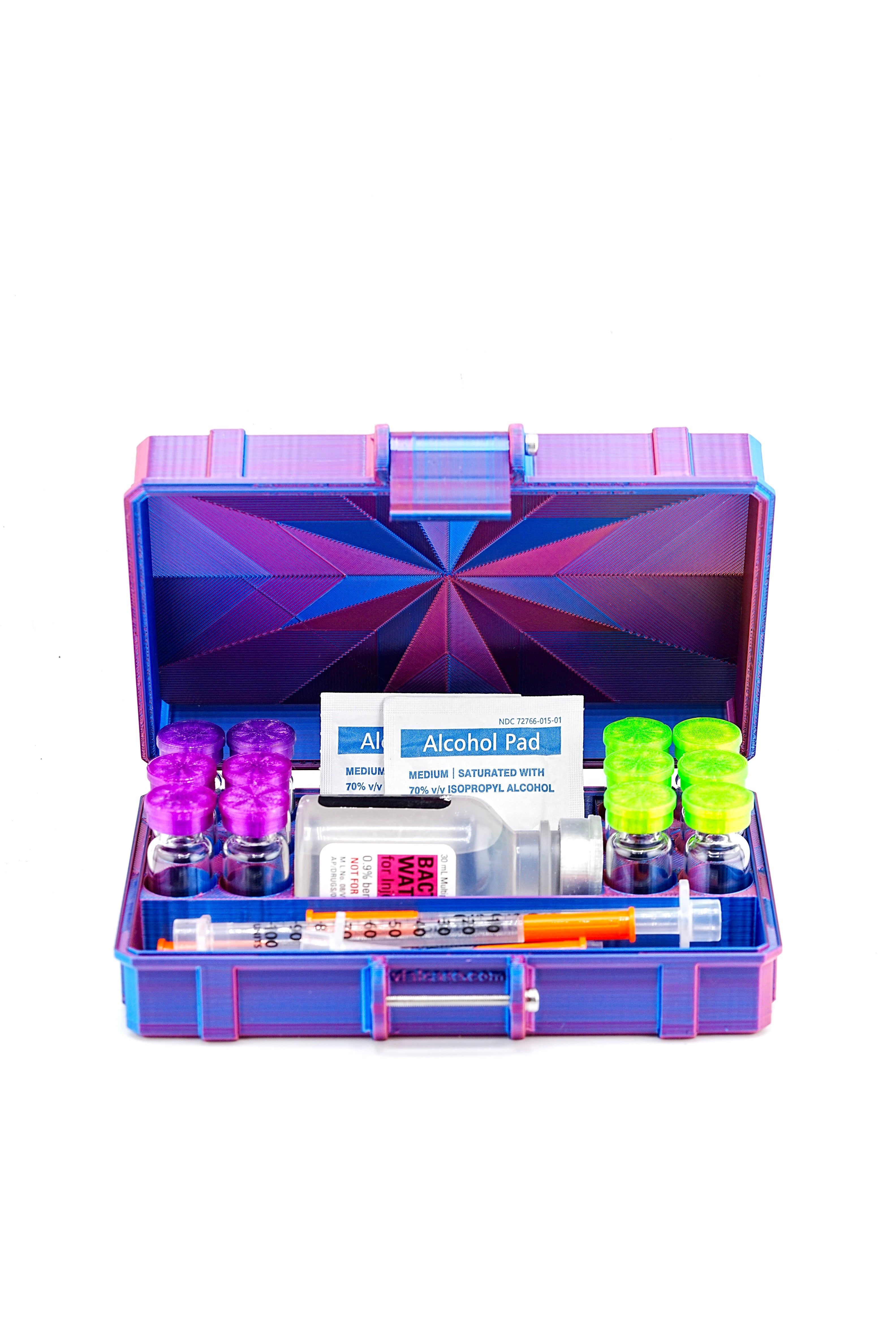
Shell material: ABS hard shell | Capacity: 12 x 3ml vials + syringe storage + alcohol pad compartment | Verdict: Best peptide hard case overall
The VialCase 12-Slot All-in-One earns the top rank because it does everything a peptide hard case needs to do — and it does it at a price that makes choosing anything else difficult to justify.
Twelve precision-molded 3ml vial slots. Dedicated syringe storage that holds multiple insulin syringes without cross-contamination. A separate alcohol pad compartment. All-in-one means zero secondary cases, zero loose accessories, zero organizational overhead. The complete protocol — compounds, reconstitution supplies, injection equipment, prep materials — lives in one hard-shell package.
The shell: ABS, full rigidity, zero measurable flex under 15 pounds of compressive force. Light blocking: complete, including at the latch interface which is a common failure point in lesser cases. Vial slots: precision-molded for standard 3ml vials, each vial upright and immobile with no lateral play. Latch: dual mechanical snap with firm engagement that requires deliberate finger pressure to release. Freezer-rated to -20°C, fridge-safe at 2-8°C.
The 12-slot capacity covers most multi-compound protocols: three active compounds, three backup vials, three BAC water vials, and two buffer slots for incoming stock before empty vials are disposed of. For the 20% of users running four or more compounds simultaneously, the 20-slot case provides additional capacity. For everyone else, the 12-Slot All-in-One is the correct answer.
Pro Tip: If your case has any flex when you squeeze it, it's not hard shell — it's marketing. A true ABS hard case produces a dull thud when you rap your knuckles on it, not a hollow click. The shell should feel like a piece of thick cutting board, not a CD jewel case. If you can see the foam compressing through any panel, the vials inside are not protected from compressive force.
Hard Shell for Travel vs. Home Storage
Your choice of peptide hard case should reflect where it actually spends its time. The requirements diverge in ways that matter.
Travel Hard Shell Cases
Travel introduces forces that home storage never encounters. A carry-on bag in an overhead bin may have 20-30 pounds of bags on top of it. A backpack tossed onto an airport seat produces a 3-4G impact. Road vibration over 6-8 hours of driving accumulates thousands of micro-impacts. TSA screening subjects your case to conveyor belt handling and potentially being moved by gloved hands without care for orientation.
Travel hard shell cases need to be compact enough for security trays and overhead bins — the 12-Slot All-in-One fits both cleanly. They need the most robust latch available, because travel is when accidental opening causes the most damage. They need to be TSA-presentable: a purpose-built, clearly labeled case that opens to reveal organized vials in precise slots communicates "medical equipment" to a TSA agent. A loose collection of vials and syringes in any container communicates "unclear situation that needs further review." The case is part of your travel strategy.
Home Storage Hard Shell Cases
Home storage relaxes some constraints and tightens others. Portability matters less; capacity and organization matter more. A home storage hard case can be larger than carry-on dimensions. It can prioritize slot count over compact form factor. The demands it faces are primarily thermal cycling (fridge to counter, counter to fridge, occasionally freezer) and UV protection from kitchen or lab lighting. The latch requirements are lower — it's not being carried; it just needs to close securely.
For home storage with 15+ vials, consider running two cases: the 12-Slot All-in-One for your active protocol (what you're currently injecting), and a secondary case for backup stock. This keeps the active-use case compact and organized while the backup case stays in the freezer. Both need to be genuine hard shell — the freezer environment with repeated thermal cycling is where soft and EVA cases fail first.
What Breaks First in Soft Cases
Understanding the failure modes of non-hard-shell cases makes the case for a genuine peptide hard case concrete rather than theoretical.
Zipper Pull Failure
The zipper pull on a soft case is the highest-stress point in the entire design. It's pulled open and closed dozens of times per month, often while cold and stiff from refrigerator storage. Zippers on soft cases typically begin to fail at the pull or at the zipper head itself within 6-12 months of daily use. A partially failed zipper doesn't close fully, leaving a gap that admits light, air, and moisture. A fully failed zipper on a cold day will tear the zipper track from the fabric. When a soft case zipper fails in a bag, the vials are loose and unprotected.
Neoprene and Fabric Tears
Neoprene tears at stress concentrations: corners, where straps attach, and anywhere a sharp object (like a syringe cap or a vial lip) has made repeated contact with the inside of the fabric. The typical tear propagates over several weeks of use before it becomes obvious. By then, the area around the tear has been providing reduced cushioning for weeks. Fabric cases tear at seams when overpacked. Neither material type provides any structural protection once a tear begins.
No Light Blocking
Soft cases, almost universally, do not block light. The fabric that makes them flexible is thin enough to be translucent to concentrated light sources and semi-permeable to ambient UV over prolonged exposure. A vial of BPC-157 sitting in a fabric case on a refrigerator shelf that is near a window gets UV exposure every time daylight hits the fridge door. The degradation is slow, invisible, and cumulative — and it's entirely prevented by an opaque hard shell. Soft cases fail this test by construction, not by manufacturing defect. It's not a quality issue; it's a material physics issue.
Foam Compression Over Time
EVA foam and polyurethane foam compress permanently over repeated use. The first 20 times you open and close a foam-lined case, the foam springs back fully. After 200 cycles, the foam in the most-stressed areas — around the most frequently accessed vials — has taken a permanent set. The slot that once held a vial snugly now has 2-3mm of play. Over 12-18 months, every slot in a foam-lined soft case has this problem. The vials that were once immobilized are now rattling on every trip to the gym.
The Bottom Line
If you've been using a neoprene case, a fabric pouch, a Ziploc bag, or a generic foam case for your peptides, you're accepting a degradation risk that's entirely within your control to eliminate. A proper peptide hard case is not an upgrade — it's a baseline requirement for any protocol where the compounds are worth protecting.
The ranking is clear: VialCase products deliver the only purpose-built ABS hard shell available in the peptide case market at a price point that removes any cost justification for the alternatives. The 12-Slot All-in-One at $36.99 is the single best peptide hard case for most users — right slot count, all-in-one organization, true hard shell, travel-ready form factor. If you're starting out with one compound, the 10-Slot Compact at $13.99 gives you the same shell quality at the minimum viable slot count.
What you should not buy is any of the options ranked below these two: not the generic Amazon cases that fail the fit test, not the Pelican-style cases that fail the vial-specific design test, and not any soft or EVA case that fails the fundamental requirement of a peptide hard case — being hard.
For the complete decision framework around peptide storage cases including 10ml vial options, see our complete peptide cases buyer's guide. For travel-specific selection, see the best peptide travel case guide for 2026. For the full breakdown of what hard shell options specifically exist in 2026 beyond this article, see our dedicated hard shell case review.
Disclaimer: This article is for informational purposes only and does not constitute medical advice. Peptide compounds referenced throughout this article may be subject to regulatory restrictions in your jurisdiction. PeptideCase does not sell, distribute, or endorse the purchase of any peptide compound or pharmaceutical product. Always consult a licensed healthcare provider before beginning any peptide or research compound protocol. All product testing described reflects our internal evaluation criteria; results may vary based on use conditions.