Quick Answer: Does BAC Water Need to Be Refrigerated?
Unopened BAC water: no refrigeration required. Store at room temperature (15–30°C / 59–86°F), away from direct light, until you're ready to use it. Shelf life is typically 2–3 years from the manufacture date — check the label on your specific product.
After opening: yes, refrigerate. Once you've punctured the stopper and drawn your first dose, the vial goes into the fridge at 2–8°C (36–46°F). Use it within 28–30 days. That's the manufacturer's guideline and the standard the research community follows.
Those two rules cover 90% of the questions people have. The rest of this guide covers the reasoning behind each rule, the edge cases, and exactly how to handle BAC water at every stage of a peptide protocol.
What Is Bacteriostatic Water?
Bacteriostatic water (BAC water) is sterile water for injection that contains 0.9% benzyl alcohol as a preservative. That preservative is the entire reason BAC water exists — it inhibits the growth of bacteria, which means a single vial can be punctured multiple times over weeks without becoming a contamination risk. Regular sterile water contains no such preservative, so once it's punctured it should be used immediately and discarded.
The 0.9% benzyl alcohol concentration is precise by design. High enough to be bacteriostatic (inhibiting bacterial growth) without being bactericidal (killing bacteria outright at first contact). This balance is what makes it suitable for multi-dose use in research protocols. It's also why benzyl alcohol concentration matters — a vial that has been contaminated, frozen incorrectly, or stored too long may have degraded benzyl alcohol distribution, reducing its protective effect even if the water looks clear.
BAC water differs from sterile water in one other important way: because of the benzyl alcohol, it has a slightly different osmolarity than plain water. This is why some practitioners prefer it not just for multi-dose use but specifically because it's designed to remain chemically stable in a vial over an extended period. Sterile water is a single-use product. BAC water is a multi-dose product. If you're running a 30-day peptide protocol and injecting daily, you need BAC water. Using sterile water in that context is one of the common peptide storage mistakes that quietly degrades your results.
Key Distinction: Sterile water = single use, no preservative. BAC water = multi-dose, 0.9% benzyl alcohol preservative. If your protocol involves more than one injection from the same vial, always use BAC water.
Unopened BAC Water Storage: What You Need to Know
An unopened vial of bacteriostatic water is a sealed, sterile product with a 2–3 year shelf life when stored correctly. The storage requirements are simple:
- Temperature: Room temperature is fine — 15–30°C (59–86°F). You do not need to refrigerate unopened BAC water.
- Light: Keep it away from direct sunlight and UV exposure. A drawer, cabinet, or the original cardboard box all work.
- Humidity: Avoid excessively humid environments. A bathroom cabinet next to a shower is not ideal. A bedroom drawer or a storage case is better.
- Physical integrity: Check that the vial stopper is intact and the aluminum crimp seal has not been disturbed before use. If the seal looks tampered with, discard the vial.
The label on your specific BAC water product is the definitive reference for shelf life. Most commercial products (including Hospira 30 mL vials, the standard used in research) carry a 2–3 year expiration from manufacture. If you're stocking up, buy from a reputable supplier and check that expiration date — old BAC water stored incorrectly before it reaches you is still degraded BAC water regardless of what the label says.
After Opening: Does BAC Water Need to Be Refrigerated?
Yes. Once you puncture the stopper of a BAC water vial, refrigerate it. This is explicitly stated in Hospira's own labeling for their bacteriostatic water for injection product. The instruction is: refrigerate after opening at 2–8°C (36–46°F).
Here's why cold matters even when benzyl alcohol is present. The 0.9% benzyl alcohol does inhibit bacterial growth, but it does not make the solution immune to degradation. Temperature accelerates two things: the growth rate of any bacteria that managed to enter through needle puncture, and the rate at which benzyl alcohol itself degrades. Refrigeration at 2–8°C slows both processes dramatically.
The 28–30 day guideline after opening reflects the point at which benzyl alcohol preservative effectiveness has declined enough that the manufacturer can no longer guarantee the bacteriostatic protection. In practice, many researchers use the 28-day mark as a hard cutoff. Some use 30 days. After that, discard and open a new vial.
Manufacturer Rule: Hospira's labeling is explicit — refrigerate after opening, use within 28 days. This is not a conservative estimate; it's the tested and validated guideline. Follow it.
Can You Keep BAC Water at Room Temperature After Opening?
Technically, yes — for a short period. The benzyl alcohol does provide meaningful bacteriostatic protection at room temperature, and a freshly opened vial left at ambient temperature for a few hours is not immediately compromised. The issue is cumulative exposure over time.
The practical rule: do not leave opened BAC water at room temperature for more than 72 hours. If you're traveling and your case is at room temperature for a few hours, that's not a crisis. If your opened BAC water vial has been sitting on your desk for a week, that is a problem.
The 72-hour threshold is not an official manufacturer guideline — it's a practical working limit based on how quickly bacterial growth can become concerning at typical room temperatures (20–25°C) even in the presence of benzyl alcohol. If you're unsure how long an opened vial has been at room temperature, refrigerate it immediately and mentally note the date you first opened it. When in doubt, fridge it.
How Long Does BAC Water Last After Opening?
The standard answer is 28–30 days, refrigerated at 2–8°C. This comes directly from Hospira's product labeling and is the number used across the research community. Here's what that window actually means in practice:
- Days 1–14: Full preservative effectiveness. The vial is at its cleanest and most protected.
- Days 15–28: Still within manufacturer guidelines. Benzyl alcohol is doing its job. Refrigerate consistently and do not leave at room temperature.
- Day 28+: Discard. Do not push past the 28-day mark looking for a few more doses. A fresh vial costs a few dollars. Compromised BAC water mixing with a peptide protocol that costs significantly more is not worth the risk.
Always label your BAC water vial with the date you first opened it. Write it on a piece of tape on the vial, or use the label of your storage case if it has a notes panel. This is one of the simplest things you can do to protect your protocol — and one of the most commonly skipped steps.
Label It: Write the date you opened your BAC water on the vial before you use it for the first time. 28 days goes by faster than you think, especially when a peptide protocol is running in the background of a busy month.
Can You Freeze BAC Water?
No. Do not freeze bacteriostatic water.
This is a firm rule, not a gray area. Freezing BAC water disrupts the homogeneous distribution of benzyl alcohol in the solution. When water freezes, it forms ice crystals that push solutes (including the benzyl alcohol) out of the ice lattice. As a result, when the vial thaws, the benzyl alcohol is no longer evenly distributed throughout the solution — you may end up with concentrated pockets and diluted areas. This directly compromises the preservative effectiveness of the product.
Beyond benzyl alcohol distribution, the physical act of freezing can also stress the glass vial and stopper seal. Glass vials for injection are not designed to be frozen. The stopper material can become brittle at sub-zero temperatures and may not reseal properly after thawing.
If you're thinking of freezing BAC water to extend its shelf life past 28 days — don't. The economics don't make sense. A 30 mL vial of bacteriostatic water costs a few dollars. Ruining a peptide protocol because you tried to stretch a BAC water vial past its limit costs significantly more. Buy a fresh vial.
Does BAC Water Need to Be Room Temperature to Reconstitute Peptides?
No. Cold BAC water reconstitutes peptides just fine. There is no chemical requirement for BAC water to be at room temperature before adding it to a lyophilized peptide. The peptide powder will dissolve whether the water is 4°C or 22°C.
That said, some people prefer to let their BAC water warm to room temperature before reconstituting, for practical reasons. Cold liquid can make mixing slightly slower because the reconstitution kinetics are marginally faster at higher temperatures. If your peptide isn't dissolving quickly, letting the BAC water sit for 5–10 minutes at room temperature can help. But this is a convenience preference, not a chemical necessity.
The key rule for reconstitution is about how you add the water, not the temperature of it. Always inject BAC water slowly down the side of the peptide vial — never squirt it directly onto the powder. Swirl gently; do not shake. Vigorous agitation can denature the peptide. For a full walkthrough of the process, see our BAC water reconstitution guide.
Reconstitution Tip: Cold BAC water works. If you prefer room temperature for easier mixing, let the drawn syringe of BAC water sit uncapped in the air for 5 minutes. Don't microwave, don't use warm water, and never shake the peptide vial after adding the water.
How to Store Hospira BAC Water Specifically
Hospira 30 mL bacteriostatic water for injection is the most commonly used BAC water in peptide research. The storage rules are identical to what's described above — but here are a few Hospira-specific details worth knowing:
- Keep the original cardboard box. Hospira ships their BAC water in individual boxes specifically because the box provides light protection. Storing the vial inside the box — even in the fridge — is better than leaving the glass vial exposed to ambient light from the refrigerator bulb every time the door opens.
- Hospira's labeling is explicit: Store at 20–25°C before opening. Refrigerate at 2–8°C after opening. Use within 28 days. Discard unused portions.
- 30 mL vial capacity: A 30 mL vial is a significant volume. Most peptide protocols use 1–2 mL per reconstitution. Plan your protocol so that the BAC water you open gets fully used within the 28-day window. If you're running multiple peptides simultaneously, one opened BAC water vial can typically supply multiple reconstitutions within the window.
If you're building out a full protocol that includes multiple peptides alongside BAC water vials, our peptide starter kit guide walks through what to have on hand and how to plan your supply to minimize waste.
Storing BAC Water Alongside Peptide Vials
The most practical question for people running active protocols isn't just "how do I store BAC water" — it's "how do I organize BAC water alongside my peptides without creating chaos in my fridge."
The problem with loose vials in a fridge drawer: glass vials roll, tip over, and collide. Peptide vials (typically 2–3 mL, 10–13 mm diameter) and BAC water vials (typically 10–30 mL, 20–28 mm diameter) are different sizes and don't stack together neatly. When vials are disorganized, you lose track of which you opened when, which peptide has been reconstituted, and whether the BAC water vial on the left is a new one or the one you've been using for three weeks.
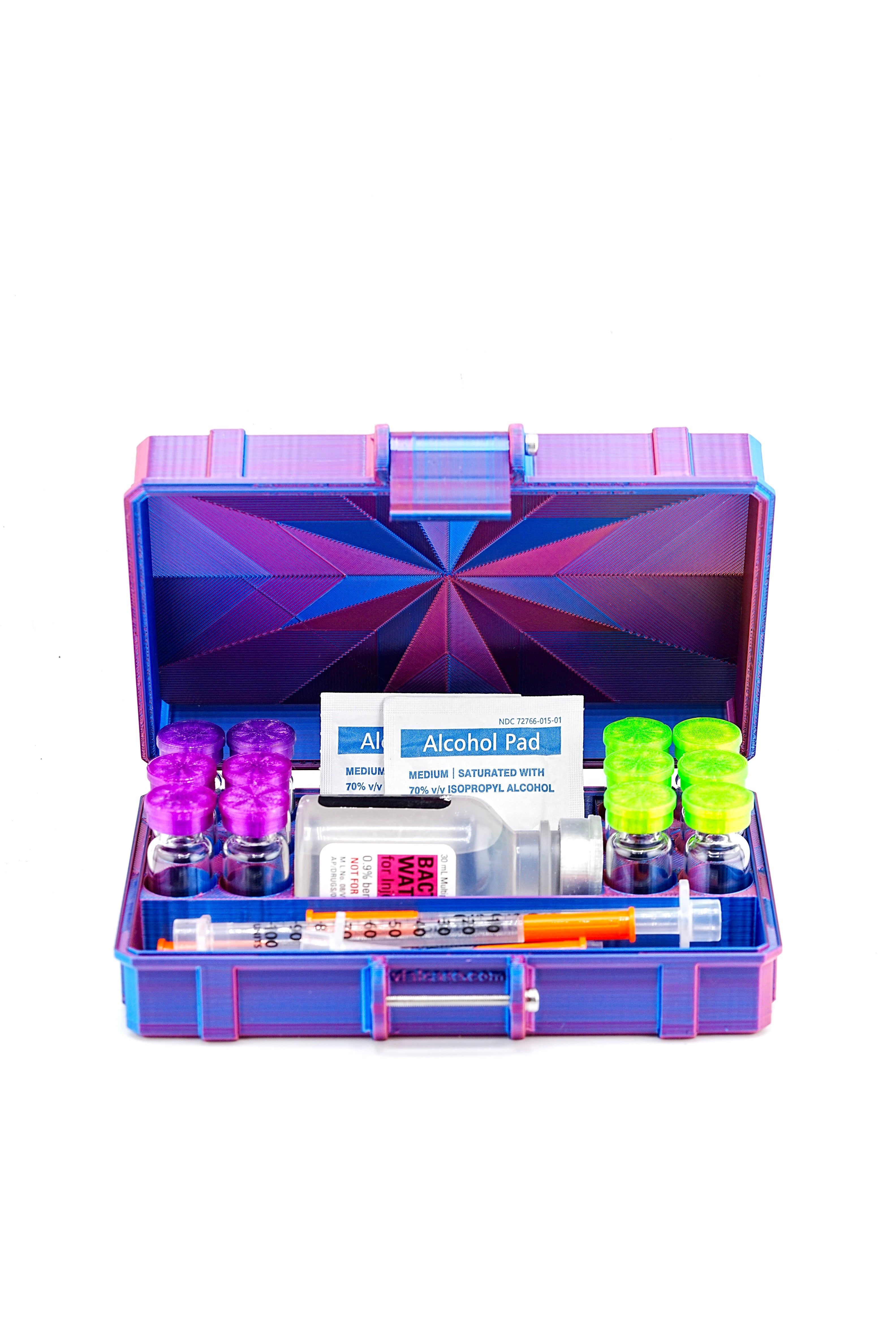
A dedicated peptide storage case solves this. Purpose-built cases like the ones at VialCase have machined foam slots sized for both 3 mL peptide vials and 10 mL BAC water vials in the same case. Each vial has its own slot, can't tip over, can't contact adjacent glass, and can be labeled. You open the fridge, open the case, see every vial you have at a glance, and know exactly what state each one is in.
This matters more than people expect. The single most common reason people don't know when they opened their BAC water is that it's just rolling around on a fridge shelf with no label system. An organized case with labeled slots eliminates that entirely. See our BPC-157 storage guide for a concrete example of how this works in a multi-vial protocol.
Organization Rule: Every vial in your protocol should have a visible date label. BAC water: date opened. Reconstituted peptide: date reconstituted. Lyophilized peptide: date purchased. A storage case with individual foam slots makes this systematic rather than aspirational.
Signs Your BAC Water Has Gone Bad
BAC water should always be a clear, colorless, odorless liquid. If any of the following are present, discard the vial immediately — do not use it to reconstitute peptides:
- Cloudiness or haziness: Clear BAC water that has turned cloudy indicates bacterial contamination or particulate formation. No exceptions — discard.
- Visible particulate matter: Flakes, specks, or floating material that doesn't dissolve means the solution is compromised. Discard.
- Discoloration: BAC water is colorless. Any yellow, brown, or other tint is a red flag. Discard.
- Unusual smell: Fresh BAC water has a faint benzyl alcohol odor — slightly sweet, slightly antiseptic. A sour, putrid, or strongly chemical smell indicates degradation. Discard.
- Compromised seal: If the aluminum crimp seal is bent, the stopper is punctured without your knowledge, or the seal has been tampered with, the sterility of the product cannot be guaranteed. Discard.
When in doubt, throw it out. BAC water is inexpensive. The peptides you're dissolving into it are not. Protecting your investment means not cutting corners on the carrier solution. This is one of the principles covered in our guide to common peptide storage mistakes — using questionable BAC water is on that list for good reason.
Common BAC Water Storage Questions (FAQ)
Where in the fridge should you store BAC water?
In the main body of the refrigerator, not the door. The door is the warmest part of a fridge because it experiences a temperature spike every time the door opens. The main body — particularly the back and middle shelves — maintains the most consistent 2–8°C temperature. Keep BAC water in the main body in a stable spot where it won't get knocked over. A storage case in the main body is the cleanest solution.
Does BAC water have to be refrigerated before opening?
No. Unopened BAC water is shelf-stable at 15–30°C. You can store it in a drawer, cabinet, or storage case at room temperature until you're ready to use it. Refrigerating an unopened vial won't hurt it, but it's not required. After opening, refrigeration is required.
Can BAC water be stored at room temperature after opening?
Briefly, yes — the benzyl alcohol does provide some protection at room temperature. But "briefly" means hours, not days. Best practice is to refrigerate after opening. If your opened vial has been at room temperature for more than 72 hours, refrigerate it immediately and watch the 28-day clock carefully. If it's been at room temperature for multiple days, discard and open a fresh vial.
How do you store unopened BAC water?
Cool, dark place at room temperature (15–30°C). A drawer, cabinet shelf, or the original product box all work. Keep it out of direct sunlight, away from heat sources, and in a low-humidity environment. Check the expiration date before use. An organized storage case with dedicated slots for BAC water vials keeps everything together and easy to inventory.
What happens if you use expired BAC water?
An expired vial (past its printed expiration date) may have degraded benzyl alcohol effectiveness. The water itself doesn't "go bad" in a dramatic way, but you can no longer rely on the manufacturer-validated preservative activity. Using expired BAC water to reconstitute a peptide means your multi-dose vial is operating without the protection you're counting on. Discard expired BAC water and use a vial within its validity period.
Can you use BAC water in a regular syringe?
Yes — draw BAC water with a standard insulin syringe or reconstitution needle. The 18–21 gauge needle is common for drawing from a BAC water vial because the large bore makes it easy to pull significant volume quickly. Switch to a finer gauge (27–31g) for injection. The needle used to draw from the BAC water vial should not be the same needle used to inject — drawing blunts the tip slightly.
Disclaimer: This article is for research and educational purposes only. The information provided is not medical advice and is not intended to diagnose, treat, cure, or prevent any condition. Consult a qualified healthcare provider before beginning any peptide protocol or making changes to your current regimen.