Why You Need More Than Just Peptides
Most people buy their first peptide — BPC-157, Semaglutide, Tirzepatide, or whatever compound they've researched — and then realize they have no idea what else they need. The peptide itself is just one piece of the puzzle. Without the right supplies, you can't safely reconstitute, accurately dose, or properly store your compounds.
This guide is your complete shopping list. We've organized it from absolute essentials to nice-to-haves, so you can start your protocol with confidence on day one.
The Essential Peptide Starter Kit Checklist
1. Your Peptide(s)
Obviously. But a few tips on purchasing:
- Buy from reputable sources — compounding pharmacies, licensed vendors, or Mexican farmacias with established track records
- Check the vial size — most research peptides come in 3ml vials (lyophilized), while BAC water comes in 10ml or 30ml bottles
- Consider buying extra — if your protocol is 4-8 weeks, buy enough vials upfront to avoid mid-protocol shipping delays
- Note the form — lyophilized (powder) needs reconstitution; pre-mixed solutions from compounding pharmacies are ready to use
2. Bacteriostatic (BAC) Water
BAC water is the solvent you use to reconstitute lyophilized peptides. It contains 0.9% benzyl alcohol as a preservative, which inhibits bacterial growth and extends shelf life to 4-8 weeks after mixing.
- Standard size: 30ml bottle (enough for 10-15 peptide vials)
- Never substitute with tap water, distilled water, or saline
- Sterile water is an alternative but lacks preservative — only use if you'll finish the vial within 5-7 days
- One bottle typically lasts an entire protocol
Pro Tip: Buy BAC water at the same time as your peptides. Nothing is more frustrating than having your vials arrive but not being able to mix them because your BAC water is still in transit.
3. Insulin Syringes
Insulin syringes are the standard delivery method for subcutaneous peptide injections. Here's what to look for:
- Size: 1ml (100 unit) or 0.5ml (50 unit) — smaller syringes give more precise dosing
- Needle gauge: 29-31 gauge (the higher the number, the thinner the needle)
- Needle length: 1/2 inch is standard for subcutaneous injection
- Quantity: Buy a box of 100. At 1-2 injections per day, a box lasts 1-3 months. Never reuse needles
- Where to buy: Pharmacies (often OTC), Amazon, medical supply websites
4. Alcohol Prep Pads
Used to sterilize vial stoppers before each draw and skin before each injection. Non-negotiable for contamination prevention.
- 70% isopropyl alcohol is standard
- Buy a box of 200 — you'll use 2-3 per dose (one for the vial, one for injection site, optionally one for BAC water)
- Individual packets are more convenient than a bottle and cotton balls
5. A Storage Case
This is where most beginners make their biggest mistake: storing peptide vials loose in the fridge, in Ziploc bags, or worse — on the bathroom counter. A proper peptide storage case solves every storage problem at once:
- Light blocking — opaque shell eliminates photodegradation
- Impact protection — precision foam slots prevent glass breakage
- Organization — separate slots for peptide vials, BAC water, and syringes
- Temperature stability — insulated construction during transport
- Fridge-ready — compact footprint, keeps peptides separate from food
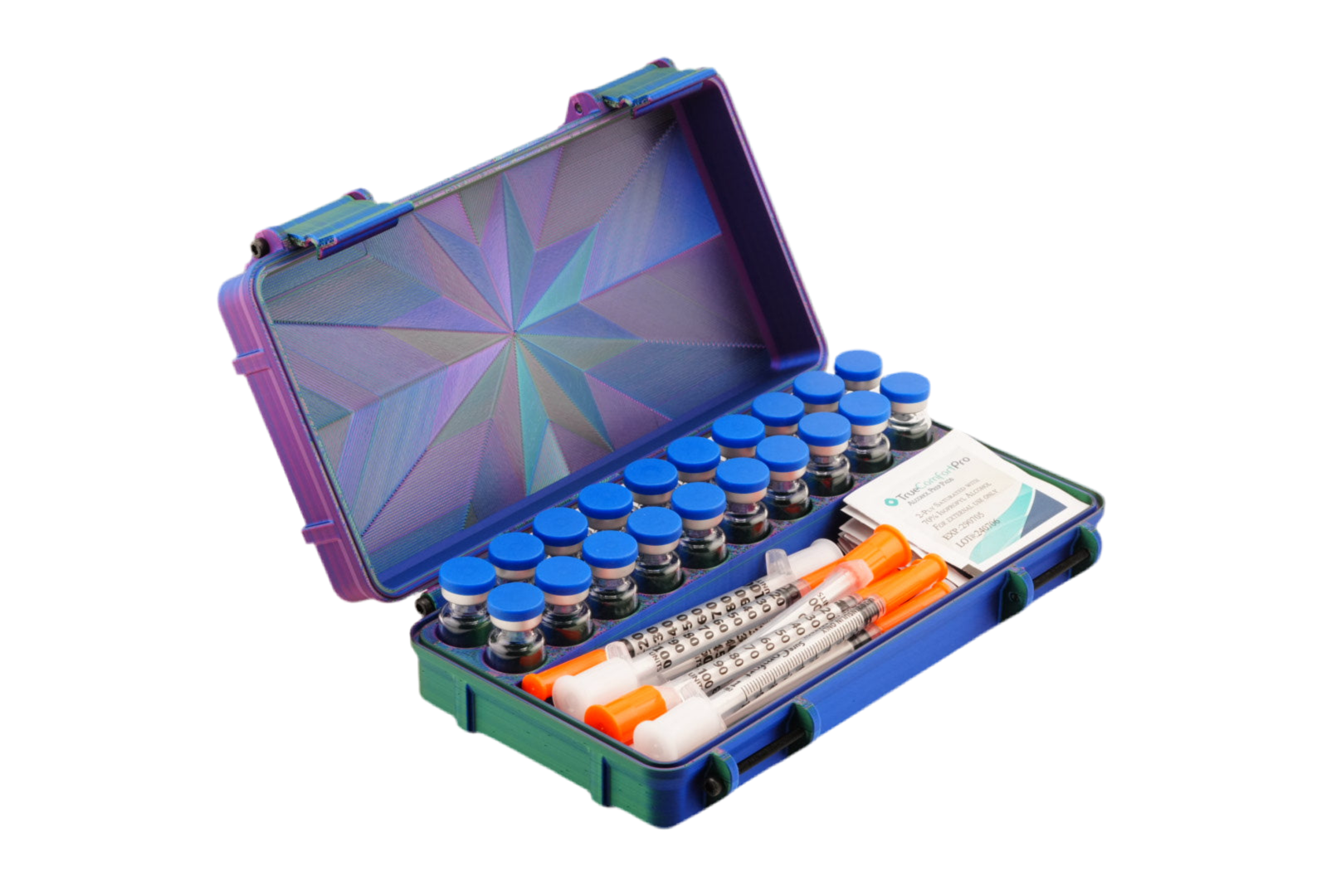
Best Starter Case: Our All-in-One Reconstitution Case holds 3ml peptide vials, a BAC water bottle, insulin syringes, and alcohol pads all in one organized case. It's the single purchase that completes your starter kit.
Nice-to-Have Supplies
6. Mixing Needles (Optional)
Larger-gauge needles (18-22 gauge) used specifically for reconstitution — drawing BAC water and injecting it into the peptide vial. The larger bore makes drawing water faster and more precise. Some people use their insulin syringes for everything, which works fine — mixing needles are a convenience, not a necessity.
7. Sharps Container
A proper sharps disposal container for used needles. If you don't have a dedicated container, a thick plastic laundry detergent jug with a screw cap works. Never throw loose needles in the trash.
8. Labels or Marker
A fine-tip permanent marker to write the compound name and reconstitution date on each vial. When you have 3-4 reconstituted vials that all look like clear liquid, labels are the difference between a clean protocol and a guessing game.
9. Cold Packs for Travel
Small gel cold packs that fit inside your storage case. Essential if you'll be traveling with reconstituted peptides or driving home from a pharmacy. Wrap in cloth to prevent direct contact with glass vials.
Choosing the Right Case for Your Protocol
The right case depends on how many peptides you're running and what supplies you need to store:
- Single peptide (e.g., just Semaglutide): A compact 3ml case with 4-6 slots is plenty
- Peptide + BAC water: A starter case with BAC water slot keeps everything together
- Multi-peptide stack (Wolverine, CJC/Ipa, etc.): A larger multi-slot case with room for 8-12 vials
- Full kit (vials + syringes + pads): The All-in-One case is designed for exactly this
Your First-Day Setup Routine
Once you have everything, here's how to set up on day one:
- Wash hands thoroughly with soap and water
- Organize your case — place vials, BAC water, and syringes in their designated slots
- Wipe the BAC water stopper with an alcohol prep pad
- Draw BAC water into an insulin syringe (typically 1-2ml per vial)
- Wipe the peptide vial stopper with an alcohol pad
- Inject BAC water slowly into the peptide vial, aiming the stream at the glass wall — not directly onto the powder
- Roll gently between palms to dissolve — never shake
- Label the vial with compound name and today's date
- Return to case, return to fridge
For a detailed reconstitution walkthrough with photos, see our BAC water reconstitution guide.
Common Beginner Mistakes
- Storing vials in the fridge door — the door is the warmest, most temperature-variable part of the fridge. Use the main shelf, toward the back.
- Using sterile water instead of BAC water — fine for single-use, but your vial won't last a week without preservative
- Leaving vials on the counter — even 30 minutes of room temperature + light exposure causes measurable degradation
- Not labeling vials — reconstituted peptides all look the same. Label everything.
- Reusing syringes — dulls the needle, increases pain, introduces contamination. Always use a fresh syringe.
- Buying no case — a $20-35 case protects hundreds of dollars in peptides. The ROI is infinite.
Bottom Line: Your peptide starter kit isn't just the peptide — it's BAC water, syringes, alcohol pads, labels, and a storage case. Get everything before your first dose, and you'll start your protocol with the same confidence as someone who's been doing this for years.