Peptides are expensive. A single vial of BPC-157 or retatrutide can run $50–$200 depending on source, concentration, and quantity. Yet the majority of people who invest that kind of money store their vials with essentially zero protection — loose in a cardboard box, rattling around a Ziploc, or sitting uncovered on a fridge shelf where the light hits them every time the door swings open. The result is accelerated degradation, wasted doses, and compounds that underperform before the protocol is even halfway done.
This guide covers exactly what unprotected storage means scientifically, how fast it destroys your peptides, and what a proper vial case actually does — along with how to set one up in under a minute.
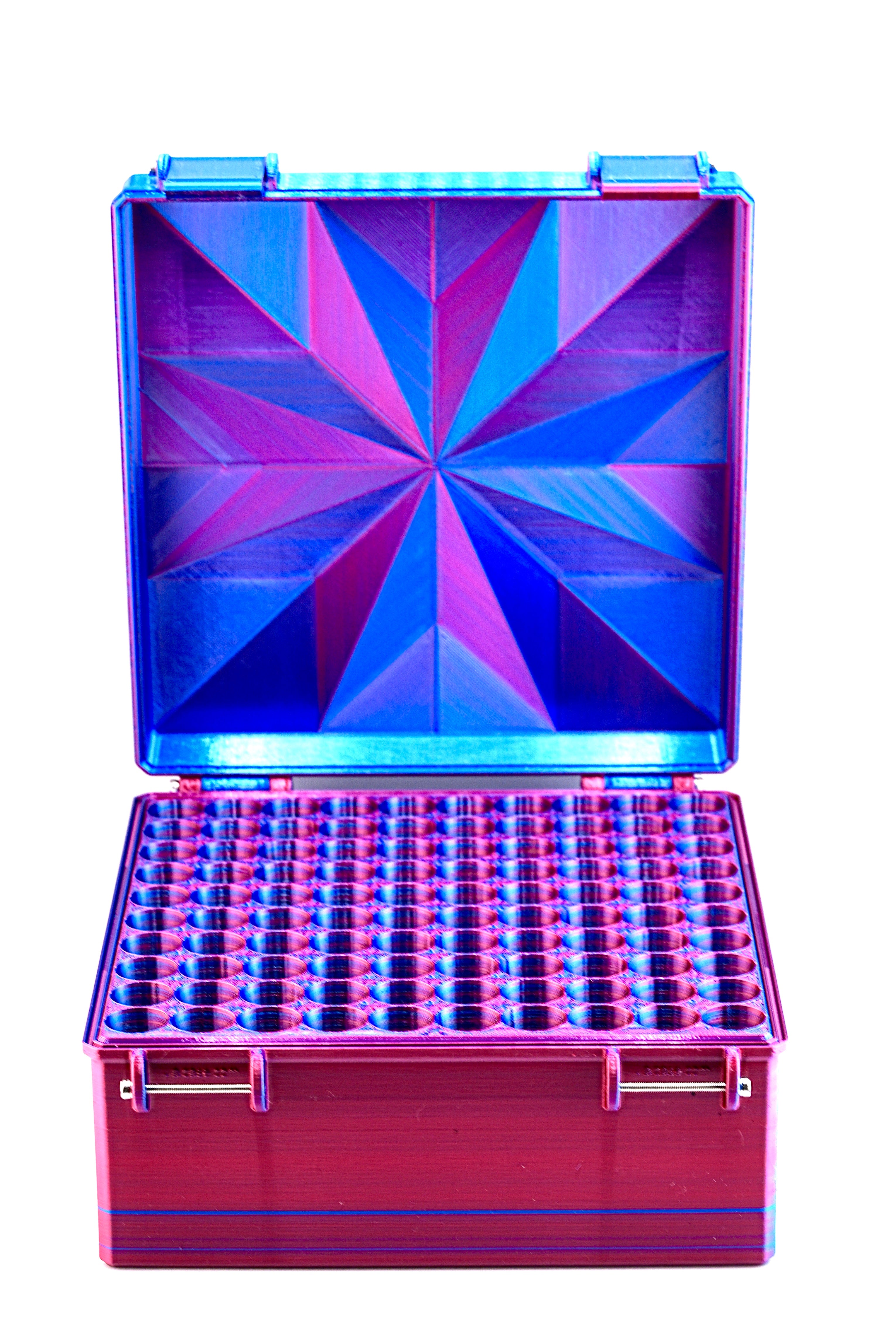
What "Unprotected" Storage Actually Means
When we say "unprotected," we don't just mean exposed to open air. In practical terms, unprotected storage covers a wide range of setups that all share the same core problem: the vial and its contents are exposed to one or more of the three primary degradation forces — heat, light, and physical stress.
The paper box your peptides shipped in is designed for transit, not long-term storage. It provides minimal insulation and zero light blocking once the flaps are open. A Ziploc bag offers no structural rigidity — glass vials can knock together and crack — and provides no light protection whatsoever. A loose vial on a fridge shelf sits in a temperature zone that fluctuates every time the door opens, gets hit by the interior light on every access, and has nothing stopping it from tipping or falling when you move something nearby.
None of these setups were designed with the chemical fragility of peptides in mind. Peptides are short chains of amino acids held together by peptide bonds — bonds that break under the right conditions of heat, oxidation, and physical disruption. What seems like minor environmental exposure to you represents a constant low-level assault on the molecular structure of your compound.
The good news is that protecting your vials is not complicated. It requires one piece of equipment — a proper storage case — and about 30 seconds of setup. But first, you need to understand exactly what you're protecting against.
The Three Risks You're Taking Every Day
Unprotected peptide storage exposes your vials to three distinct degradation pathways, each operating continuously whether you're aware of it or not.
Heat Exposure: Fridge Door Temperature Spikes
Most people know peptides need to be refrigerated. What most people don't know is that not all parts of the refrigerator maintain the same stable temperature. The fridge door — where most people instinctively put their vials — experiences the most dramatic temperature swings of any fridge location. Every time you open the door, ambient room-temperature air washes over whatever is stored there. If you're opening your fridge 10–15 times a day, your door-stored peptides are experiencing 10–15 temperature excursions daily.
Peptides stored in the main body of the fridge on a middle shelf experience far fewer swings, but they're still not immune — particularly when stored near the door or in an unstabilized location. A proper case with even minimal insulation acts as a thermal buffer, smoothing out these spikes and keeping the internal vial temperature more consistent. The fridge keeps the average temperature right; the case keeps the moment-to-moment temperature steady.
For reconstituted peptides specifically, temperature instability is particularly damaging. Repeated warming and partial cooling cycles degrade peptide bonds faster than a single sustained temperature elevation. The peptide isn't just being damaged once — it's being stressed repeatedly, with each cycle taking a small toll on overall potency.
Light Exposure: The Fridge Light Problem Nobody Talks About
Here's something the packaging almost never mentions: every time you open your refrigerator, the interior light turns on and illuminates your vials. If you're opening that door 10–15 times per day, your peptides are getting 10–15 light exposure events daily. Each one is brief — a few seconds — but the cumulative effect over days and weeks is measurable.
Peptides are photosensitive because UV and visible light generate free radicals and drive oxidation of specific amino acid residues. Methionine, tryptophan, and cysteine are particularly vulnerable. The oxidation doesn't destroy the peptide all at once — it's a gradual degradation that progressively reduces the percentage of active, intact compound in your vial. A vial that starts at 98% purity might be at 85% after two weeks of light exposure, then 70% after a month. You're injecting less active compound with every dose.
Amber glass helps at the UV end of the spectrum, but it still transmits significant visible light. The only reliable solution is storing your vials inside an opaque container — specifically one that closes completely and blocks 100% of ambient light, including the fridge light that hits every time you reach for your leftovers.
Physical Damage: Glass Vials Are More Fragile Than You Think
Glass pharmaceutical vials are not designed to survive drops, collisions, or sustained vibration. They're designed to be handled carefully, one at a time, by trained pharmacy technicians. In a household fridge, they're often stored loose, near other heavy items, and accessible to anyone who might be grabbing something quickly without paying attention to the vials nearby.
A tipped vial on a fridge shelf might crack or shatter. Two vials knocking together — say, when you grab something from the shelf they're on — can chip the glass or, worse, compromise the rubber stopper seal. A cracked stopper allows air and bacteria into the vial, destroying sterility. A chipped vial rim makes every draw a contamination risk.
Beyond outright breakage, vibration matters. Frequent micro-vibrations — from the fridge compressor, from nearby appliances, from being handled — stress the liquid contents of reconstituted vials and can gradually degrade the peptide solution over time. Purpose-built foam inserts in a proper case cushion against all of this, holding each vial individually so nothing touches, nothing vibrates against anything else, and nothing can tip or fall.
How Fast Do Unprotected Peptides Degrade?
The degradation rate of unprotected peptides depends on which compound you're running, but the numbers are sobering across the board.
Reconstituted BPC-157 stored in a clear glass vial with regular light exposure degrades measurably within 48–72 hours. Over two weeks of fridge storage with daily light hits, potency loss can exceed 20–30% compared to properly protected vials stored in identical conditions minus the light exposure. That means by the time you finish a two-week protocol, your later doses are significantly weaker than your first doses — not because the compound has expired, but because the light exposure has been quietly degrading it the entire time.
GLP-1 peptides like semaglutide, tirzepatide, and retatrutide are slightly more stable than shorter research peptides, but they're still sensitive to sustained temperature excursions. The FDA's own guidance on compounded semaglutide storage specifies 2–8°C refrigeration because even modest deviations from this range drive degradation. Fridge door storage, with its repeated temperature spikes, routinely pushes outside this window.
Growth hormone peptides like CJC-1295 and ipamorelin are among the most sensitive to all three degradation forces simultaneously. A reconstituted vial of ipamorelin stored unprotected for 30 days may retain less than 70% of its original potency — well below what's needed for a meaningful physiological effect at standard doses. This isn't a theoretical risk; it's a predictable outcome of ignoring the compound's storage requirements.
The common thread across all peptides is that degradation is cumulative and largely invisible. The liquid in your vial looks exactly the same whether it's at 95% potency or 60% potency. You can't see degradation happening, which makes it easy to underestimate — until you notice that your protocol stopped working and you can't figure out why.
Key Fact: Peptide degradation is silent. Your vial looks identical at 95% potency and 60% potency. The only way to know you're getting full-strength doses is to protect your storage conditions from day one.
What a Proper Vial Case Actually Does
A purpose-built peptide storage case solves all three degradation risks simultaneously, with no ongoing effort required on your part. Once your vials are inside, the case works passively — blocking light, buffering temperature, and physically protecting the glass around the clock.
Here's what each feature actually accomplishes:
- Opaque hard shell: Blocks 100% of ambient light including the fridge interior light. Your vials are in complete darkness from the moment the case closes. No UV, no visible light, no photodegradation.
- Precision-machined foam inserts: Each vial sits in its own dedicated slot. Vials cannot tip, roll, touch each other, or vibrate against the case walls. The foam absorbs impact from drops and reduces compressor-generated vibration. Glass stays intact even if you knock the case off the fridge shelf.
- Insulated construction: The case body slows heat transfer between the fridge interior and the outside world during transit. It also smooths out the brief temperature spikes that occur when the fridge door is opened. Your vials see a steadier temperature than anything stored loose in the fridge.
- Secure latching: The case stays closed. No accidental openings, no vials rolling out when the fridge shifts, no risk of a vial escaping and sitting unprotected on the fridge floor for an unknown period.
- Organization: Separate dedicated slots for each vial eliminate the risk of grabbing the wrong compound. When you're running multiple peptides or a full stack, this matters enormously — the wrong dose of the wrong compound is a serious mistake that a labeled, organized case prevents entirely.
A good case doesn't just protect your peptides from degradation — it protects you from errors. When every vial has a home and you can see at a glance what's in each slot, you're less likely to make dosing mistakes, less likely to forget which vial you're on, and less likely to realize mid-protocol that a vial cracked and you've been wasting product.
Setting Up Your Case in 30 Seconds
One of the most common objections to using a proper storage case is that it sounds like a hassle. It isn't. Here's the complete setup process:
- Open the case. Remove any packaging material from the foam inserts.
- Place your vials in the slots. Each slot is sized for either 3ml or 10ml vials — match vial size to slot size. Snug fit means protected fit.
- Label if needed. If you're running multiple compounds, apply small labels to the vial caps or the foam slots so you can identify each one at a glance. A piece of medical tape and a marker takes 10 seconds per vial.
- Close the case and place it in your fridge. Back of the main compartment, away from the door, on a middle shelf. Done.
That's it. Every dose you draw from this point forward comes from a protected, stable environment. The case does the rest — passively, continuously, without any effort from you.
The setup takes less time than reading this section. What it buys you is weeks or months of compound integrity that unprotected storage gradually destroys.
30-Second Setup: Vials in slots, label if you're running multiple compounds, close the case, place at the back of your fridge's main compartment. Every dose from this point forward is protected.
Common "Solutions" That Don't Work
Before settling on the right approach, most people try one or more improvised alternatives. Here's why each one fails:
The Paper Box: Came with your vials. Looks like it should work. Problems: the flaps don't seal (light gets in), there's no structural rigidity (vials can tip and knock together inside the box), and there's no insulation. It's also not water-resistant — a spill in the fridge destroys it. Good for transit from the mailbox to the fridge. Not a storage solution.
Ziploc Bags: Flexible plastic provides zero structural protection. Two vials in a Ziploc touching each other and bouncing against the fridge shelf is worse than no containment at all, because it gives a false sense of organization while creating conditions for glass-to-glass damage. Ziplocs are also semi-translucent — light passes through them. Not a storage solution.
Pill Organizers: Designed for solid tablets, not liquid-containing glass vials. The compartments are too small, too large, or the wrong shape for pharmaceutical vials. Pill organizers don't close securely, don't block light, and don't provide foam cushioning. Any impact tips or shatters the vials inside. Not a storage solution.
The pattern across all three improvised options is the same: they address at most one problem (looseness) while ignoring the others (light, temperature, impact protection). A purpose-built case addresses all of them simultaneously with a single piece of equipment that costs less than one replacement vial.
Choosing the Right Case for Your Protocol Size
Peptide storage cases come in several configurations, and the right choice depends on how many vials you're managing at any given time.
Single-compound users (1–2 vials): A compact case with 2–4 slots is ideal. You likely have one active vial and one BAC water vial, plus possibly a backup. A small case takes up minimal fridge space, keeps everything organized, and makes travel easy — it fits in a carry-on without taking up significant room.
Standard protocol users (3–6 vials): This covers most people running a single stack like the Wolverine (BPC-157 + TB-500), a GH stack (CJC-1295 + ipamorelin), or a GLP-1 plus ancillaries. A mid-size case with 6–8 slots gives you room for active vials, BAC water, and one or two extras without forcing you to overflow into a second container.
Heavy stack users (7+ vials): If you're running a full looksmaxing protocol, a biohacking stack with multiple compounds, or managing a supply of multiple GLP-1s alongside research peptides, you need a case designed for high-capacity storage. Look for cases with 10+ slots and clear slot organization that lets you separate compounds by category — GLP-1 vials in one row, research peptides in another.
Travel-focused users: If you travel regularly with your protocol, prioritize a case with a secure latch, airline carry-on compatible dimensions, and foam dense enough to protect vials through overhead bin turbulence. A case that works at home but falls apart on a flight defeats the purpose.
The VialCase lineup covers all of these use cases with cases sized specifically for 3ml and 10ml pharmaceutical vials — not generic storage boxes retrofitted for peptides, but purpose-built designs where the foam geometry matches the vial dimensions exactly.
Rule of Thumb: Buy one size up from what you need right now. Protocols tend to expand over time, and it's easier to have a case with a few empty slots than to scramble for a second case when you add a compound mid-protocol.
FAQ
Does it matter what material the case is made from?
Yes. Hard-shell cases made from polycarbonate or ABS plastic provide crush resistance that soft cases and fabric pouches cannot match. If you drop a hard case, the shell absorbs and distributes the impact before it reaches the vials. Drop a soft case and the vials absorb the impact directly. For glass vials, hard shell is non-negotiable.
Can I use a case in the freezer for long-term storage?
For lyophilized (unreconstituted) powder only, yes. A case stored in the freezer protects against light and physical damage. Never freeze reconstituted peptides — the freeze-thaw cycle creates ice crystals that physically shear peptide bonds. If you're freezing lyophilized stock, make sure the foam inserts in your case are rated for sub-zero temperatures so they don't become brittle and crack.
How do I clean the case?
Wipe the exterior and interior shell with a damp cloth. For the foam inserts, spot-clean with a slightly damp cloth and allow to dry completely before replacing vials. Never submerge foam inserts in water — they absorb moisture and take a long time to dry fully. A small amount of isopropyl alcohol on a cloth works well for disinfecting without saturating the foam.
What if I travel and can't bring a cold pack?
For trips under 4 hours, a case with insulated construction alone is generally sufficient to maintain safe temperatures for reconstituted peptides. For longer trips, a small gel cold pack (not direct ice) wrapped in a cloth and placed in the case provides reliable cold chain. Most airports sell cold packs at pharmacy sections or convenience stores near gates if you didn't pack one.
Is it worth buying a case if I only run one vial at a time?
Absolutely. The case isn't just about organizing multiple vials — it's about protecting a single vial from the light, temperature, and impact risks that exist regardless of how many vials you have. One vial of a $150 peptide is worth far more than a $40 case. The math is straightforward from the first purchase.
Can I label the foam slots instead of the vials?
Yes, and many people prefer this approach. Use a permanent marker or small adhesive labels on the foam insert next to each slot. This keeps the vials themselves clean and makes identification faster when you're reaching into the case without pulling everything out. For multi-compound protocols, slot labeling is the most efficient system.
Disclaimer: This article is for informational and educational purposes only. PeptideCase does not sell peptides, provide medical advice, or encourage the use of any specific compound. All peptides mentioned are research chemicals. Consult a licensed healthcare provider before beginning any protocol involving injectable compounds. Storage guidance is based on general pharmaceutical handling best practices and publicly available research data.