The Bulk Problem With Multi-Protocol Carry
Ask anyone running a GLP-1 + TRT + peptide stack what their biggest day-to-day frustration is, and "carrying all this stuff" comes up constantly. The problem isn't just inconvenience — it's that most people solve the size problem in ways that create new storage problems.
The most common workarounds: a Ziploc bag stuffed in a gym bag (no light protection, no impact resistance, everything rattles), a makeup or toiletry bag (soft-sided, crushable, still too big), or just leaving everything in the refrigerator at home and skipping doses on the road. None of these are real solutions.
The bulk typically comes from using the wrong containers, not from actually having too much gear. A multi-compound protocol that requires a medium-sized bag when stored incorrectly can fit into a case the size of a hardcover book when organized properly. The difference is foam-fitted slots, stacked layout, and eliminating the dead space that soft bags create.
The core insight: Bulk isn't caused by having too many vials. It's caused by cases and bags that aren't designed around the actual dimensions of vials and syringes. A purpose-built compact case eliminates dead space and gives you a footprint that's a fraction of improvised setups.
What You Actually Need to Carry Every Day
Before solving the size problem, it's worth being precise about what a combined protocol actually requires to carry on any given day. For most GLP-1 + TRT + peptide users, the daily carry list looks something like this:
- GLP-1 vial: Typically a 3ml or 5ml vial of compounded semaglutide, tirzepatide, or retatrutide. Weekly dosing means you may not need it daily, but it travels with you on injection day.
- Testosterone vial: Most TRT protocols call for 1–2 injections per week from a 10ml multi-dose vial. This is usually the largest single item in the kit.
- Peptide vials: BPC-157, TB-500, CJC-1295/Ipamorelin, or whatever research peptides are in your stack. These are typically 2mg–5mg vials — small, but often you're carrying 2–4 of them.
- BAC water: One 30ml vial covers reconstitution for multiple peptides over weeks.
- Syringes: Insulin syringes (29g–31g) for peptides and GLP-1, and a larger 23g–25g syringe for TRT if you're doing IM injections.
- Alcohol swabs: 5–10 individually wrapped swabs per trip.
- Needle disposal: A small travel sharps container if you'll be injecting away from home.
That's the real list. When you map those items against the actual dimensions of the hardware — vials are 17–65mm tall and 13–20mm in diameter, syringes uncapped are 100–160mm long — the total footprint is much smaller than most people's improvised setups suggest.
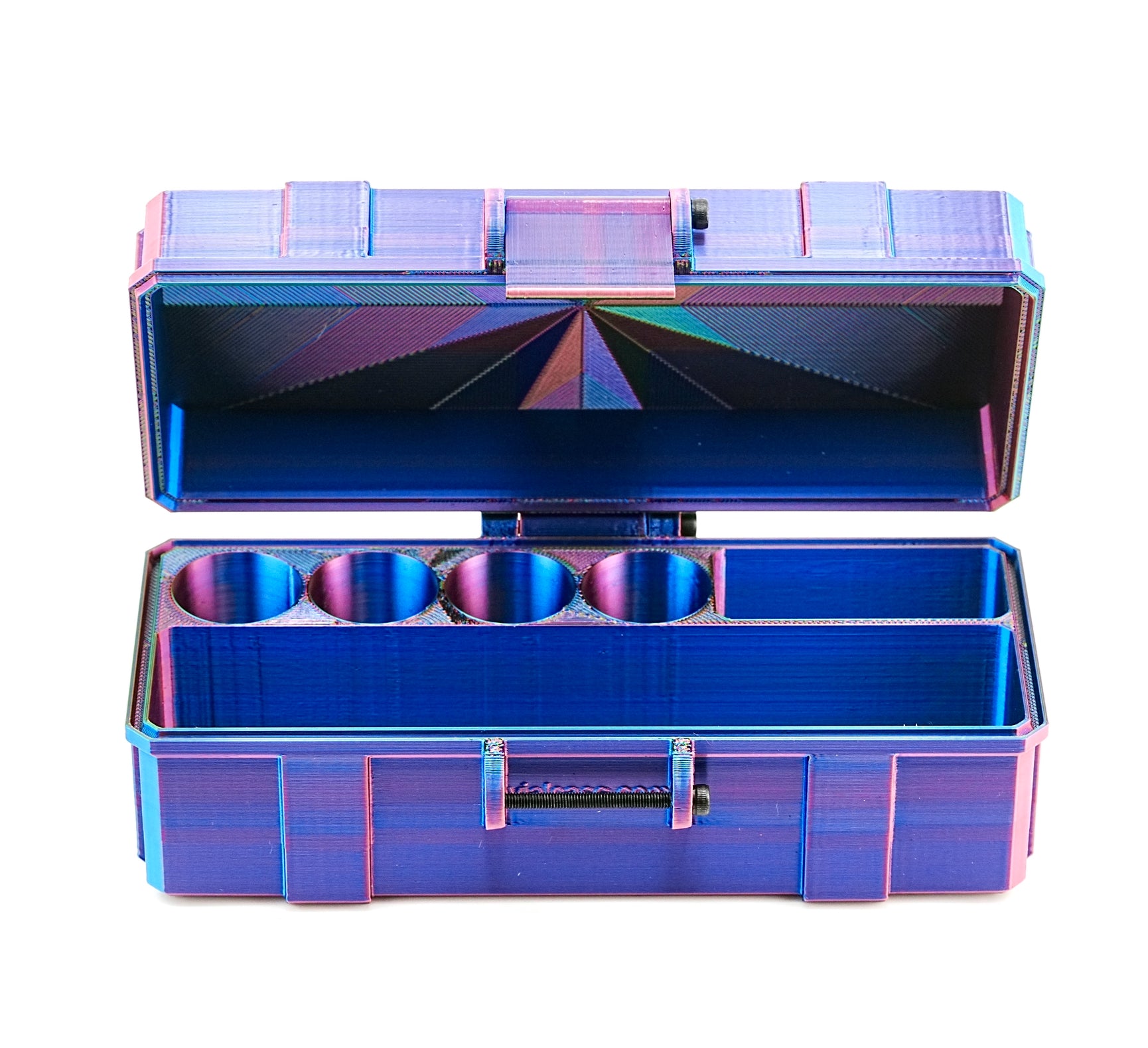
Slim vs. Standard Cases: What You Give Up and What You Keep
There's a real trade-off between compact and standard-sized cases, and it's worth being direct about it. Here's what actually changes when you go slim:
What you keep in a compact case:
- Full hard-shell protection — a quality slim case is still crush-resistant and drop-rated
- Complete light blocking — an opaque shell works regardless of case size
- Foam-fitted vial slots — most compact cases accommodate 3ml and 10ml vials side by side
- Syringe storage — slim cases can include a dedicated syringe layer above or below the vial layer
- TSA compliance — smaller often means less scrutiny, not more
What you give up in a compact case:
- Raw capacity — a slim case typically holds 4–8 vials versus 10–20 in a full-sized case
- Room for extras — gel packs, multiple swab packages, and backup syringes require more space
- Flexibility for stack expansion — if your protocol grows, you may outgrow the case quickly
For most GLP-1 + TRT + peptide users, the 4–8 vial capacity of a compact case is exactly right. You're not running 15 compounds — you're running 3–5, plus consumables. A slim case fits that protocol with room to spare.
Size reality check: Measure your actual vials before buying a case. A 10ml testosterone vial is 65–70mm tall. Make sure the case interior depth accommodates it. Some "compact" cases are sized only for 3ml vials and will leave you without a slot for your TRT vial.
The Anatomy of a Compact Carry Case
Not all compact cases are built the same. Understanding what separates a purpose-built compact vial case from a repurposed cosmetic case or generic hard case helps you make the right call the first time.
Shell construction: Look for ABS plastic or polycarbonate shell with a rubberized outer coating. This combination is impact-resistant, light-blocking, and thin enough to keep the case profile genuinely compact. Avoid soft-sided "hard cases" — the shell flexibility defeats the purpose.
Foam insert design: Custom-cut foam inserts are the single biggest differentiator. A proper insert has precision-cut slots that grip vials securely without rattling. Each vial type — 3ml peptide, 10ml TRT, 30ml BAC water — should have a slot sized to its actual outer diameter. Generic foam that requires cutting or stuffing leads to vials shifting during transport.
Layered storage: The best compact cases use a two-layer design. Bottom layer: vials seated upright in foam. Top layer: syringes, swabs, and small accessories lying flat. This stacked approach keeps the footprint small while maximizing usable volume.
Closure system: A dual-latch or zipper closure keeps the case sealed during movement. Single-latch designs are prone to popping open if the case gets compressed in a bag. If the case will go in a gym bag or backpack with other gear on top of it, dual-latch is mandatory.
Waterproofing: A fully waterproof case isn't necessary for most users, but a water-resistant gasket seal protects against condensation from cold packs and accidental spills. This matters more than it seems — condensation inside a case creates humidity that accelerates label degradation and can compromise vial stopper integrity over time.
Fitting Your Protocol Into a Small Footprint
The goal is to minimize what you're carrying without compromising what you need. Here's a practical slot assignment for a GLP-1 + TRT + 2 peptide protocol in a compact case:
- Slot 1: GLP-1 vial (3ml or 5ml) — center position for easy access on injection day
- Slot 2: TRT testosterone vial (10ml) — longest vial, needs the deepest slot or dedicated 10ml position
- Slot 3: Peptide vial #1 (e.g., BPC-157, 2–5mg) — front-left position
- Slot 4: Peptide vial #2 (e.g., CJC-1295, 2mg) — front-right position
- Slot 5: BAC water (30ml) — most compact cases include a slot for one 30ml vial
- Accessory layer: 3–4 insulin syringes, 1 TRT syringe, alcohol swabs
That's a complete 4-compound injection protocol stored in a case that measures roughly 8" x 5" x 3" — smaller than most laptop bags' front pocket. The key is starting with precise slot assignment rather than trying to fit things in after the fact.
If your protocol uses more than 5 vials, consider which ones actually need to travel with you versus which ones stay in the refrigerator at home. Most peptide users only need to carry the vials they'll use within the current injection window. A 4-vial travel subset of an 8-vial home protocol is a completely valid approach.
The Gym Bag Test: Will It Fit?
The gym bag is the most demanding compact carry test. It's a chaotic environment — shoes, water bottles, a change of clothes, a shaker cup, headphones. Anything you add to it has to survive being compressed, tossed, and occasionally dropped.
Here's what a compact case needs to pass the gym bag test:
- Exterior dimensions under 9" x 6" x 4": Most gym bags have a dedicated compartment in this size range. A case that exceeds these dimensions goes in the main compartment where it competes with bulkier gear.
- Dual-latch closure: When a water bottle falls on top of your case, a single latch fails. Dual latches hold.
- Foam that locks vials in place: Loose vials clinking inside a case during a gym session are a sound problem and a glass-breakage problem. Custom-cut foam eliminates both.
- A carry handle or exterior loop: Being able to pull the case out by a handle rather than digging into the bag saves time and reduces the chance of dropping it.
The practical gym carry scenario: you inject BPC-157 post-workout before leaving the locker room. The case comes out of your bag, opens with a latch click, vial is in the designated slot, you inject, and the case goes back. Total time: under 3 minutes. A disorganized bag-within-a-bag setup easily triples that time and increases the stress of the process enough that many people just skip the dose. Consistency matters in peptide protocols, and friction is the enemy of consistency.
Gym bag tip: Store your compact case in the same compartment every single time. Creating a fixed location in your bag means you reach for it instinctively rather than searching, especially useful when you're post-workout and not thinking clearly about where you packed things.
Office and Commute Carry: The Professional Case Setup
Carrying peptides and TRT to work introduces a discretion requirement that gym carry doesn't have. A compact case solves this — but only if it reads as professional rather than medical.
The cases that work best for office and commute carry share a few characteristics. They look like a pen case, tech accessories case, or toiletry kit rather than a medication organizer. Black or dark gray matte shells are ideal. Avoid cases with visible medical crosses, pill imagery, or anything that suggests injectable medication to a casual observer.
For desk drawer storage during the workday, the case needs to fit inside a standard desk drawer (roughly 11" x 14" x 2.5" interior). Most compact vial cases satisfy this, but measure before you buy if this is a priority. Some people prefer a slightly thinner case profile specifically to slide it into a desk drawer without the drawer catching.
Commute carry — whether that's a briefcase, laptop bag, or backpack — is similar to gym carry in terms of dimensional requirements, but the compression forces are different. Briefcases and laptop bags tend to have structured compartments with less chaotic movement, but they also get stacked, set down on surfaces, and occasionally put through bag scanners. A hard-shell case looks completely normal going through office building security.
For protocols that require mid-day dosing (twice-daily peptide injections are common with CJC-1295/Ipamorelin), the office carry case also needs to provide temporary refrigeration or insulation. A compact case with a thin gel pack on top of the foam insert can hold 2–8°C temperatures for 4–6 hours in typical office environments — enough to bridge a morning commute, a workday, and an evening commute without temperature excursion.
Travel Carry: When Compact Matters Most
Travel is where the compact carry case earns its cost most clearly. Every extra inch of case size becomes a genuine problem when you're navigating airports, hotel rooms, and rental cars.
The hierarchy of travel carry storage: personal item bag > carry-on bag > checked luggage. Your peptides and TRT should always be in a personal item bag — the bag that goes under the seat in front of you. It's with you the entire flight, it never goes into temperature-variable cargo holds, and it doesn't get lost. A compact case that fits in the front pocket of a personal item bag is the ideal form factor.
TSA screening is a consistent anxiety point for people carrying injectables. The reality is that TSA officers see insulin kits, EpiPens, and medical supplies constantly. An organized, compact hard-shell case communicates "medical necessity" immediately and clearly. A Ziploc bag of random vials communicates "something to investigate." The case itself is part of your TSA strategy.
For international travel, the compact case reduces customs scrutiny for the same reason. A purposefully organized case is easier to explain than a disorganized collection of loose vials and syringes. If you're carrying a physician's prescription or letter, keep it accessible in the case's accessory pocket — not buried in your luggage.
Hotel room storage for a compact case is straightforward. The case goes directly into the minibar or in-room refrigerator. Its footprint is small enough that it doesn't dominate the fridge shelf, and the hard shell protects vials from being disturbed if housekeeping opens the fridge. Label the case on the exterior with your name and room number as a basic precaution.
Travel cold chain tip: For flights under 3 hours, a compact case without a cold pack is typically fine — aircraft cabins are cool, and your body temperature offsets some ambient warming. For flights over 3 hours, add a single slim gel pack in the accessory layer. Freeze it the night before so it's at maximum cold capacity at departure.
FAQ
Can a compact case fit a 10ml testosterone vial alongside 3ml peptide vials?
Yes, but only in cases specifically designed for mixed vial sizes. Confirm the case lists 10ml vial compatibility before purchasing. A case sized only for 3ml vials will not accommodate a standard 10ml TRT vial (which is approximately 65mm tall and 20mm in diameter).
How many vials can a compact case actually hold?
Most true compact cases hold 4–8 vials depending on size mix. A case with 4 slots for 3ml vials and 2 slots for 10ml vials covers the vast majority of GLP-1 + TRT + 2 peptide protocols. If you're running more than 5 distinct compounds, consider whether a standard-sized case is more appropriate.
Do I need refrigeration inside the case for day carry?
For reconstituted peptides and GLP-1 vials, yes — if the carry time exceeds 2–3 hours. A slim gel pack in the accessory layer handles this without meaningfully increasing the case's size or weight. TRT testosterone vials are stable at room temperature for 24+ hours, so they don't require active cooling during day carry.
Are compact cases TSA-approved?
TSA does not pre-approve specific cases, but a hard-shell compact case with organized slots is the ideal presentation for carrying injectable medications through airport security. Declare your medications if asked. The case itself is not the issue — TSA cares about the contents, not the container.
What's the difference between a compact case and a travel case?
The terms overlap significantly. "Travel case" typically implies a case optimized for airport travel — possibly with documentation pockets, TSA-compliant dimensions, and insulation. "Compact case" implies primarily a small footprint. The best compact cases for GLP-1 + TRT + peptide protocols are both: small and travel-ready.
Can I store TRT and GLP-1 in the same case?
Yes. TRT testosterone is oil-based and GLP-1 vials are water-based — they don't interact chemically when stored in the same case. The main consideration is that both benefit from refrigeration and both require light protection, which a quality hard-shell case provides for all slots simultaneously.
What's the best compact case for a GLP-1 + TRT + 2 peptide protocol?
Look for a case with dedicated slots for mixed vial sizes (3ml and 10ml), a two-layer design for vials and accessories, dual-latch closure, and an exterior footprint under 9" x 6". VialCase's compact options are purpose-built for exactly this use case.
Disclaimer: This article is for informational and educational purposes only. PeptideCase does not sell, endorse, or prescribe any pharmaceutical compounds, research peptides, or controlled substances. GLP-1 medications require a valid prescription from a licensed physician. Testosterone replacement therapy requires medical supervision. Research peptides are not approved for human use by the FDA. Nothing in this article constitutes medical advice. Consult a qualified healthcare provider before starting any injection protocol.