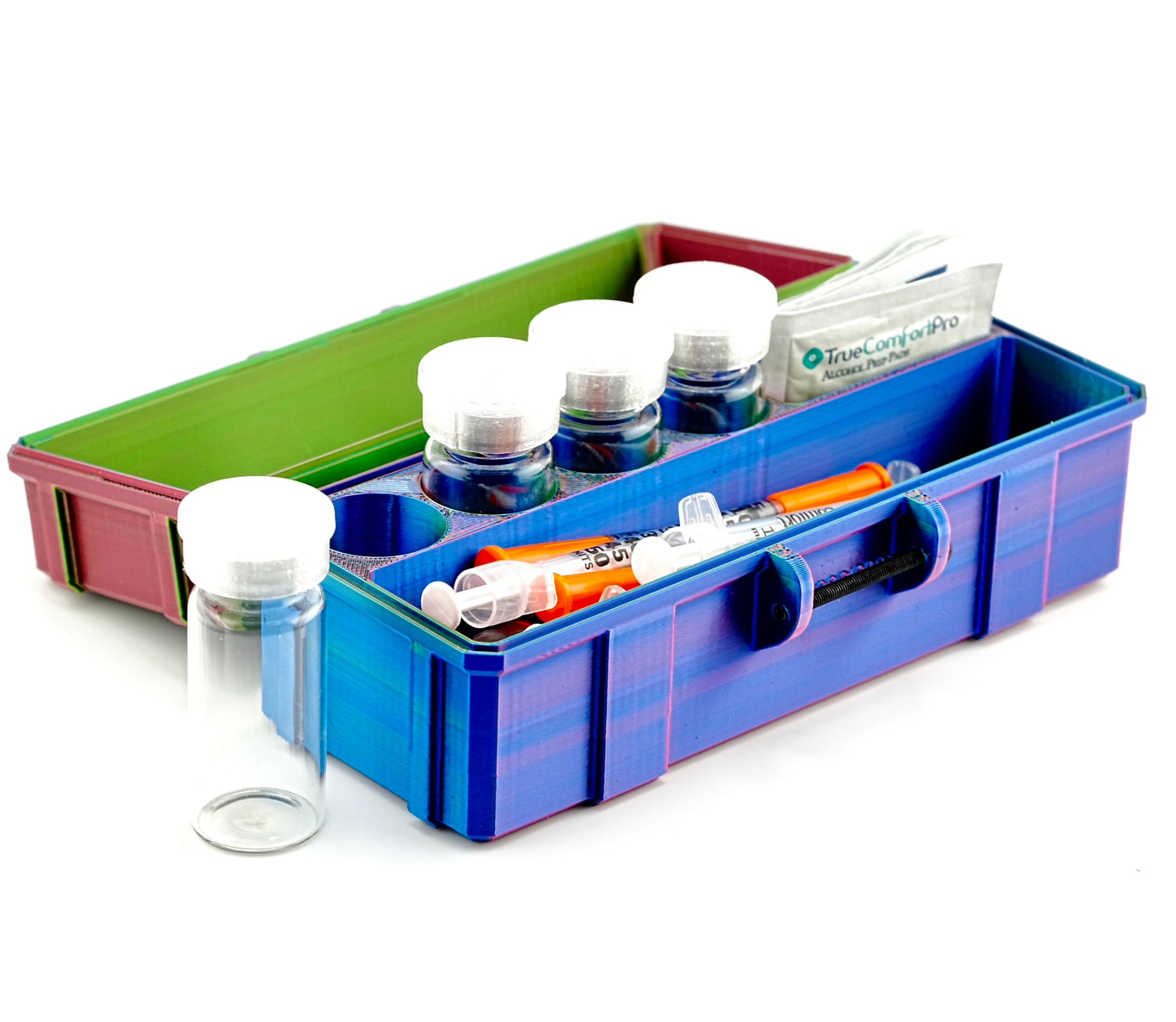
What a Combined GLP-1 + TRT + Peptide Protocol Looks Like
Before solving the storage problem, it helps to understand what a typical combined protocol actually contains. The most common configuration — the one we see across forums, clinics, and personal consultations — looks something like this:
- GLP-1 component: One 10ml multi-dose vial of compounded semaglutide (2.5mg/ml is common) or tirzepatide, dosed weekly. Some users run retatrutide for its triple-agonist fat loss profile. This is the primary metabolic intervention.
- TRT component: One or two 10ml vials of testosterone cypionate or testosterone enanthate in oil suspension. Most TRT protocols involve injections every 3.5 to 7 days, so a single 10ml vial at 200mg/ml lasts several weeks.
- Peptide stack: Anywhere from one to five additional compounds. Common additions include BPC-157 and TB-500 for recovery, CJC-1295 with Ipamorelin for GH optimization, or GHK-Cu for skin and hair. Each comes in its own 3ml or 5mg vial.
- Reconstitution supplies: BAC water vials (10ml), syringes in multiple sizes (0.5ml insulin pins for subcutaneous peptide injections, 3ml for testosterone), and needles.
By the time you add it up, a moderate combined protocol involves 6–12 vials of different sizes, multiple syringe types, and injection schedules that differ across compounds. The organizational challenge is real — and the risk of grabbing the wrong vial or drawing the wrong compound is highest when you are not organized.
Why Each Component Has Different Storage Needs
One of the central complications of a combined protocol is that each category of compound has distinct storage requirements. They are not interchangeable, and treating them as if they are leads to degradation and wasted money.
GLP-1 vials (water-based, compounded). Compounded semaglutide, tirzepatide, and retatrutide are aqueous solutions that must be refrigerated at 2–8°C (36–46°F). They are moderately light-sensitive and should be stored in a dark environment. Once opened, compounded GLP-1 vials typically have a shelf life of 28–56 days refrigerated, depending on the compounding pharmacy's formulation and any added preservatives. They should never be frozen once reconstituted or dispensed in solution form.
TRT vials (oil-based). Testosterone cypionate and testosterone enanthate are suspended in sesame or cottonseed oil. This matters for storage because oil-based preparations behave very differently from water-based ones. Oil-based TRT vials do not require refrigeration under normal circumstances — they are stable at room temperature (up to about 25°C / 77°F) for their labeled shelf life, which is typically 2–5 years. Refrigerating testosterone oil can cause the suspension to become viscous and difficult to draw. If you do refrigerate your TRT vials alongside your GLP-1 and peptides, allow them to warm to room temperature before drawing — or keep them at room temp in your case and refrigerate the case only during travel or when ambient temperatures are high.
Peptide vials (lyophilized powder or reconstituted). Lyophilized peptide powder is the most stable form. Stored frozen (-20°C) and away from light, powdered peptides like BPC-157, TB-500, CJC-1295, and Ipamorelin can last 1–2 years. Once reconstituted with BAC water, the shelf life drops to 4–8 weeks refrigerated. Reconstituted peptides must stay at 2–8°C and should never be frozen (freeze-thaw cycles destroy the molecular structure). They are sensitive to both temperature and light.
Key Takeaway: GLP-1 vials and reconstituted peptides share refrigeration requirements. TRT vials prefer room temperature and don't need refrigeration. BAC water vials are stable at room temp until opened, then should be refrigerated. Your case needs to accommodate all of these in a way that keeps everything accessible without requiring refrigeration for compounds that don't need it.
The Organization Problem With Multi-Protocol Storage
The chaos that comes with a combined protocol is not random — it follows predictable patterns. Understanding the failure modes helps you design a system that avoids them.
Vial confusion. A 10ml vial of semaglutide and a 10ml vial of testosterone cypionate are the same physical size. Without a clear labeling and organization system, the only way to distinguish them is to read the label each time — and at 6am, in a hurry, people don't always read carefully. Cases with dedicated zones for each compound category eliminate this risk.
Needle cross-contamination. The needle gauge and length for subcutaneous peptide injections (typically 29–31g, 4–8mm) is very different from what many use for intramuscular testosterone injections (typically 21–25g, 25mm). Mixing needle types in a disorganized drawer creates the risk of using the wrong needle for the wrong injection, which ranges from uncomfortable to genuinely dangerous.
Expiration tracking failure. Each compound has a different shelf life and reconstitution date. Without a system, you are relying on memory — or the label you wrote with a marker that has since smudged. A protocol with six compounds means tracking six separate expiration windows simultaneously.
Travel disassembly and reassembly. If your storage is disorganized at home, it becomes genuinely difficult to travel with your protocol. What do you pack? What stays home? How do you keep everything cold without knowing what needs to be cold? An organized all-in-one case solves the travel problem automatically — if it's in the case, it travels with you.
Choosing a Case That Fits Everything
The right all-in-one case for a combined GLP-1 + TRT + peptide protocol has to solve several problems simultaneously. Here is what to look for:
Mixed vial capacity. Your protocol likely includes 10ml vials (GLP-1, testosterone, BAC water) and smaller 3ml or 5mg vials (peptides). The case needs slots for both sizes, ideally in clearly defined zones. A case with only 3ml slots forces your 10ml vials into improvised positions. A case with only 10ml slots wastes space and leaves your small peptide vials rattling around.
Total vial count. Count your vials: one GLP-1, one or two TRT, two or three peptides, one or two BAC water. Most moderate protocols run 6–10 vials. Allow room to grow — if you're at 6 now, a 12-slot case gives you headroom without being absurd. For heavier stacks with 5+ peptide compounds, look at 18–24 slot configurations.
Hard-shell construction. Glass vials do not forgive soft cases. A fabric or neoprene case provides essentially no crush protection. If you set a bag down hard, or something is stacked on top of it in a suitcase, glass vials in soft storage break. Hard-shell cases with machined foam interiors absorb impact and keep vials from touching each other.
Full light blocking. GLP-1 and peptide vials are photosensitive. The case needs to block 100% of light when closed. Mesh panels, clear windows, and thin fabric walls all fail this requirement. A hard-shell opaque case is the only adequate solution.
Portability and TSA compatibility. For travel, the case needs to fit in a carry-on bag — never check injectables. A case with a clean, professional appearance passes TSA screening without drawing unnecessary attention. Your organized, labeled vials in a purpose-built case look like medical supplies, which is exactly what they are.
The VialCase lineup includes multi-slot configurations specifically designed for mixed vial sizes and combined protocols. If you are running GLP-1, TRT, and peptides simultaneously, you want a case that accommodates all three without compromise.
Slot Assignment Strategy for Mixed Protocols
Having a case is step one. Knowing how to assign slots is step two. A clear, consistent slot assignment strategy turns a case from storage into a system.
The most effective approach divides the case into zones by compound category:
Zone 1 — GLP-1 (weekly dosing). Assign the most accessible slot position to your GLP-1 vial. You use this once a week, but it is your primary weight management intervention — it should be easy to find and easy to draw from without disturbing other compounds.
Zone 2 — TRT (every 3.5–7 days). Assign adjacent slots to your testosterone vials. Keep your TRT vials together and separate from aqueous compounds. If you run both testosterone cypionate and HCG (common for maintaining testicular function on TRT), keep them adjacent in this zone.
Zone 3 — Research peptides (daily or multi-daily dosing). Assign dedicated slots for each peptide, in the order you use them. If you inject CJC/Ipa at night and BPC-157 in the morning, put the morning compounds at the front of the zone. Consistent slot assignment means you always reach for the same position without thinking.
Zone 4 — Reconstitution supplies. BAC water vials and any unreconstituted lyophilized powder vials that haven't been opened yet. This zone is accessed less frequently than the active compound zones.
Label each slot. The case should tell you what belongs there at a glance, so you can see immediately when something is missing or out of place.
Organization Tip: Use colored dot stickers on vials to correspond to zones — one color for GLP-1, another for TRT, another for each peptide. You can see at a glance what everything is before reading the label. This is especially useful when drawing up injections quickly or when someone else (a partner, a nurse) needs to access your supplies.
Travel With Your Full Protocol
Traveling with a combined GLP-1 + TRT + peptide protocol is more logistically complex than traveling with any single compound. Here is how to do it correctly.
Always carry on. No exceptions. Cargo holds on aircraft can reach -40°C in winter or +50°C in summer. Your GLP-1 and reconstituted peptides cannot survive either extreme. Check your bags, but carry your case.
Cold packs for temperature-sensitive compounds. If your total transit time exceeds 2–3 hours, add a gel cold pack to the case. Wrap it in a cloth or paper towel to prevent direct contact with vials — you want the case cool, not frozen. A frozen cold pack pressed directly against a GLP-1 vial can actually drop the temperature below 0°C and damage the compound.
Room-temperature TRT during transit. Your testosterone vials do not need the cold pack. They are fine at room temperature. If your case has separate zones, keep the TRT zone away from direct cold pack contact to avoid unnecessary viscosity increase.
Documentation matters more with a combined protocol. TSA sees injectable supplies frequently and generally does not require explanation, but if you are carrying a case with 10 vials, multiple syringes, and cold packs, a one-paragraph letter from your prescribing physician — listing the compounds, prescribed doses, and your name — eliminates any potential for delay or confusion. This is especially important for international travel where border agents may be less familiar with compounded GLP-1 and research peptides.
Hotel fridge management. Most hotel mini-fridges maintain 4–8°C, which is adequate for your GLP-1 and reconstituted peptides. Confirm the fridge is actually cooling (feel the back wall) before storing vials in it. Keep your case in the fridge overnight and remove it for injection, keeping the case on the counter only long enough to draw your dose.
Duration limits on travel. For short trips of 2–3 days, your full protocol travels with you as-is. For longer trips, assess whether you need to bring full backup vials or whether existing vials will last the duration. A 10ml GLP-1 vial dosed weekly at 0.5ml has 20 doses — more than enough for a month-long trip. A 3ml peptide vial reconstituted with 3ml BAC water and dosed at 250mcg per injection yields 12 doses — enough for 4–6 days of daily injections. Plan ahead.
Avoiding Cross-Contamination and Mix-Up Errors
Mix-up errors in a combined protocol range from annoying to dangerous. Injecting your GLP-1 dose from your BAC water vial wastes a dose. Injecting testosterone cypionate subcutaneously instead of intramuscularly causes a painful oil deposit. Injecting the wrong peptide is usually benign but wastes compound and disrupts your protocol. None of these are acceptable outcomes of poor organization.
The following practices eliminate or dramatically reduce mix-up errors:
Never draw without reading the label. This sounds obvious, but the most common error source is assuming you know what you're picking up because of its position in the case. Read the label every time. The 3 seconds it takes is worth it.
Use distinctly different syringes for different compounds. Your testosterone injections use a different needle than your subcutaneous peptide injections. If you use color-coded syringe caps or keep different gauge syringes in clearly separate pouches, there is no way to accidentally use the wrong delivery method.
Prepare one injection at a time, then put the vial away. The error mode is: draw compound A, set the vial on the counter, draw compound B, and then accidentally cap the compound A syringe with compound B. If you complete each injection — draw, cap, label the syringe, put the vial back — before touching the next compound, this error mode does not exist.
Label drawn syringes immediately. If you pre-draw injections the night before, label every syringe the moment you draw it. A capped, unlabeled syringe on the counter is an accident waiting to happen.
Quarantine opened vials from sealed ones. Once you have reconstituted a peptide vial or punctured a GLP-1 vial, it goes into the "active" section of your case. Sealed, unreconstituted, or unopened vials stay in the "reserve" section. This prevents accidentally injecting from a backup vial you intended to keep sealed.
The Ideal All-in-One Case Setup
Based on the storage requirements, organizational principles, and travel needs described above, here is what the ideal all-in-one setup looks like for a combined GLP-1 + TRT + peptide protocol:
The case itself: A hard-shell, opaque, multi-zone case with individual foam-fitted slots. Minimum 10-slot capacity for a moderate protocol; 18+ slots for heavier stacks. The case should fit inside a standard carry-on without using a disproportionate amount of packing space — most VialCase configurations are compact enough to slip into a toiletry kit or the front pocket of a carry-on bag.
Zone labeling: Use a label maker or write clearly on the case exterior and interior. Each zone should be labeled with the compound category (GLP-1, TRT, Peptides, Supplies). Each slot should have a small label or marker for the specific compound assigned to that position.
Vial labeling: Every vial, without exception, should have a handwritten or printed label showing: compound name, concentration (if reconstituted), reconstitution date (if applicable), and expiration date. A fine-tip permanent marker on medical tape works. Waterproof labels work better.
Supplementary supplies: A small alcohol swab holder or alcohol prep pad pouch. Extra needles in two sizes (subcutaneous and intramuscular). A compact sharps disposal container — many airlines and hotels do not provide these, and improperly disposed sharps are both a safety issue and a courtesy issue. A physician's note for TSA and border control.
Cold chain management: A slim gel cold pack that fits in the case or in a dedicated slot. Pre-chill the cold pack the night before travel. It should provide 6–8 hours of temperature maintenance inside a closed, hard-shell case.
Bottom Line: A combined GLP-1 + TRT + peptide protocol is not more complicated than it needs to be — but it requires a system. One purpose-built case, a clear slot assignment strategy, and consistent labeling habits are enough to manage 10+ vials across three compound categories without confusion or error. The case pays for itself the first time it prevents a broken vial or a mix-up injection.
FAQ
Can I store GLP-1 and testosterone in the same case?
Yes. They are physically compatible in the same case. The important distinction is refrigeration: your GLP-1 and reconstituted peptides need to stay at 2–8°C, while your testosterone cypionate or enanthate is stable at room temperature. If you refrigerate the whole case, your TRT vials will be cold but unharmed — just allow them to warm slightly before drawing. If you keep the case at room temperature, your GLP-1 and peptides need to be moved to the fridge separately, which defeats the all-in-one purpose. Most users find it simplest to refrigerate the entire case.
What's the maximum number of vials one case can realistically hold?
VialCase configurations range from 6 slots to over 30 slots. A "moderate" combined protocol of 8–12 vials fits in a mid-size configuration. Heavy stacks with 5+ peptide compounds plus GLP-1 and TRT can require 18–24 slot configurations. The practical limit is what you can carry comfortably — a 30-slot case full of vials gets heavy.
Do I need to declare my injections at TSA?
TSA does not require pre-declaration of medical injectables in carry-on bags, but they should be easily accessible for inspection. Having them in a dedicated case rather than scattered through your bag speeds the security process. You are not required to remove injectable supplies from your bag the way you remove liquids over 3.4oz, but having your case organized and accessible makes the screening process smoother for everyone. See our full guide on flying with peptides for complete TSA guidance.
Can I mix peptide compounds in the same syringe to reduce injection frequency?
Some compounds can be co-administered, some cannot. BPC-157 and TB-500 are commonly stacked in the same injection. CJC-1295 and Ipamorelin are often drawn into the same syringe. However, mixing compounds introduces risk of chemical incompatibility and makes dosing math more complicated. This is a protocol question for your prescribing physician, not a storage question — but your case should support single-vial draws if that is what your protocol requires.
How do I handle my protocol when power goes out?
Your reconstituted peptides and GLP-1 are the time-sensitive compounds. A full fridge maintains safe temperature for approximately 4 hours without power. Do not open the fridge during an outage — every opening vents cold air and shortens the safe window. If power is restored within 4 hours, your compounds are almost certainly fine. If the outage exceeds 4–6 hours, assess each vial: if the fridge temperature rose above 15°C for more than 2 hours, err on the side of discarding and reordering rather than using potentially degraded compounds.
What's the best way to label vials for a combined protocol?
Use waterproof label tape (available at any pharmacy) and a fine-tip permanent marker. Write: compound abbreviation (SEMA, TEST-C, BPC, CJC, IPA), concentration if applicable, and reconstitution date. Keep it short enough to read at a glance. For a more polished system, pre-printed labels from a label maker work well. See our complete guide on organizing a multi-peptide protocol for a full labeling system.
Disclaimer: This article is for informational and educational purposes only. It does not constitute medical advice, and nothing in this article should be interpreted as a recommendation to use, combine, or modify any pharmaceutical compound or research peptide. GLP-1 medications should be used only under the supervision of a licensed healthcare provider. Research peptides are sold for research purposes only and are not approved for human use by the FDA. Always consult a qualified medical professional before beginning any new medication or supplement protocol. PeptideCase is a storage products company and does not provide medical or pharmaceutical guidance.