The Two Danger Zones, Stated Plainly
Every peptide and GLP-1 medication on the market has two temperature thresholds you cannot cross without consequences:
- The heat zone — sustained exposure above 86°F (30°C). Every hour above this threshold causes measurable degradation. Brief excursions (under an hour) are typically survivable. Hours-long exposure in a hot car, a USPS truck, or a non-air-conditioned hotel room is not.
- The freeze zone — any duration below 32°F (0°C) once reconstituted. Unlike heat, freezing is binary for reconstituted vials. A single freeze-thaw cycle can render a peptide partially or fully inactive. This is the most commonly missed failure mode in winter shipping and checked-luggage travel.
Between these two extremes, peptides have a wide and forgiving operating window. Refrigerated storage at 36–46°F (2–8°C) is ideal. Brief excursions to room temperature (68–77°F / 20–25°C) are well-tolerated by most compounds for short windows. The trouble starts when temperatures move outside that band — and the trouble compounds with every excursion.
Why Peptides Are Temperature-Sensitive in the First Place
Peptides are short chains of amino acids held together by peptide bonds and folded into specific three-dimensional shapes. Their biological activity depends on that shape. Three failure modes destroy it:
- Protein denaturation. Heat agitates the molecule, breaking the weak hydrogen bonds and hydrophobic interactions that maintain the folded structure. Once unfolded, the peptide can refold incorrectly, aggregate with other peptide molecules, or remain permanently disordered. The receptor it was designed to bind no longer recognizes it.
- Peptide bond hydrolysis. At elevated temperatures, water molecules cleave the amide bonds linking amino acids. The peptide literally fragments into smaller, inactive pieces. This process accelerates exponentially with temperature — a vial held at 104°F (40°C) degrades roughly 4–8x faster than one held at 77°F (25°C).
- Ice crystal damage. When a reconstituted peptide freezes, water molecules form sharp crystalline structures. Those crystals physically penetrate and disrupt the peptide chain, and concentrate solutes (including the peptide itself) into the unfrozen liquid pockets, where pH shifts and high local concentration trigger irreversible aggregation. Re-thawing does not undo this damage.
The implication: temperature damage is mostly invisible. A degraded vial usually looks identical to a fresh one. You only discover the problem when your protocol stops working, your weight loss plateaus inexplicably, or your inflammation markers don't improve as expected.
The cumulative excursion principle: Peptides do not "reset" between temperature events. A vial that spent 4 hours at 90°F during shipping, then 2 hours at 88°F during a delivery delay, then a week in your fridge has the cumulative damage of all those excursions. There is no rest period that restores potency. Treat your storage history as a running balance.
Lyophilized vs. Reconstituted: Two Different Stability Profiles
Most peptide users encounter their compounds in two states: lyophilized (freeze-dried powder, sealed under vacuum) and reconstituted (mixed with bacteriostatic water for injection). These two states behave very differently under temperature stress.
Lyophilized (Powder) Peptides
Lyophilized peptides are remarkably stable. Without water, the hydrolysis reaction that fragments peptide bonds slows by orders of magnitude. Lyophilized BPC-157, TB-500, CJC-1295, and GH peptides typically tolerate:
- Room temperature (68–77°F / 20–25°C) for 30–90 days with minimal degradation
- Brief excursions up to 86°F (30°C) for several days
- Freezing at -4°F (-20°C) or even -112°F (-80°C) without damage — many research labs store lyophilized peptides in freezers indefinitely
Where lyophilized peptides fail: sustained heat above 95°F (35°C), repeated humidity exposure that allows moisture into the vial, and direct UV light. A USPS shipping box left on a sunny porch in August summer for 8 hours can damage even lyophilized stock.
Reconstituted Peptides
Once you add bacteriostatic water, the clock starts. Reconstituted peptides are vulnerable on every temperature axis:
- Refrigerated (36–46°F / 2–8°C): typically stable for 14–30 days, compound-dependent
- Room temperature: stable for hours to a few days, depending on compound
- Above 86°F: degrades measurably with every additional hour
- Freezing: damaging on first event, often catastrophic
The protocol implication: if you're not going to use a vial within its reconstituted shelf life, leave it lyophilized. Don't reconstitute "to be ready" — every day in liquid form is a day of degradation, even at perfect refrigeration.
Specific Danger Scenarios With Real Numbers
Abstract temperature thresholds become urgent when you map them to everyday situations. Here are the scenarios that actually destroy peptide stocks every summer and winter:
The Hot Car Interior
A car parked in direct sun on a 90°F (32°C) day reaches an interior temperature of 140°F (60°C) within an hour. On a 100°F day, the dashboard surface can exceed 180°F. A peptide vial left in a center console, glove box, or door pocket during a 30-minute grocery stop is an injection-grade chemistry experiment. Reconstituted vials exposed to these temperatures for even 20–30 minutes lose meaningful potency. After 1–2 hours, assume substantial degradation regardless of compound.
Checked Airline Luggage
Cargo holds on commercial aircraft typically maintain pressurization but not temperature. At cruising altitude (35,000 feet), unheated cargo holds can drop to -40°F (-40°C). Even partially heated holds can dip below 32°F on long flights. Any reconstituted vial in checked luggage is at high risk of freeze damage. This is why every reputable peptide travel guide tells you to carry vials in your cabin bag, never check them. See our TSA peptide travel guide for documentation strategies and carry-on protocols.
USPS and Carrier Trucks in Summer
An unrefrigerated delivery truck on a 95°F summer day reaches interior temperatures of 120–140°F (49–60°C) by mid-afternoon. USPS, UPS, and FedEx delivery vehicles are not climate-controlled. A peptide order shipped without ice packs in summer can spend 4–8 hours daily in this environment, compounding daily for the duration of transit. Reputable suppliers ship with ice packs and insulated mylar specifically because they know this — but the ice pack only helps for 24–48 hours. Multi-day weather delays during summer heat waves remain the single biggest cause of degraded peptide deliveries.
Mailbox in Winter
A standard outdoor mailbox in a Minnesota winter can hold temperatures of -10°F to -25°F (-23 to -32°C) for hours. A delivery sitting there for an afternoon before you check the mail is functionally a freezer. Reconstituted peptides freeze. Lyophilized peptides may be fine, but bacteriostatic water in a glass vial can crack the vial as it expands. The fix is simple: monitor delivery alerts in winter and bring packages inside immediately, or reroute to a heated facility.
Hotel Room Without Working AC
A hotel room without functioning AC during a heat wave can reach 88–95°F. The mini-fridge in such a room may struggle to maintain refrigeration if the unit is small and the ambient temperature is high. Some hotel mini-fridges only cool 15–25°F below ambient — meaning at 88°F room temp, the fridge interior may be 63–73°F. Always verify mini-fridge temperatures on day one of any travel using a small thermometer.
Compound-Specific Stability Windows
Not every peptide degrades on the same timeline. Here's what the published literature and manufacturer guidance suggest for the compounds most users handle:
BPC-157
BPC-157 is one of the more thermally robust research peptides. Lyophilized BPC-157 tolerates room temperature shipping for 30+ days with minimal degradation. Reconstituted in bacteriostatic water at 5mg/2ml, it remains stable in refrigeration for approximately 30 days. Brief excursions to 86°F are tolerated, but cumulative time above 77°F should be tracked. For a deeper protocol-level discussion, see our BPC-157 storage guide.
TB-500
TB-500 (thymosin beta-4 fragment) is similarly stable. Lyophilized TB-500 stores well at room temperature for short periods and can be frozen for long-term storage. Reconstituted TB-500 keeps for 30 days refrigerated, but is more sensitive to repeated freeze-thaw than BPC-157 — never refreeze once thawed.
GLP-1 Medications: Semaglutide, Tirzepatide, Retatrutide
Compounded GLP-1s in bacteriostatic water are stable for approximately 28–56 days refrigerated, with semaglutide typically extending toward the upper end and retatrutide toward the lower end. None of these compounds tolerate freezing once reconstituted. A frozen GLP-1 vial should be considered compromised. For dose-volume math after temperature events that may have cost you potency, our GLP-1 calculator can help you reason about whether to top up. See also our GLP-1 storage guide.
Branded GLP-1 In-Use Windows
The branded pens have explicit manufacturer-specified in-use room-temperature windows that are worth memorizing:
- Ozempic (semaglutide): Up to 86°F (30°C) for up to 56 days in use after first pen pierce.
- Wegovy (semaglutide): Up to 86°F for up to 28 days in use.
- Mounjaro and Zepbound (tirzepatide): Up to 86°F for up to 21 days in use.
These windows assume the pen has not exceeded 86°F at any single point. A pen that briefly hit 95°F for an afternoon does not get its full window — manufacturers do not provide a "cumulative excursion" formula publicly, but the conservative interpretation is to subtract days proportional to the heat exposure.
GH Peptides: CJC-1295 and Ipamorelin
CJC-1295 (especially CJC-1295 with DAC) and Ipamorelin are robust as lyophilized powders but more delicate when reconstituted. Both are stable refrigerated for approximately 30 days post-reconstitution. CJC-1295 with DAC is slightly more thermally tolerant than the no-DAC variant. Ipamorelin is moderately freeze-sensitive once mixed.
Melanotan II
Melanotan II is one of the more freeze-tolerant peptides when lyophilized — many users freeze unmixed MT-II vials for long-term storage with no measurable potency loss. Once reconstituted, the standard rules apply: refrigerate, do not freeze, and use within 30 days for best results.
Summary Table: Safe Ranges by Peptide Category
| Compound | Lyophilized Storage | Reconstituted Storage | Freeze-Tolerant? |
|---|---|---|---|
| BPC-157 | Room temp 30+ days; freezer long-term | Refrigerated 30 days | Lyo: yes / Recon: no |
| TB-500 | Room temp 14 days; freezer long-term | Refrigerated 30 days | Lyo: yes / Recon: no |
| Semaglutide | Refrigerated; freezer acceptable | Refrigerated 56 days | Lyo: yes / Recon: no |
| Tirzepatide | Refrigerated; freezer acceptable | Refrigerated 21–30 days | Lyo: yes / Recon: no |
| Retatrutide | Refrigerated only | Refrigerated 21–28 days | Lyo: caution / Recon: no |
| CJC-1295 / Ipamorelin | Room temp short-term; freezer long-term | Refrigerated 30 days | Lyo: yes / Recon: no |
| Melanotan II | Room temp 30 days; freezer long-term | Refrigerated 30 days | Lyo: yes / Recon: no |
How to Tell If Your Peptides Are Degraded (And Why You Often Can't)
Peptide degradation is sneakier than most users assume. The visible signs that do indicate degradation:
- Cloudiness or haze. A clear vial that becomes cloudy has likely undergone aggregation — peptide molecules have clumped together. This is a clear discard signal.
- Discoloration. A yellow, amber, or brown tint (in a peptide that should be water-clear) signals oxidation or Maillard-style browning. Discard.
- Visible particulates. Floating flakes, suspended particles, or sediment at the bottom of the vial all indicate physical degradation. Even after gentle swirling, particulates that don't redissolve mean the vial is compromised.
- Cracked or compromised seal. Any breach in the rubber stopper or vial integrity introduces air, moisture, and potential contamination. Discard.
Here's the uncomfortable truth: visual checks miss most degradation. A vial can lose 30–50% of its potency while remaining perfectly clear, colorless, and particulate-free. The molecular damage from heat or freezing usually doesn't produce visible aggregates until late-stage degradation. The only definitive test is HPLC analysis at a third-party lab, which most users won't run for a single vial.
Practical workaround: track your storage history actively. If your protocol has been working consistently and suddenly stops working — and a vial has had any temperature exposure history you're unsure of — replace the vial before troubleshooting other variables.
The "looks fine" trap: The most expensive peptide mistake is dosing from a clear vial that's been temperature-compromised, then concluding the compound itself doesn't work for you. Far more often, the compound works — the storage didn't. When something stops working, suspect storage before suspecting biology.
Cold-Chain Failure Recovery: Discard, Reduced Dose, or Risk It?
You receive a delivery and the ice packs are warm to the touch. The vial inside is room temperature. Now what? Here's the framework most experienced users follow:
Lyophilized Vial, Brief Excursion (under 24 hours, peak under 86°F)
Use it. Lyophilized peptides survive this scenario routinely. Track the excursion in your storage notes if you're meticulous, but full dosing is appropriate.
Lyophilized Vial, Extended Excursion (24–72 hours, peak 86–95°F)
Probably usable, but expect 5–15% potency loss. If your protocol is dialed in tightly, consider it a partial loss. For most users, this remains within the acceptable variance.
Lyophilized Vial, Severe Excursion (peak above 100°F for hours)
Document with photos, contact the supplier, and discard or replace. Most reputable suppliers will replace shipments with documented thermal failure. Don't try to "save" a severely heat-damaged vial — the dose-response uncertainty isn't worth the cost.
Reconstituted Vial, Any Freeze Event
Discard. The damage is irreversible and the magnitude is unpredictable. A frozen-and-thawed reconstituted vial is the textbook discard scenario.
Reconstituted Vial, Brief Heat Excursion (under 1 hour, peak under 86°F)
Use it. Brief warm-up (e.g., the time between fridge and injection) is normal and tolerated.
Reconstituted Vial, Sustained Heat (multiple hours above 86°F)
Discard if duration exceeded 4–6 hours. For shorter durations, decision depends on compound and your tolerance for variance — but most users discard.
For a broader treatment of common storage errors and how to avoid them, see our peptide storage mistakes guide.
Practical Monitoring: Hardware That Catches Problems Early
You cannot react to a temperature event you didn't know happened. The single highest-leverage piece of hardware for any peptide user is a min/max thermometer in your storage fridge. The basics:
- Min/max digital fridge thermometer ($10–25). Records the highest and lowest temperatures since last reset. Check weekly. Any reading above 50°F or below 32°F triggers a vial inspection. Models with external probes that sit inside the fridge while the display lives outside are easier to read without opening the door.
- Bluetooth temperature logger ($30–60). Logs continuous temperature data to a phone app. Useful for tracking fridge cycles, identifying brief excursions during power outages, and proving cold-chain integrity for valuable shipments.
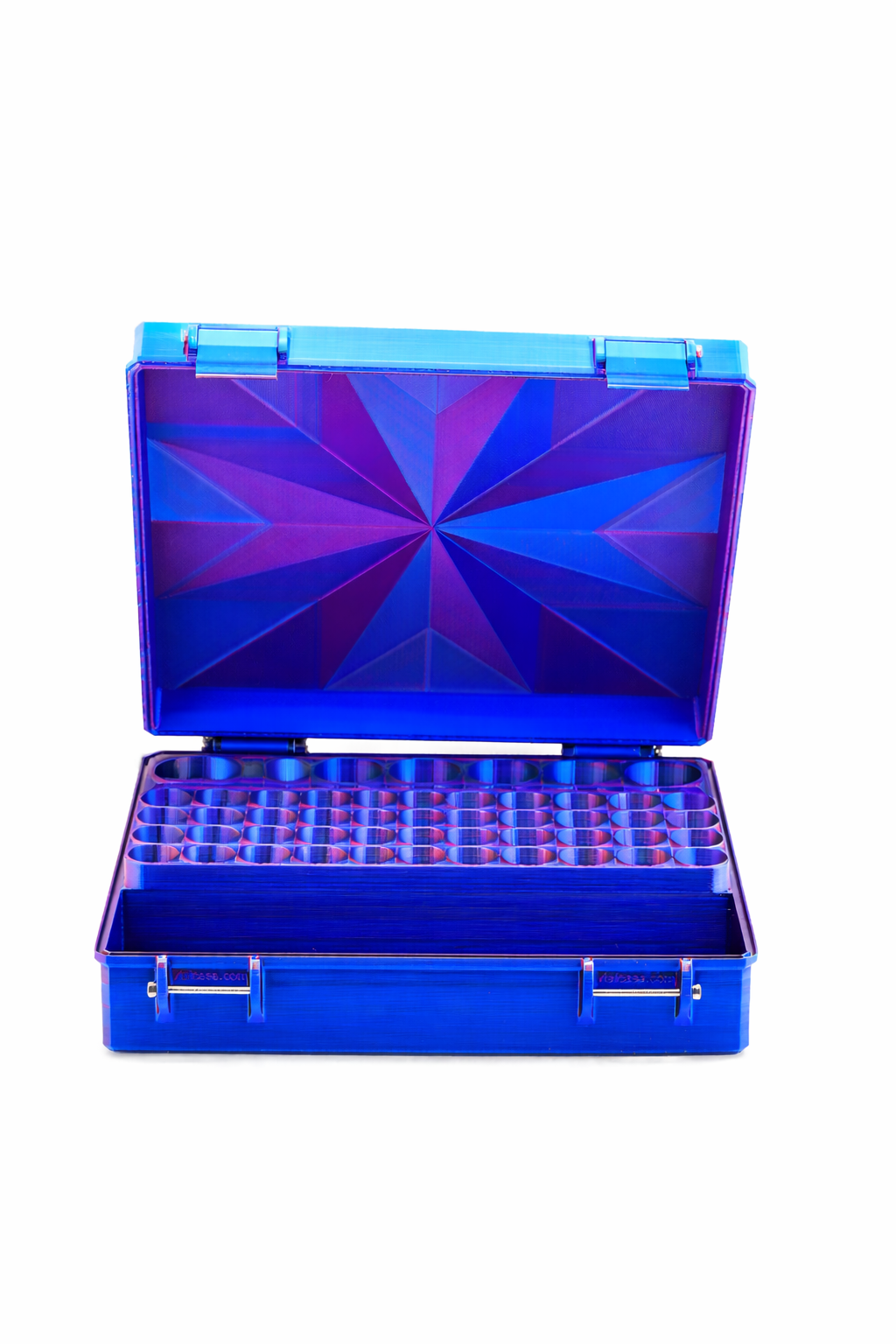
- Hard-shell insulated case ($50–120). A purpose-built peptide case with foam vial slots prevents the bottle-knocking damage that compounds temperature damage. The vials sit cradled, you don't have to dig them out, and the foam adds thermal mass that buffers brief external excursions.
- Indicator stickers / freeze-watch labels ($1–5 each). Single-use stickers that change color irreversibly when exposed to a specific temperature threshold. Stick one to incoming shipments to verify cold chain at delivery.
For deeper-cold long-term storage of lyophilized stocks, see our guide on freezer storage for peptides — including which compounds tolerate freezing and which should never see sub-zero temperatures even as powder.
The Cumulative Excursion Concept (Repeated Because It Matters)
The single most important mental model for long-term peptide storage is that peptides remember every temperature event. There is no rest period that erases prior damage. Every excursion adds to the cumulative degradation total.
Practical implications:
- A vial that survived a hot summer shipment and spent two days in a hotel room mini-fridge that wasn't quite cold enough and went on a road trip in a cooler — even if no single event was catastrophic — has now consumed most of its stability budget.
- Older vials in your supply with unknown storage histories should be used first or treated with skepticism. Don't save them "for later" — later means more time for degradation in conditions you can't perfectly control.
- Buying in bulk at a discount only saves money if your storage is genuinely cold-chain intact for the full window. A 6-month supply that loses 20% potency in months 4–6 isn't a savings.
Frequently Asked Questions
How long can a reconstituted peptide sit at room temperature before it's ruined?
Most reconstituted peptides tolerate room temperature (68–77°F / 20–25°C) for several hours without meaningful degradation. The trouble starts at sustained exposures of 8+ hours, or any exposure above 86°F. For dosing convenience (taking a vial out of the fridge, drawing a dose, returning to the fridge), there's plenty of margin. For overnight or multi-day room-temperature storage, expect cumulative loss.
Does the bacteriostatic water itself degrade?
Bacteriostatic water (BAC water — sterile water with 0.9% benzyl alcohol) is shelf-stable at room temperature for months and refrigerated for the labeled expiration. It does not require cold storage in the same way reconstituted peptides do, but freezing can crack glass vials and should be avoided.
Can I extend a reconstituted peptide's shelf life by freezing it?
Generally no. While freezing slows hydrolysis dramatically, the ice-crystal damage to the peptide structure during the freeze and subsequent thaw typically causes more harm than the extended shelf life saves. Some research labs flash-freeze peptide solutions in liquid nitrogen specifically to avoid slow ice crystal formation, but home freezers are not capable of this.
Is dry ice safe for peptide shipping?
Dry ice (-109°F / -78°C) is appropriate for shipping lyophilized peptides intended for freezer storage. It is generally too cold for reconstituted vials — direct contact will cause the vial contents to freeze and the peptide to suffer ice-crystal damage. Ice packs (regular gel packs at 32–40°F) are the right cold-chain method for reconstituted shipments.
What temperature should my fridge actually be?
Aim for 36–40°F (2–4°C) for peptide storage. Below 36°F risks accidental freezing if the fridge cycles colder; above 46°F starts to compress the peptide's effective shelf life. The middle shelf, away from the back wall (where freezing pockets form) and away from the door (where temperatures fluctuate), is the optimal physical location for vial storage.
Disclaimer: This article is for informational purposes only and does not constitute medical advice. Temperature stability data varies between specific manufacturers, formulations, and lots — manufacturer-provided storage guidance for any specific product takes precedence over the general ranges cited here. Peptide degradation testing and dose adjustment decisions should be made in consultation with a qualified healthcare provider familiar with your specific protocol. Research peptides referenced in this article are described in the context of storage and stability only; this is not a recommendation for any particular use.