Most peptide users start with a single compound, a single case, and a single protocol. Then the stack grows. A GLP-1 here, a growth hormone secretagogue there, a healing stack layered on top. Before long, you're managing six, eight, ten vials — and a standard 10-slot case is no longer cutting it. For those running extended protocols, purchasing in bulk to reduce cost, or managing inventory for a clinic or research setting, the question shifts from "what case should I buy?" to "what storage system do I need?" This article covers exactly that — from modest 20-slot expansions all the way up to 300-vial high-capacity solutions.
Who Needs High-Capacity Peptide Storage?
The answer is more people than you'd expect. High-capacity storage isn't just for labs or clinics — it's for anyone whose protocol has scaled beyond a single case's capacity. Here's who typically reaches this point:
- Bulk buyers: Purchasing peptides in larger quantities reduces per-vial cost significantly. If you're buying a 3-month supply of BPC-157, CJC-1295, and ipamorelin simultaneously, you could easily be managing 30-50 vials at once — most of which are lyophilized and need organized freezer storage.
- Stack runners: A full looksmaxing or performance protocol easily reaches 6-8 active compounds. Add in BAC water vials, spare vials, and rotation stock, and you're looking at 20+ items needing coordinated storage.
- Cross-border purchasers: Those who buy peptides in Mexico or import from international suppliers often purchase in volume to justify the trip or shipping cost. A single cross-border run can produce 50-100 vials that need immediate, organized intake.
- Clinic and research settings: Functional medicine clinics, compounding pharmacies, and research institutions may store hundreds of vials across multiple patient protocols. The stakes are higher — a storage failure isn't just personal, it's operational.
- Longevity protocol users: Biohackers running multi-month Epithalon cycles, NAD+ protocols, and complex GH stacks often hold reserve inventory. Active compounds in the fridge, backup supply in the freezer, and this quickly demands a system rather than a single case.
If you find yourself spending more than two minutes locating the right vial each morning, or if you've ever accidentally used the wrong compound because of poor organization, you've already outgrown your current storage setup.
The Problem With Scaling Up (And How to Solve It)
The challenges that emerge when managing large peptide inventories aren't simply about space — they're about maintaining the integrity of every compound in the collection. Several distinct problems appear as vial counts climb:
Temperature stratification becomes harder to manage. A standard household refrigerator maintains 2-8°C on average, but the door shelf can fluctuate by 5-10°C with each opening. When you have 10 vials, you can place them all in the optimal back-shelf zone. When you have 80 vials, you may be forced into suboptimal zones — and the compounds in those zones degrade faster.
Identification errors become a real risk. When every vial looks roughly the same — a clear glass tube with a rubber stopper and a small label — confusing BPC-157 with TB-500, or a 5mg vial with a 2mg vial, becomes genuinely possible. At scale, without a rigorous labeling and organization system, dosing errors are a matter of when, not if.
Rotation management becomes essential. First-in, first-out (FIFO) inventory management isn't just for grocery stores. When your peptide stock runs into the dozens of vials, ensuring that older reconstituted vials get used before newer ones — and that lyophilized stock gets rotated correctly — requires deliberate planning.
Key Principle: High-capacity storage is fundamentally a systems problem, not just a space problem. The goal isn't simply to fit more vials somewhere — it's to maintain the same level of protection, organization, and accessibility that a well-run 10-slot case provides, but at 10-30x the scale.
Light exposure risk multiplies. Opening a larger storage unit more frequently — to retrieve vials from different sections — means the entire inventory is briefly exposed to ambient light each time. A well-designed high-capacity system compensates for this with sectioned internal organization that limits how long any individual vial is exposed during retrieval.
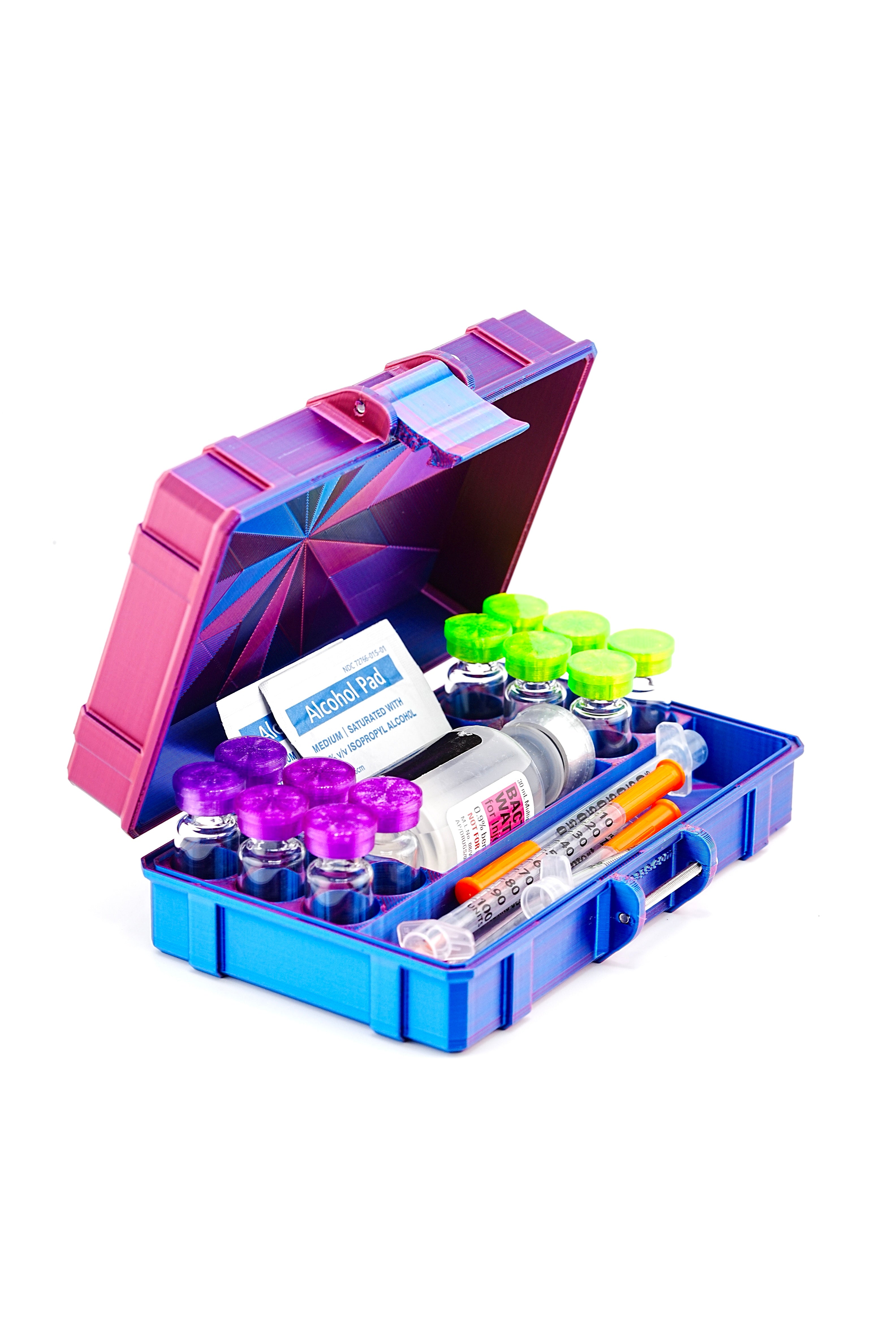
Capacity Options: From 10 Slots to 300 Vials
Understanding the full spectrum of storage capacity helps you right-size your system before investing in one. Here's a practical breakdown:
10-20 slots: The standard entry point for peptide users. Handles a typical 3-5 compound active protocol plus BAC water vials. Purpose-built peptide cases in this range offer the best protection per vial — hard shell, foam-lined, light-blocking, and portable. This is the right tier for daily-use storage of active compounds. See our full guide to organizing a multi-peptide protocol for setup best practices at this scale.
20-50 slots: The intermediate tier. Often achieved by running two purpose-built cases — one for active compounds in the fridge, one for backup lyophilized stock in the freezer. At this range, organization becomes the primary challenge; the physical storage solutions already exist.
50-100 vials: This is where dedicated systems become necessary. A single large hard-shell case with internal dividers, combined with a purpose-built fridge zone (such as a small dedicated mini-fridge), handles this range effectively. You'll want to introduce a tracking log at this point — either a simple spreadsheet or a physical ledger.
100-300 vials: The high-capacity tier. This requires a tiered approach: purpose-built daily-access cases for active compounds, plus dedicated refrigerator or freezer capacity for reserve stock. VialCase offers configurations specifically designed for this scale — modular setups that let you expand without replacing your entire system. Purpose-built 300-vial solutions combine the protection features of smaller cases (light blocking, impact cushioning, individual slots) with the capacity that serious protocols demand.
Pro Tip: When evaluating high-capacity options, calculate your "active vial count" (compounds currently in use) and your "reserve vial count" (lyophilized backup stock) separately. They have different storage requirements — active compounds need refrigerator access; reserve stock needs freezer organization. Don't conflate the two in your planning.
Organization Systems for Large Vial Collections
The physical case is only half the solution. What makes a high-capacity storage system actually functional is the organization methodology applied to it. Experienced users running 50+ vials consistently rely on variations of the same core system:
Zone-based organization. Divide your storage into logical zones: active compounds (currently in a protocol), transition compounds (recently reconstituted, awaiting use), and reserve stock (lyophilized, in the freezer). Each zone has its own physical location and its own labeling standards. Moving a vial between zones is a deliberate, documented act — not an accident waiting to happen.
Consistent labeling. At scale, visual labeling becomes non-negotiable. Every vial needs: compound name, concentration (mg/mL), reconstitution date (if applicable), and expiration date. Color-coded label tape by compound type dramatically speeds up retrieval. For a complete labeling methodology, see our guide to peptide fridge organization.
A running inventory log. When you have more than 20 vials in storage, memory is no longer adequate for tracking. A simple spreadsheet with columns for compound, vial size, quantity, reconstitution date, and expiration date takes five minutes to set up and saves hours of uncertainty. Update it every time you reconstitute a vial or remove one from inventory.
Dedicated slots for each compound. Resist the temptation to put vials wherever there's space. Assign fixed slots in your case to fixed compounds. This makes retrieval automatic and makes it immediately obvious when a slot is empty — triggering a reorder before you run out mid-protocol.
FIFO rotation discipline. When adding new stock, place it behind existing stock rather than on top of it. The oldest vials should always be retrieved first. This is especially important for reconstituted compounds where shelf life is measured in weeks, not months. For the science behind shelf life, see our guide on how long reconstituted peptides actually last.
Temperature Management at Scale
Temperature control doesn't get easier as your inventory grows — it gets harder. More vials mean more fridge real estate consumed, more frequent door openings, and more complex temperature zones to manage. Here's how to stay on top of it:
Dedicate a fridge shelf exclusively to peptides. This isn't just about organization — it's about temperature consistency. A shelf used exclusively for peptides won't have items pushed in and out constantly, reducing the thermal disruption that every door opening causes. The ideal location is the middle shelf at the back of the refrigerator, away from the door and from the cooling vent that can cause freeze events.
Use a purpose-built peptide mini-fridge for high-volume setups. Once your active compound count exceeds 30-40 vials, a dedicated mini-fridge — set to exactly 4°C and never used for food — is a worthwhile investment. It eliminates competition for fridge space, maintains more stable temperatures (fewer door openings), and keeps your peptide inventory separate from household items that could cause accidental temperature excursions.
Separate freezer organization for lyophilized stock. Lyophilized peptides stored at -20°C in the freezer are stable for 12-24 months in most cases. Keep them in sealed, labeled bags or purpose-built freezer-safe cases, organized by compound and date. A separate freezer drawer — or a dedicated small chest freezer for very large inventories — prevents your lyophilized stock from being disturbed by routine freezer access.
Temperature logging for clinic and research settings. At the professional level, temperature logging is mandatory. Digital thermometers with min/max memory, or connected temperature sensors that log data continuously, provide documentation that storage conditions have been maintained — important for liability, quality assurance, and regulatory compliance.
Critical Rule: Never freeze reconstituted peptides. Ice crystal formation physically destroys peptide bonds. If your freezer organization is adjacent to your fridge storage zone, make sure there's no risk of reconstituted vials accidentally migrating to freezer temperatures.
Clinic and Research Lab Storage Requirements
High-capacity storage in clinical or research settings involves requirements beyond what individual users face. The stakes are higher, the quantities are larger, and the consequences of a storage failure extend beyond personal inconvenience.
Chain of custody documentation. Clinics and research labs need to track not just what compounds are stored, but when they were received, who has accessed them, and when they were dispensed. A proper inventory management system — even a simple spreadsheet — needs to capture this information consistently.
Segregated storage by access level. Not every vial should be equally accessible. In a clinic setting, controlled substances or high-value compounds may need locked storage within the larger cold-storage system. Purpose-built cases with locking mechanisms provide this security without sacrificing the temperature or light protection the compounds require.
Emergency protocols for power outages and equipment failures. What happens when the refrigerator fails at 2 AM? For individual users, the answer is manageable. For a clinic with 300 vials in storage, it's a potential loss of thousands of dollars of compound. Backup coolers, temperature alarm systems, and a documented emergency response protocol are not optional at this scale.
Regulatory considerations. Depending on jurisdiction and the specific compounds being stored, clinical storage of peptides may be subject to pharmacy regulations, controlled substance laws, or research institution policies. Compliance with these requirements often dictates specific storage standards — including temperature logging, access controls, and disposal procedures.
The Cost Math: Why High-Capacity Cases Pay For Themselves
The upfront cost of a purpose-built high-capacity storage system is real. But so is the cost of not having one. Let's run the numbers with a conservative example:
Assume you're running a protocol with 8 active compounds, averaging $40 per vial. That's $320 in active compound value at any given time. Add in a typical 2-month backup supply (another $640 in lyophilized stock), and you have approximately $960 in peptide inventory at stake.
A storage failure — whether from a temperature excursion, light exposure, or a broken vial due to inadequate protection — that damages just 10% of that inventory costs $96. A failure that wipes out the reconstituted compounds costs $320. A catastrophic failure (refrigerator malfunction over a weekend) could cost the entire active inventory.
A purpose-built high-capacity storage solution that prevents even a single partial-inventory loss pays for itself in the first incident it prevents. And unlike the peptides it protects, the case doesn't degrade over time.
Beyond loss prevention, a proper storage system also reduces waste from expired compounds. When your inventory is organized and tracked, you use compounds before they expire. When it isn't, vials get pushed to the back of the fridge and forgotten — discovered months later, past their effective window.
Choosing Between Multiple Small Cases vs. One Large System
This is the most common strategic question for users scaling up: is it better to run several smaller cases, or invest in one unified large-capacity system? The answer depends on your specific use case, but here's the framework for deciding:
Multiple small cases make sense when:
- Your active and reserve compounds have different storage requirements (fridge vs. freezer) and different access frequencies
- You travel frequently and need portable, TSA-appropriate storage for active compounds while reserve stock stays home
- Your compound rotation is highly dynamic — you frequently add and remove compounds from active protocol status
- You're sharing storage space with others and need discrete, individually identifiable cases
A single large system makes sense when:
- Your inventory is relatively stable and consists primarily of compounds with similar storage requirements
- You're managing a clinic or research setting where a unified inventory view is operationally important
- You want to minimize the organizational overhead of tracking multiple separate storage units
- Your storage location is fixed (a dedicated fridge or temperature-controlled room) and portability isn't a factor
Many high-volume users end up with a hybrid: a purpose-built daily-access case for active compounds (10-20 slots, portable, in the fridge), and a larger organized system for reserve stock (50-300 slots, freezer-based, static). This separates access frequency and storage temperature requirements cleanly while keeping each system manageable.
Bottom Line: Explore the full range of VialCase configurations — from compact 10-slot daily carriers to high-capacity solutions built for serious inventory management. The right system is the one that matches your actual protocol, not your current protocol.
FAQ
Q: Can I store 300 vials in a standard household refrigerator?
A: Physically, yes — but practically, it's challenging. A standard fridge doesn't have the temperature consistency or organized space to handle 300 vials without some vials ending up in suboptimal positions (door shelf, top shelf near freezer vent). For inventories this size, a dedicated peptide mini-fridge or purpose-built cold storage solution is strongly recommended.
Q: How should I store lyophilized vials versus reconstituted vials at scale?
A: Keep them completely separate — physically and systematically. Lyophilized vials belong in organized freezer storage (-20°C), labeled by compound and date. Reconstituted vials belong in the refrigerator (2-8°C), accessible for daily dosing, with reconstitution date labels prominently visible. Never mix the two storage zones.
Q: What's the best way to track a large peptide inventory?
A: A spreadsheet is sufficient for most individual users. Track compound name, vial size (mg), quantity on hand, reconstitution date (for active vials), and estimated expiration. Update it every time you reconstitute or deplete a vial. Clinics and research settings should consider dedicated inventory software with access logging.
Q: Does high-capacity storage require any special equipment beyond the case?
A: For most users: no. A purpose-built high-capacity case plus a dedicated fridge shelf (or mini-fridge) is sufficient. For clinic or research settings, add a calibrated thermometer with logging, a backup cooler for emergency situations, and a temperature alarm system. These aren't accessories — they're operational necessities at that scale.
Q: How often should I audit a large peptide inventory?
A: Monthly for most users. Go through every vial, verify labels and dates, remove expired compounds, and update your inventory log. For clinic settings, weekly audits — or continuous automated monitoring — are more appropriate. The larger the inventory, the more important the audit discipline.
Q: Can I mix vial sizes (3ml and 10ml) in the same high-capacity case?
A: This depends on the case design. Purpose-built peptide cases from VialCase accommodate specific vial sizes — check the product specifications before purchasing. Many high-capacity configurations include separate compartments for 3ml and 10ml vials, which is ideal for users who run both peptide vials and larger BAC water or diluent vials.
Disclaimer: This article is for informational and educational purposes only. PeptideCase does not manufacture, sell, or distribute peptides or pharmaceutical compounds. Information provided is not medical advice. Always consult a qualified healthcare professional regarding any medical treatment or protocol. Storage guidelines are general best practices and may vary based on specific compounds, formulations, and individual circumstances.