Understanding the Three Vial Types in Your Protocol
Before you can select the right case, you need to understand what makes each vial type different — because their storage requirements don't fully overlap, and the best case accommodates all of them without compromise.
GLP-1 vials (water-based, refrigerated): Compounded semaglutide, tirzepatide, and retatrutide are all water-based peptide solutions. They require continuous refrigeration at 2–8°C (36–46°F) and are sensitive to both light and temperature excursion. Once reconstituted (most compounded GLP-1s come pre-mixed), they have a shelf life of 28–56 days under proper refrigeration. These vials are typically 3ml or 5ml with rubber stoppers — they look and behave exactly like research peptide vials, which simplifies storage somewhat.
TRT vials (oil-based, room temp or fridge): Testosterone cypionate, enanthate, and propionate are suspended in oil (typically cottonseed, sesame, or grapeseed oil). Unlike water-based peptides, oil-based testosterone is stable at room temperature for its entire shelf life — typically 2–3 years from the manufacturing date. Refrigeration is optional but does no harm. What matters most for TRT vials is light protection (UV degrades the ester bonds) and impact protection (10ml multi-dose vials are larger and heavier than peptide vials). TRT vials are almost always 10ml.
Peptide vials (lyophilized vs. reconstituted): Research peptides like BPC-157, TB-500, CJC-1295, Ipamorelin, and GHK-Cu come in two states. Lyophilized (freeze-dried powder) in their original sealed vials are stable at refrigerator temperature for months and at room temperature for weeks. Once reconstituted with BAC water, they behave like GLP-1 vials — refrigeration is mandatory, shelf life is 4–8 weeks. The key distinction is that lyophilized vials are more forgiving of temperature fluctuations during transport, while reconstituted peptide vials require the same cold chain diligence as GLP-1s.
The key insight: GLP-1 and reconstituted peptide vials share identical storage requirements (2–8°C, light-blocked). TRT vials don't need refrigeration but do need light protection. A case that refrigerates everything and blocks light for all slots handles the entire protocol correctly regardless of which compound is in which slot.
Why Generic Cases Fail Multi-Protocol Users
The generic case failure mode is consistent: the case was designed for one vial type, and a multi-protocol user tries to force all three into it. Here's where that breaks down.
Insulin cooler cases are designed for pre-filled insulin pens, not vials. The compartments don't fit 10ml TRT vials, foam inserts (if any) don't grip 3ml peptide vials, and the insulation is sized for a single medication — not a 5-vial protocol.
Soft-sided travel pouches have no impact protection and often no light blocking. Everything rattles around together. For glass vials, "rattle" eventually means "break." The pouch also collapses under weight, so a water bottle sitting on top of it in a bag can crush vials.
Medical supply bags are too large for everyday carry and have adjustable compartments that don't secure vials. An adjustable divider that's perfect for syringes does nothing to prevent a 3ml vial from rolling sideways and landing stopper-down on another vial.
Makeup cases and toiletry bags are the most common improvised solution and the worst for vials. They block no light (clear panels are common), offer no impact resistance, and have no vial-specific slots. They do, however, look discreet — which is the only thing they get right.
The unifying failure across all generic cases is the same: they weren't designed around the dimensions and fragility of glass vials with rubber stoppers. A case purpose-built for vials solves this at the design level so you don't have to solve it with improvisation every time.
What Your Case Must Handle
A case for a GLP-1 + TRT + peptide protocol needs to satisfy requirements from three different directions simultaneously. Here's the complete checklist:
- Mixed vial sizes: Your case must accommodate both 3ml/5ml vials (GLP-1, peptides) and 10ml vials (TRT). These have meaningfully different dimensions. A 3ml vial is approximately 17mm in diameter and 50mm tall. A 10ml vial is approximately 20mm in diameter and 65–70mm tall. The case interior needs slots (or foam cutouts) sized for both.
- Light blocking: All three vial types degrade with UV and visible light exposure. The case shell must be fully opaque — no transparent panels, no mesh windows. Light-blocking performance comes from the shell material and design, not from a label on the outside.
- Impact resistance: Glass vials require a case that absorbs drops and compressions without transmitting force to the vials. This means a hard outer shell and foam (not just fabric lining) inside. The foam should grip each vial in its own slot so vials don't contact each other.
- Temperature management: For GLP-1 and reconstituted peptides, the case should support a small gel pack for transit temperature control. Insulated shells slow heat transfer; thin cases with no insulation allow ambient heat to reach the vials quickly.
- Enough capacity for your protocol: Map your protocol before choosing a case. A 4-compound protocol needs at minimum 4 vial slots plus a BAC water slot. A 5-compound protocol with daily dosing needs 5–6 vial slots. Buy for the protocol you're running, not a protocol you might run someday.
- Syringe and consumable storage: Needles, syringes, alcohol swabs, and a travel sharps container need a home in the same case. A dedicated accessory layer or internal pocket keeps these organized without taking up vial slots.
The Best Case Options for Combined Protocols
With the requirements defined, here's how different case configurations perform for GLP-1 + TRT + peptide protocols:
Small compact cases (4–6 vial slots): Ideal for protocols with 3–4 active compounds plus BAC water. Best for gym carry, commuting, and overnight travel. The footprint fits easily in any bag. Limitation: limited accessory storage and no room for protocol expansion.
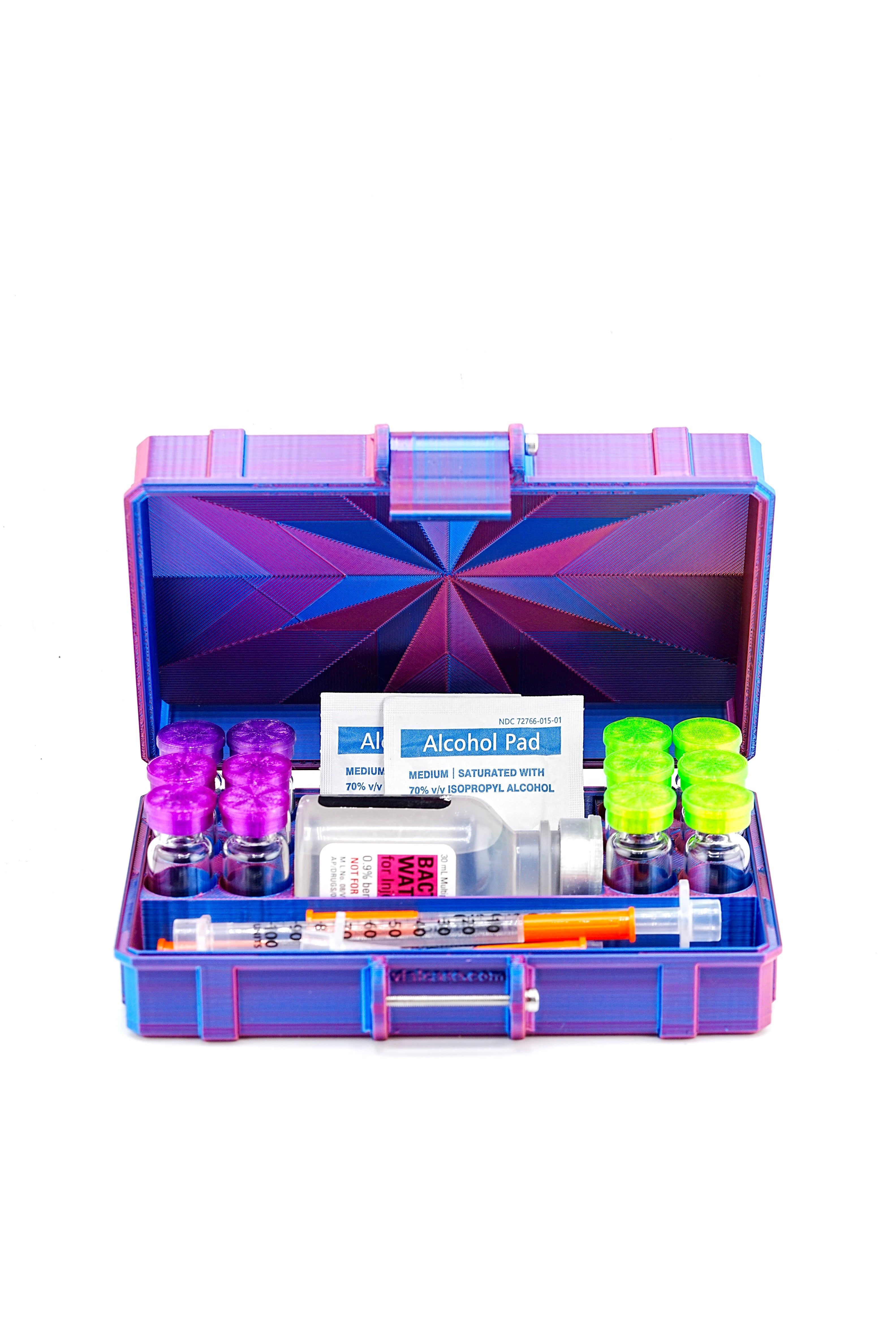
Medium cases (6–10 vial slots): The sweet spot for most multi-protocol users. Holds a complete 5-compound protocol plus consumables in a case that still fits in a personal item bag for air travel. This configuration accommodates mixed 3ml and 10ml vial sizes without compromise and typically includes a dedicated accessory layer.
Large cases (10–20 vial slots): Best for users running extended research stacks alongside their clinical protocols — for example, GLP-1 + TRT + BPC-157 + TB-500 + CJC/Ipa + GHK-Cu. These cases work well for home storage and carry-on travel but are too large for gym bags and commute bags.
For the majority of GLP-1 + TRT + 2–3 peptide users, a medium case is the correct choice. It's large enough to hold everything without improvisation and small enough to go anywhere. VialCase's medium-format options are built specifically for this mixed-protocol use case, with pre-cut foam for both 3ml and 10ml vials in the same case.
Buy for your current protocol, not future expansion. It's tempting to buy a large case "in case" you add more compounds. But a case that's half-empty has loose vials rattling in unused slots — exactly the impact risk you bought the case to prevent. Fit the case to the protocol.
Setting Up Your Case: Slot Assignment That Works
A good case is only as organized as its slot assignment. The goal is to create a system where you reach for a specific slot instinctively — without reading labels under pressure or searching through the case in a gym locker room.
Here's a proven slot assignment system for a 5-vial GLP-1 + TRT + 2 peptide + BAC water protocol:
- Position 1 (front left): GLP-1 vial. This is your highest-value, highest-stakes compound. Front position means it's the first thing you see when you open the case.
- Position 2 (front right): BAC water. Paired with the GLP-1 slot because these are used together for reconstitution (if applicable).
- Position 3 (center): TRT testosterone vial. 10ml vials need the center slot in most foam configurations because it's the widest position. The center slot also creates visual balance.
- Position 4 (back left): Peptide vial #1 (e.g., BPC-157). Back positions are for compounds used on a schedule rather than on-demand.
- Position 5 (back right): Peptide vial #2 (e.g., CJC-1295 or Ipamorelin).
- Accessory layer: TRT syringe (largest), insulin syringes for peptides and GLP-1 (sorted by length), alcohol swabs in a small zip bag, travel sharps container.
The system works because each compound always lives in the same slot. Muscle memory develops after a week of consistent use. You stop reading labels on every injection and start reaching directly for the right slot — which reduces errors and speeds up the process.
Traveling With GLP-1, TRT, and Peptides
Travel is the scenario where having the right case provides the most tangible benefit. Here's how a multi-protocol travel setup should work from door to destination:
Pre-trip prep (night before): Check every vial for clarity and expiration. Ensure BAC water and reconstituted peptide vials are not approaching their shelf life date. Load a slim gel pack into the case's accessory layer and place the entire case in the refrigerator overnight to pre-chill.
Morning of travel: Remove the case from the refrigerator and place it directly in your personal item bag. The pre-chilled case and gel pack will maintain 2–8°C for 4–6 hours in a standard room-temperature environment.
Airport security: Declare injectable medications if asked. TSA officers will typically ask you to remove the case for inspection. Open it, let them look, and explain that it's injectable medication storage. An organized case with labeled slots creates a professional presentation that answers questions before they're asked. Keep your physician's prescription or letter of medical necessity in the case's accessory pocket if you have one.
In-flight storage: Keep the case in your personal item bag under the seat, not in the overhead bin. Aircraft cabin temperatures are typically 18–24°C — above optimal for GLP-1 and reconstituted peptides, but well within the acceptable short-exposure range. The gel pack handles the temperature differential for flights under 5 hours.
Hotel storage: The case goes directly into the in-room refrigerator or minibar upon arrival. Most hotel mini-fridges maintain 4–6°C, which is within the acceptable range for all three vial types. If the mini-fridge doesn't have a reliable thermostat (common in budget hotels), request a refrigerator from the front desk.
International travel note: Many countries have specific regulations around testosterone (a controlled substance in most jurisdictions) and research peptides. Carry a copy of your TRT prescription and be prepared to declare all injectable medications at customs. The rules vary significantly by country — research the regulations for your specific destination before traveling with TRT internationally.
Labeling Your Vials to Prevent Errors
Running three compound types with different dosing schedules creates real error risk, especially in the early weeks of a new protocol. A vial labeling system reduces that risk to near zero.
The minimum viable labeling system for a GLP-1 + TRT + peptide protocol:
- Compound name: Write the abbreviated compound name on a small label affixed to the vial body, not the cap (caps get swapped). "Sema," "Test-C," "BPC," "CJC" are sufficient abbreviations.
- Reconstitution date: For any reconstituted vial, write the date you added BAC water. This is the start of the shelf life clock. Format: MM/DD for brevity.
- Expiration date: Calculate shelf life from reconstitution date and write the expiration date on the same label. For BPC-157 in BAC water refrigerated: add 42 days. For compounded GLP-1: follow the pharmacy's labeled expiration.
- Concentration: If you've diluted peptides to a non-standard concentration, note it. "BPC 500mcg/ml" prevents calculation errors on every dose.
Use small white adhesive labels (available at any office supply store) and a fine-tip permanent marker. The labels hold up under refrigerator conditions. Replace them when they start peeling — a label that comes off in the case creates confusion about which unlabeled vial is which.
For more detail on the full labeling system, see our guide on how to label peptide vials.
How Often to Reorganize Your Case
A case that works well at the start of a protocol can drift into disorganization over weeks. Here's a realistic maintenance schedule:
After every injection: Return the vial to its designated slot. This takes 5 seconds and prevents the gradual drift that turns a well-organized case into a mess. Wipe the outside of any vial that had solution on the stopper before returning it to the case.
Weekly: Check every vial in the case against your labeling system. Verify that expiration dates are current. Remove any expired vials immediately — keeping expired vials in the case creates error risk. Wipe down the foam inserts with a dry cloth if there's any residue.
When adding a new compound: Before placing a new vial in the case, reorganize the slot assignment deliberately. Don't just stuff it in wherever there's space. Assign it a specific slot, update your mental model (or a written note if you're running 5+ compounds), and maintain the system from day one of the new addition.
Monthly: Do a full case audit. Check the gel pack (if included) for integrity — they degrade over time and can eventually leak. Check the foam insert for compression — foam that's been compressed too many times stops gripping vials securely. Inspect the shell for any impact damage. A case that took a hard drop is worth inspecting for structural integrity before trusting it with your vials.
FAQ
Can I store GLP-1 and TRT in the same case if they have different temperature requirements?
Yes. Testosterone is stable at room temperature, but it also tolerates refrigeration without any negative effects. Storing your TRT vial in the same refrigerated case as your GLP-1 and reconstituted peptide vials is completely safe for the compound. The case simply needs to accommodate the larger 10ml TRT vial dimensions.
Does a hard-shell case maintain temperature better than a soft-sided case?
Yes, meaningfully so. A hard shell with insulating foam creates a thermal barrier that slows heat transfer from ambient air to the case interior. Soft-sided cases transfer ambient temperature almost directly to the vials. For short transit times (under 1 hour), the difference is minor. For gym bag and commute scenarios where the case might be at room temperature for 2–4 hours, the hard shell + gel pack combination is significantly more protective.
How many vials can I realistically fit in one case?
This depends on the case size and vial size mix. A typical medium case holds 6–8 vials when all slots are 3ml, or 4–5 vials when mixing 3ml peptide slots with one or two 10ml TRT slots. Be realistic about your protocol's actual vial count and choose a case with a 1–2 slot buffer rather than maxing out capacity.
Is it safe to travel internationally with both TRT and peptides in the same case?
The customs legality varies by country and is your responsibility to research before travel. From a storage standpoint, having them in the same case is fine. From a legal standpoint, testosterone is a controlled substance in most countries and requires a valid prescription for international travel. Research peptides have variable legal status by jurisdiction. Consult the destination country's customs authority before traveling.
What's the best case for a protocol with both 3ml and 10ml vials?
Look for a case specifically marketed as compatible with multiple vial sizes. Confirm the specifications list both 3ml and 10ml vial slot dimensions. VialCase's multi-size configurations are built for exactly this use case — mixed 3ml peptide slots and 10ml TRT slots in the same foam insert.
Do I need a separate case for my TRT since it doesn't need refrigeration?
No. A single case that refrigerates everything is simpler than managing two separate storage systems. The TRT vial doesn't benefit from refrigeration but isn't harmed by it either. One organized case beats two separate improvised setups every time.
How do I know when my GLP-1 vial is expired versus my peptide vials?
This is exactly why vial labeling matters. Write the reconstitution date and calculated expiration date on every vial. Compounded GLP-1 vials should also have a pharmacy-printed expiration date on the label. Check both before every injection — the earlier date is the one that governs.
Can I use a VialCase for syringes in addition to vials?
Yes. Most VialCase configurations include either a dedicated accessory layer or an internal mesh pocket for syringes, needles, and swabs. Check the specific product listing for syringe dimensions compatibility — some cases are designed for insulin syringes only, while others accommodate larger TRT syringes (up to 3ml barrel, 25g needle).
Disclaimer: This article is for informational and educational purposes only. PeptideCase does not sell, endorse, or prescribe any pharmaceutical compounds, research peptides, or controlled substances. GLP-1 medications require a valid prescription from a licensed physician. Testosterone replacement therapy requires medical supervision and in many jurisdictions is a controlled substance requiring a prescription. Research peptides are not approved for human use by the FDA. Nothing in this article constitutes medical advice. Consult a qualified healthcare provider before starting, modifying, or discontinuing any injectable protocol.