Why Cars Are So Dangerous for Peptides
Most people instinctively know that leaving medication in a hot car is bad. But the actual temperatures involved are often much worse than people imagine. Research into vehicle interior temperatures shows that on a 35°C (95°F) day with direct sunlight, dashboard surface temperatures routinely reach 70-80°C (158-176°F). The trunk, while slightly better, still reaches 55-65°C (131-149°F). Even the back seat with windows up can reach 50°C (122°F) within 20 minutes of parking.
At these temperatures, most research peptides denature within minutes. Reconstituted GLP-1 peptides like Retatrutide or Tirzepatide have an effective ceiling of around 30°C (86°F) for short-term tolerance — beyond that, degradation accelerates rapidly. Lyophilized (powder) peptides are more heat-stable but still suffer meaningful degradation above 40°C over hours. A single stop at a restaurant with your peptide case in the trunk on a summer day can destroy an entire vial's potency.
The solution is not to "be careful" or park in shade. Shade reduces interior temperatures by only 5-10°C — still far above the safe threshold. The only real solution is thermal management: keeping your peptides in an insulated container with a cold source, in the coolest accessible part of the car, for the entire trip.
Pro Tip: Never leave peptides in the car when you stop — even for 10 minutes. Temperatures spike faster than most people expect, and a brief stop becomes a 30-minute errand more often than not. Carry your case with you whenever you leave the vehicle.
Best Placement in the Car
Where you put your peptide case in the car matters as much as the insulation around it. The thermal hierarchy from coolest to hottest in a parked vehicle:
- Front passenger footwell (best): Lowest point, most shielded from direct sunlight, closest to the air conditioning vents when driving. While the car is moving and A/C is running, this area stays closest to cabin temperature. When parked, it heats more slowly than any elevated surface.
- Rear passenger footwell (good): Similar logic to the front footwell, slightly further from A/C airflow. Better than the seat surface.
- Rear seat (acceptable during drive, risky when parked): Fine while the car is moving with A/C running. Problematic when parked — seat surfaces absorb solar heat quickly.
- Glove box (avoid): Enclosed space with no A/C circulation. Heats up significantly even on mild days.
- Trunk (avoid for reconstituted peptides): Worst-case heat location. No A/C, maximum solar heat absorption through the rear of the vehicle. Acceptable only for lyophilized peptides in a well-insulated cooler with adequate ice packs, and only while driving — never parked.
Cold Pack Duration: Planning Your Stops
Standard gel ice packs (the flat blue ones) typically last 4-8 hours in a well-insulated container at ambient temperature, and 2-4 hours in a hot car even with insulation. For road trips, you need to plan your cold source refresh intervals around realistic temperatures, not optimistic ones.
A practical framework for different trip lengths:
- Under 4 hours driving: One standard gel ice pack in an insulated bag alongside your hard-shell peptide case is adequate. Pre-chill the ice pack overnight. Wrap it in a thin cloth to prevent direct contact with vials (direct contact can cause localized freezing at the glass surface).
- 4-8 hours driving: Use two gel ice packs and rotate — one packed against the case, one in a small cooler bag. Alternatively, use a larger phase-change pack (the kind rated for 24+ hours) that costs more but eliminates the mid-trip swap.
- Multi-day road trips: Plan ice or refrigerator access. Gas stations sell ice everywhere in the US; a small soft cooler alongside your peptide case gives you enough cold mass to bridge long legs between stops. Many chain hotels will keep medication in their kitchen refrigerator overnight if asked.
For longer drives, stopping at a gas station every 6-8 hours for a fresh ice bag costs almost nothing and completely solves the cold chain problem. If you're driving through remote areas with few stops, plan accordingly — bring more ice mass upfront.
Crossing Borders by Car: Mexico and Canada
Land border crossings introduce a different set of considerations from domestic driving. Both CBP (US Customs and Border Protection) and their counterparts at Mexican and Canadian borders have authority to inspect vehicle contents.
Crossing into Mexico with peptides: Mexican customs authorities (SAT) treat research peptides as pharmaceutical imports. While small personal-use quantities rarely trigger issues, having vials in your car that you can't explain is a problem at Mexican border crossings, which can be more unpredictable than the US side. Keep quantities to what you need for the trip, carry any documentation you have (vendor receipts, COAs, product information), and store everything in a clearly organized, accessible case rather than buried in luggage. Disorganized bags get searched more thoroughly.
Re-entering the US from Mexico: CBP at land crossings has full authority to inspect vehicle contents. Declare your medications honestly if asked. Research peptides are in a legal grey area but are not scheduled controlled substances — most personal-use quantities pass without issue. If detained, stay calm, present your documentation, and understand that the worst likely outcome for unscheduled peptides in personal-use quantities is seizure of the vials, not arrest.
Crossing into Canada with peptides: Health Canada regulates research peptides similarly to the FDA. Small personal-use quantities have generally passed Canadian land border crossings without issue, but Canada has stricter enforcement posture in some categories. As with Mexico, quantity and organization matter. Personal-use amounts in a clearly-labeled, organized medical case present better than a bag of loose vials.
Pro Tip: At land border crossings, having your peptides in a purpose-built, hard-shell medical-style case projects organization and legitimacy. A PeptideCase with foam-fitted vials looks like medical equipment, not contraband. Presentation genuinely matters when a CBP officer is deciding whether to flag for further inspection.
State-by-State Legal Variation
Within the US, driving across state lines with research peptides is generally not a legal concern for most compounds. Most research peptides are not scheduled controlled substances at the federal level, and interstate personal possession of non-scheduled compounds is not a crime. However, some states have their own controlled substance schedules that may include compounds not on the federal DEA list.
States known to have broader controlled substance schedules include Florida, Texas, and several others that have specifically added research chemicals. If you are driving through states where you have any uncertainty about a compound's legal status, research that state's analog act and controlled substance schedule before your trip. For mainstream research peptides — BPC-157, GHK-Cu, GLP-1 compounds — state-level legal issues are extremely rare. SARMs and some novel compounds carry more state-level risk.
Rest Stop Fridge Options
For multi-day road trips, access to refrigeration at rest stops and overnight stops keeps your cold chain solid and eliminates worry about ice pack duration. Practical options:
- Hotel room mini-fridge: Available at virtually every chain hotel. Request a room with a mini-fridge at booking if not standard. Your peptide case fits easily in any mini-fridge without taking up much space.
- Hotel front desk refrigerator: Most hotels will store clearly-labeled medication in their kitchen or office refrigerator overnight. A brief, matter-of-fact request ("Can you refrigerate my medication overnight?") is rarely declined.
- Truck stop travel centers: Major chains like Pilot Flying J and Love's have food sections with refrigerators you can buy drinks from — not useful for storage, but good for refreshing ice. Some larger truck stops have small convenience refrigerators you can briefly use with permission.
- 12V car coolers: Plug-in coolers for the 12V (cigarette lighter) outlet maintain 15-20°C below ambient temperature. Not cold enough for reconstituted peptides that need 2-8°C, but useful for lyophilized peptides that just need to avoid heat. A proper plug-in 12V refrigerator (not just a cooler) runs $80-200 and maintains true refrigerator temperatures — worth it for frequent road trippers with peptide protocols.
Packing Your Road Trip Peptide Kit
The ideal road trip peptide setup combines your hard-shell vial case inside a soft insulated bag, with cold packs, syringes, BAC water, alcohol swabs, and a small sharps container all in one organized kit. Everything you need for a dose is in one place, accessible without digging through luggage, and protected from both heat and impact.
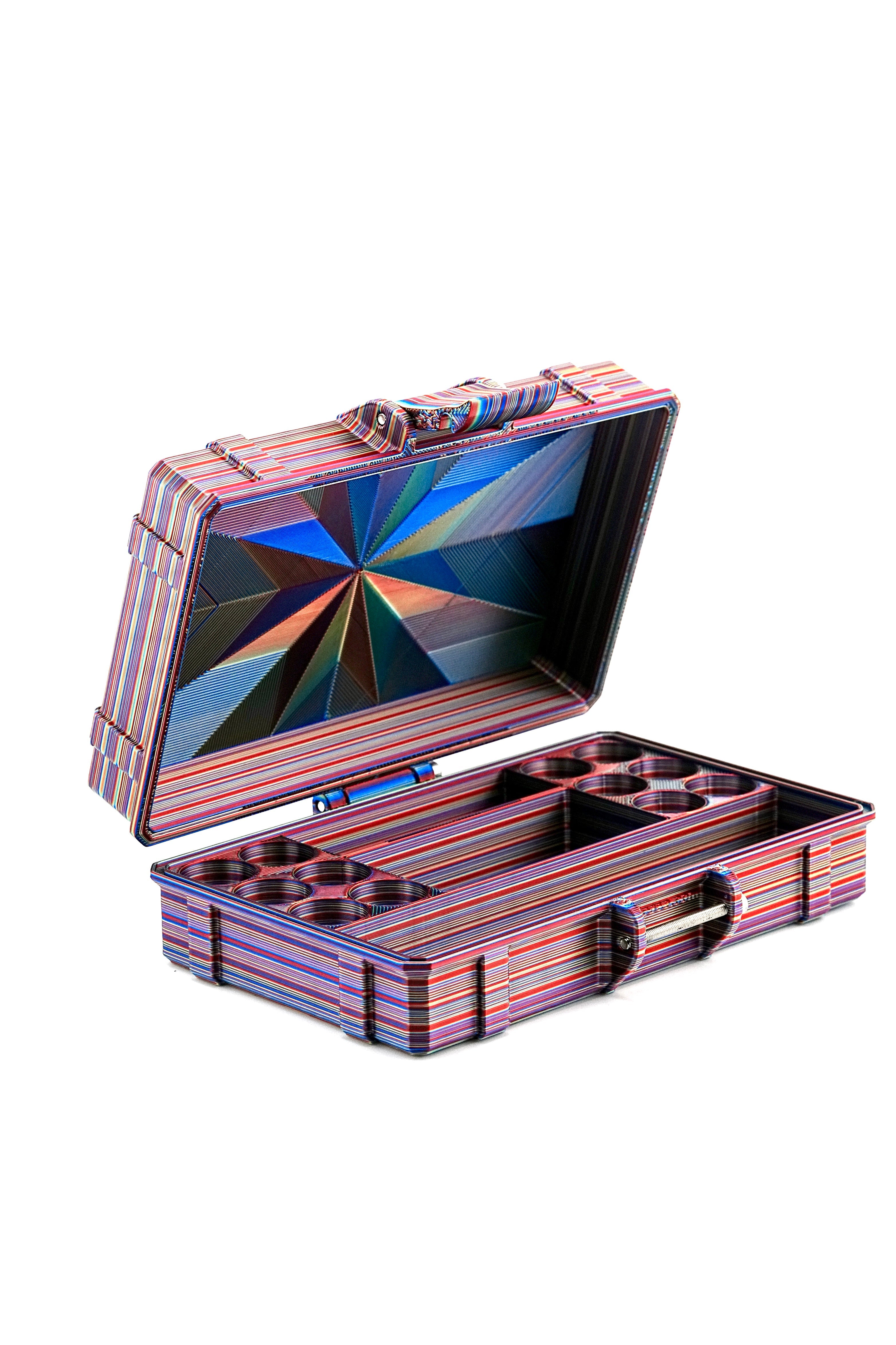
A PeptideCase serves double duty on road trips: it's your refrigerator organizer at home and your travel organizer on the road. The hard shell protects vials from being jostled in the car, the opaque construction blocks light during the drive, and the compact footprint lets it fit in an insulated lunch bag with cold packs alongside. At the hotel, it pulls straight out of the bag and goes directly into the mini-fridge. No repacking, no rearranging — your protocol stays organized start to finish.
For everything you need to know about flying with peptides, see our companion guide on TSA rules for peptides and our international travel guide.