Why the Fridge Is Not Automatically Safe for Peptides
The assumption most people make is that cold equals safe. Put the peptide in the fridge, problem solved. This assumption is wrong, and it costs people real money in degraded compounds every year.
A standard household refrigerator is designed to keep food fresh. It was not engineered for the narrow temperature stability that reconstituted peptides require. Three specific problems turn a poorly set-up fridge into a liability:
- Door zone temperature spikes. Every time the refrigerator door opens, warm room-temperature air floods in. The door shelf — where most people store vials — can spike by 6-8°C in a single door-open event. Multiply that by ten fridge trips a day and you have a compound that is thermally stressed dozens of times before you even finish the vial.
- Light exposure every time the door opens. The fridge light comes on immediately when the door opens. Direct light, even brief, contributes to photodegradation of peptide bonds. Most researchers know to avoid sunlight. Fewer think about the fridge light hitting their uncovered vials ten times a day.
- Loose vials tipping and rolling. A fridge shelf is not a stable surface. Vials knock against each other, roll toward the edge when the shelf is pulled out, and can fall during normal fridge use. A cracked or broken vial means a total loss of whatever compound was inside.
None of these problems mean the fridge is the wrong environment. It is exactly the right environment — but only when the setup is correct. The fridge provides the temperature. A proper storage case provides everything else.
The Temperature Reality Inside Your Fridge
Before ranking storage options, it helps to understand the actual temperature map of a standard refrigerator. Most people set their fridge to somewhere around 37°F (3°C) and assume the whole interior holds that temperature. It does not.
- Door shelves: 4–10°C with frequent spikes. The door is the farthest point from the cooling element and the first surface exposed to warm air every time the door opens. Door shelf temperatures routinely swing by 4-6°C during a single door-open event and can temporarily exceed 10°C in a warm kitchen. This is an unacceptable environment for reconstituted peptides.
- Front of interior shelves: 3–6°C with moderate variability. Better than the door, but still exposed to the warm air draft that enters when the door opens. Front-shelf vials feel the temperature swing within 30-60 seconds of the door opening.
- Back of middle shelves: 2–4°C, most stable. The back of the middle shelf is the sweet spot in most refrigerators. It is closest to the cooling element airflow, farthest from the door, and least affected by warm air intrusion. Temperature here stays within a narrow band even during normal use.
- Freezer zone near the top: Variable. The area directly beneath the freezer compartment can occasionally dip below 0°C in older units. Avoid placing reconstituted peptide vials here — freezing a reconstituted peptide destroys it.
- Crisper drawers: Moderate temperature, high humidity. Crisper drawers maintain higher humidity by design, which creates a condensation problem. Cold vials pulled from a humid drawer will immediately collect moisture on the surface. Over time, this can obscure labels and create a chronically damp storage environment that is less than ideal.
The practical takeaway: the back of the middle shelf is where your peptides belong, and they should be in a case that blocks the light and holds each vial in a fixed, upright position.
What a Peptide Fridge Case Must Do
Not every container that fits in a fridge qualifies as a peptide case. A proper peptide case for fridge storage needs to accomplish four specific things:
- Hold vials upright and separated. Individual slots prevent vials from contacting each other, eliminate rolling, and allow you to pull one vial without disturbing the others. Upright storage keeps the septum in contact with air rather than solution, which matters for the longevity of reconstituted peptides.
- Block light when the fridge door opens. A fully opaque, hard-shell case means the fridge light never touches your vials. This protection is passive and continuous — you never have to think about it.
- Fit standard fridge shelf dimensions without blocking airflow. A case that is too wide restricts air circulation around it, creating a warmer microclimate. The right dimensions allow cold air to flow around the case and maintain temperature consistency.
- Resist fridge moisture without degrading. The interior of a refrigerator is a humid environment relative to room conditions. A case built from ABS plastic or similar hard materials will not absorb moisture, warp, or develop mold the way foam or fabric cases can over months of fridge use.
Fridge Storage Options Ranked: Worst to Best
Here is an honest ranking of every approach people actually use to store peptides in the fridge. The ranking is based on three criteria: temperature stability, light protection, and physical security of the vials.
Worst: Loose Vials on the Door Shelf
This is the most common and most damaging approach. Loose vials on the door shelf combine every possible fridge storage failure into one setup. Temperature spikes 6-8°C every time the door opens. Vials tip over, roll, and knock against each other. The fridge light hits them directly each time the door opens. There is no organization, so you are picking through vials to find the right compound every time you dose. One vial rolls off the shelf and you lose the entire compound. If you are currently storing peptides on the door shelf, this is the single highest-impact change you can make: move them somewhere else immediately.
Bad: Generic Plastic Container With No Slots
An improvement over loose vials only because the vials are contained in a single box. The problems remain significant. Without individual slots, vials roll against each other — the constant contact between glass vials is how hairline cracks develop and how caps get loosened over time. The container provides no light blocking if it is clear, and even opaque containers with loose vials inside still allow vials to shift and collide every time you open or close the fridge. It is better than nothing, but only barely.
Mediocre: Repurposed Egg Carton
Egg cartons are exactly the wrong geometry for peptide vials. Standard egg carton cups are designed for large-diameter chicken eggs, not narrow 3ml peptide vials. A 3ml vial sits loosely in an egg cup and can still tip sideways. The carton itself is cardboard — it absorbs moisture from the fridge environment, becomes soggy over weeks, and eventually contaminates the surface around your vials with wet cardboard pulp. Light blocking is partial at best. There is no latching mechanism to keep the carton closed. This is a stopgap that people use when they have nothing better, but it creates new problems while solving old ones only partially.
Good: Small Box or Tray With Individual Slots
A box or tray with individual slots sized for vials is a real step forward. Each vial has a designated position, it cannot roll, and it does not contact other vials. If the box has a lid, light blocking improves significantly. The main limitation at this tier is usually material quality — many slot trays are made from foam or flimsy plastic that does not hold up to fridge moisture over time. If the slot dimensions are actually sized for 3ml or 10ml vials (rather than generic sizes), this approach is genuinely adequate. The gap between this and the best option is primarily in build quality, moisture resistance, and the latching mechanism.
Best: Hard-Shell VialCase on the Middle Shelf Back Position
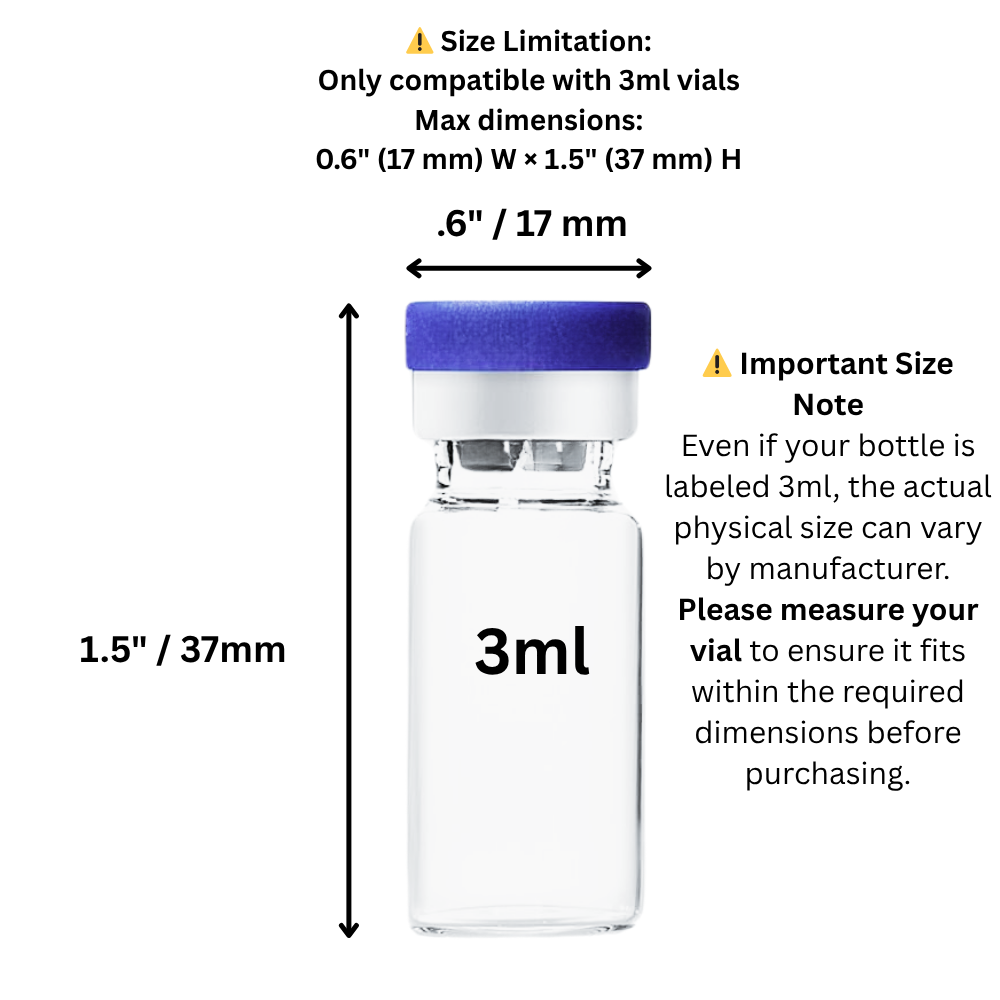
A purpose-built hard-shell case placed at the back of the middle shelf is the correct setup for fridge peptide storage. The case holds every vial upright in its own slot, sized specifically for 3ml or 10ml vials so nothing shifts or tips. The hard shell blocks light completely when closed. ABS plastic construction does not absorb moisture or degrade in the fridge environment. A secure latch keeps the case closed even if the shelf gets bumped. And because the case lives at the back of the middle shelf — the most temperature-stable zone in the fridge — the vials inside stay within a narrow, consistent temperature band. This is the setup that protects reconstituted peptides for their full refrigerated shelf life without thermal degradation, photodegradation, or physical damage.
The Fridge Door Shelf: Why It Is the Worst Place to Store Peptides
The door shelf deserves its own section because so many people default to it. It is visible, it is accessible, and it feels convenient. But the temperature data makes a clear case against it.
A typical household fridge door is opened 10-15 times per day between household members. Each door-open event exposes the door shelf to warm ambient air for an average of 15-30 seconds. During that window, the temperature at the door shelf rises by 2-4°C and can spike as high as 6-8°C if someone stands at the open fridge longer than usual.
Over 30 days of storage, a vial on the door shelf experiences 300-450 temperature excursion events. Each excursion cycles the peptide between cold and warm. This thermal stress accelerates the aggregation and degradation of peptide chains — particularly for reconstituted peptides, where the peptide is already in solution and more vulnerable to conformational changes than lyophilized powder.
Research on protein and peptide stability consistently shows that thermal cycling — not just absolute temperature — is one of the primary drivers of potency loss. A vial that sits at a steady 3°C for 30 days will retain significantly more potency than a vial that cycles between 3°C and 8°C 400 times over the same period, even if the average temperature is similar.
The door shelf is convenient for condiments. It is not appropriate for compounds that cost $50-200 per vial.
Best Placement in the Fridge: Middle Back Shelf
The physics of refrigerator design consistently point to the same location: the back of the middle shelf. Here is why this specific position is the most stable zone in a standard refrigerator:
- Proximity to the cooling element. Most refrigerators circulate cold air from the back of the unit. The back wall is where cold air enters the compartment before spreading forward. Items stored at the back of the shelf benefit from this direct cold air flow.
- Distance from the door. The further a vial is from the door, the less it is affected by warm air intrusion during door-open events. At the back of the shelf, warm air from outside the fridge has to travel the full depth of the refrigerator before reaching the vial — by which time it has already lost much of its warmth to the surrounding cold surfaces.
- Stable air circulation at middle height. The very top of the fridge (near the freezer compartment in top-freezer units) can experience temperature stratification. The very bottom can be warmer due to heat from the compressor below. The middle shelf sits in the most thermally consistent zone of the cabinet.
The specific instruction: place your peptide case flat on the middle shelf, pushed all the way to the back wall. Do not store anything in front of it that would block airflow. This position gives your case and its contents the most stable thermal environment your fridge can provide.
Pro Tip: Never store peptides near the light bulb inside your fridge. Even brief exposure every time you open the door adds up over weeks. An opaque hard-shell case eliminates this problem entirely — but still avoid placing vials near the bulb housing if you ever open the case inside the fridge.
What About a Mini Fridge?
A dedicated mini fridge for peptide storage is the best possible fridge environment, and it is worth serious consideration if you are running a consistent protocol with multiple compounds.
The primary advantage of a dedicated unit is the elimination of door-open events. A mini fridge used exclusively for peptide storage gets opened once or twice per day for dosing — compared to the 10-15 daily openings of a shared household refrigerator. Each opening event is also shorter, since you are not searching through food to find what you need. The compound you want is visible and accessible immediately.
Secondary advantages of a dedicated mini fridge include the complete elimination of food contamination risk, no competition for shelf space, the ability to set the temperature precisely for peptide storage without affecting food preferences, and discrete storage that household members do not interact with.
A small personal mini fridge costs $40-80 and can run indefinitely on minimal electricity. If you are spending $200-500 per month on peptide compounds, a dedicated storage unit pays for itself within the first month by protecting the compounds you already have.
Organizing Multiple Compounds in the Fridge
Running more than one peptide at the same time requires a systematic approach to fridge organization. Random placement leads to mistakes: drawing from the wrong vial, losing track of reconstitution dates, or missing expiration windows on time-limited reconstituted compounds.
The most effective system uses three organizing principles:
- Slot assignment by compound. Every compound gets a designated slot position in the case and never moves to a different slot. If BPC-157 lives in slot 1, it always lives in slot 1. This allows you to reach for the correct compound in low light, half awake, before your morning coffee — without reading labels.
- Labeling with compound name and reconstitution date. Every reconstituted vial should have at minimum two pieces of information: what it is and when it was reconstituted. A fine-tip permanent marker on the vial itself, plus a piece of medical tape with the information if you need more space. Never rely on memory alone for reconstitution dates — the difference between a 21-day and a 35-day old reconstituted vial matters.
- FIFO rotation for reconstituted vials. First In, First Out means the oldest reconstituted vial of any compound gets used before a newer reconstitution. When you add a fresh vial to the fridge, it goes behind the existing vial. You always dose from the vial at the front. This ensures you never end up with a degraded vial in the back that has been sitting for six weeks while you used a newer one first.
VialCase Fridge Setup: The Exact Configuration
For users running the 12-slot all-in-one VialCase or the 10-slot extra storage case, here is a suggested fridge configuration that maximizes both organization and accessibility:
12-slot case layout: Slots 1-4 hold active reconstituted vials (the compounds you are currently dosing). Slots 5-8 hold BAC water and backup vials of active compounds. Slots 9-12 hold lyophilized backup stock that you plan to reconstitute within the current month. Syringes and alcohol swabs go in the dedicated compartment. The case goes at the back of the middle shelf, closed and latched.
10-slot case layout: Slots 1-3 hold primary active compounds. Slots 4-6 hold secondary or less-frequent compounds. Slots 7-9 hold BAC water and one backup vial. Slot 10 is reserved for anything new entering the protocol. This systematic layout means every slot has a purpose and nothing gets shoved in randomly.
Both cases fit comfortably on a standard refrigerator shelf without blocking the air vents at the back wall. The hard-shell construction means they can be slid in and out of the fridge repeatedly without wear. The latch keeps everything secured during the trip from fridge to counter and back.
When to Use Freezer vs. Fridge
Understanding which peptides belong in the fridge and which belong in the freezer is foundational knowledge that is worth reviewing clearly:
- Fridge (2–8°C): All reconstituted peptides. Any vial you have added BAC water to is a reconstituted peptide and belongs in the fridge. Reconstituted peptides are stable at fridge temperature for typically 14-30 days depending on the compound.
- Freezer (−20°C): Lyophilized peptide powder that you have not yet reconstituted. Freezer storage dramatically extends shelf life for powder peptides — often from 1-2 years to 3-5 years or more. If you are buying in bulk or maintaining reserve stock, the freezer is the right choice for anything you will not reconstitute in the next few weeks.
- Never freeze reconstituted peptides. This cannot be overstated. When a reconstituted peptide freezes, ice crystals form within the solution. As these crystals grow, they physically disrupt the peptide chains — breaking bonds, causing aggregation, and permanently denaturing the compound. A frozen-and-thawed reconstituted peptide is compromised. The extent of damage depends on the specific peptide, but the risk is never worth it. If a reconstituted vial is not going to be used within its fridge shelf life, the correct action is to discard it — not to freeze it in hopes of extending its life.
Disclaimer: This article is for educational and informational purposes only. PeptideCase does not manufacture, sell, or endorse any pharmaceutical or research compound. All content is provided to inform proper storage practices and does not constitute medical or legal advice. Consult a licensed healthcare professional before using any peptide or research compound.