Quick Answer: Yes, All Four Travel Fine
Ozempic (semaglutide), Wegovy (semaglutide), Mounjaro (tirzepatide), and Zepbound (tirzepatide) can all be brought on planes, cruise ships, and across international borders for personal medical use. The TSA's medically necessary liquids exemption covers all four. Major US airlines accommodate medication storage requests. International customs for personal-use prescription medication is generally permissive with proper documentation.
The differences matter at the margins — how long a pen survives without refrigeration, what counts as "in-use" vs. unopened, how to handle a 14-hour flight, and which countries require an advance declaration. The rest of this guide gets specific about each.
Branded vs. compounded: This guide focuses on branded GLP-1 medications in original Novo Nordisk (Ozempic, Wegovy) and Eli Lilly (Mounjaro, Zepbound) packaging. If you're traveling with compounded semaglutide or tirzepatide from a US compounding pharmacy, see our compounded semaglutide storage guide and our guide to traveling with GLP-1 vials.
Room Temperature Stability: How Long Each Pen Survives Without a Fridge
This is the single most useful piece of information for travelers. Here's the manufacturer-stated room-temperature window for each medication. Always cross-check against the latest prescribing information that ships with your specific pen.
| Medication | Compound | In-Use Room Temp | Max Days Out of Fridge |
|---|---|---|---|
| Ozempic | Semaglutide | Up to 86°F / 30°C | 56 days after first use |
| Wegovy | Semaglutide | Up to 86°F / 30°C | 28 days after first use |
| Mounjaro | Tirzepatide | Up to 86°F / 30°C | 21 days unrefrigerated |
| Zepbound | Tirzepatide | Up to 86°F / 30°C | 21 days unrefrigerated |
The practical implication: for short trips (3–7 days), refrigeration during travel matters less than it feels like it should. Your Ozempic pen survives a week unrefrigerated as long as the temperature stays at or below 86°F. The risks are extreme heat (a closed car in summer can hit 140°F+) and freezing — both will damage the medication regardless of which brand you carry.
For trips longer than the room-temperature window of your specific pen, you need refrigeration access at your destination. For trips shorter than the window, an insulated case keeps things comfortable but isn't strictly required.
TSA Rules for All Four Branded GLP-1s
TSA treats Ozempic, Wegovy, Mounjaro, and Zepbound identically: as injectable prescription medications under the medically necessary liquids exemption. That means:
- Carry-on is allowed, including liquid medication that exceeds the 3.4 oz / 100 ml liquid limit.
- Frozen gel ice packs are allowed when they accompany medication. They must be fully frozen at the time of screening — slushy or partially thawed packs may be challenged at some airports.
- Sharps and pen needles are allowed in carry-on when accompanying the medication.
- Pre-filled pens are allowed — Ozempic, Wegovy, Mounjaro Kwikpens, and Zepbound autoinjectors all pass through TSA without issue.
- Original packaging recommended but not required for domestic flights.
- No prescription verification. TSA does not check prescriptions for domestic travel.
What to Say at the TSA Checkpoint
Before placing your bag on the X-ray belt, tell the TSA officer: "I have injectable medication and ice packs." That's the magic phrase. The medication and packs may be screened separately or X-rayed in a tray, but the entire process typically takes 60–90 seconds.
If you're asked the medication name, "Ozempic," "Wegovy," "Mounjaro," or "Zepbound" are familiar to TSA officers — these are not ambiguous medications. If you say "GLP-1" or "semaglutide" or "tirzepatide," you may get a follow-up question; the brand name resolves it instantly.
Always Carry On — Never Check
Cargo holds at altitude can drop to -40°F. Frozen Ozempic, Wegovy, Mounjaro, or Zepbound is destroyed — the protein structure breaks down irreversibly, and you cannot tell visually that the pen is no longer functional. There is no scenario where checking your medication is acceptable. Carry-on, every flight, no exceptions.
For a deeper breakdown of TSA rules across all peptide medications, see our complete TSA peptide guide.
How to Pack Each Medication for a Flight
Packing Ozempic for Travel
Ozempic ships in a multi-dose pen pre-loaded with semaglutide. Each pen contains either 0.25/0.5 mg (1.5 mL), 1 mg (3 mL), or 2 mg (3 mL) of medication, lasting 4 weeks of weekly doses depending on the strength.
- Keep the original carton with prescription label visible — useful for both TSA and customs.
- Pack the pen flat, not on its side, in a padded compartment of your insulated case.
- For trips under 56 days from first use, refrigeration during travel is helpful but not required as long as ambient stays under 86°F.
- Bring extra pen needles in their original sealed packaging.
Packing Wegovy for Travel
Wegovy comes in single-dose pre-filled pens, one pen per weekly dose. The pen is single-use — you don't need to manage an in-use pen across multiple weeks the way you do with Ozempic.
- Bring one pen per week of travel, plus 1 spare. Keep them in original packaging.
- Single-use pens are easier to manage than multi-dose Ozempic — no worry about cumulative time at room temperature across multiple weeks.
- If you're traveling for a month or longer and your pens have left the fridge for an extended period, plan to refrigerate at your destination.
- Bring sharps disposal — Wegovy single-dose pens are sharps after use.
Packing Mounjaro for Travel
Mounjaro comes in single-use pre-filled Kwikpens (autoinjector format). Each pen delivers one weekly dose at strengths from 2.5 mg to 15 mg.
- Bring one Kwikpen per week of travel plus 1 spare.
- Kwikpens have a relatively bulky autoinjector design — they don't pack as flat as Ozempic. A purpose-built medication case with deeper compartments works better.
- 21-day unrefrigerated window is shorter than Ozempic's; for trips approaching 3 weeks, plan to refrigerate at the destination.
- Original carton with manufacturer barcode is useful for international customs — Mounjaro is widely recognized.
Packing Zepbound for Travel
Zepbound (also tirzepatide) ships in pre-filled autoinjectors similar to Mounjaro. Functionally identical for travel purposes.
- Same packing approach as Mounjaro — autoinjector format requires deeper case compartments.
- 21-day unrefrigerated window after removal from fridge.
- Branded as "Zepbound" specifically for the obesity indication; otherwise the same compound and storage profile as Mounjaro.
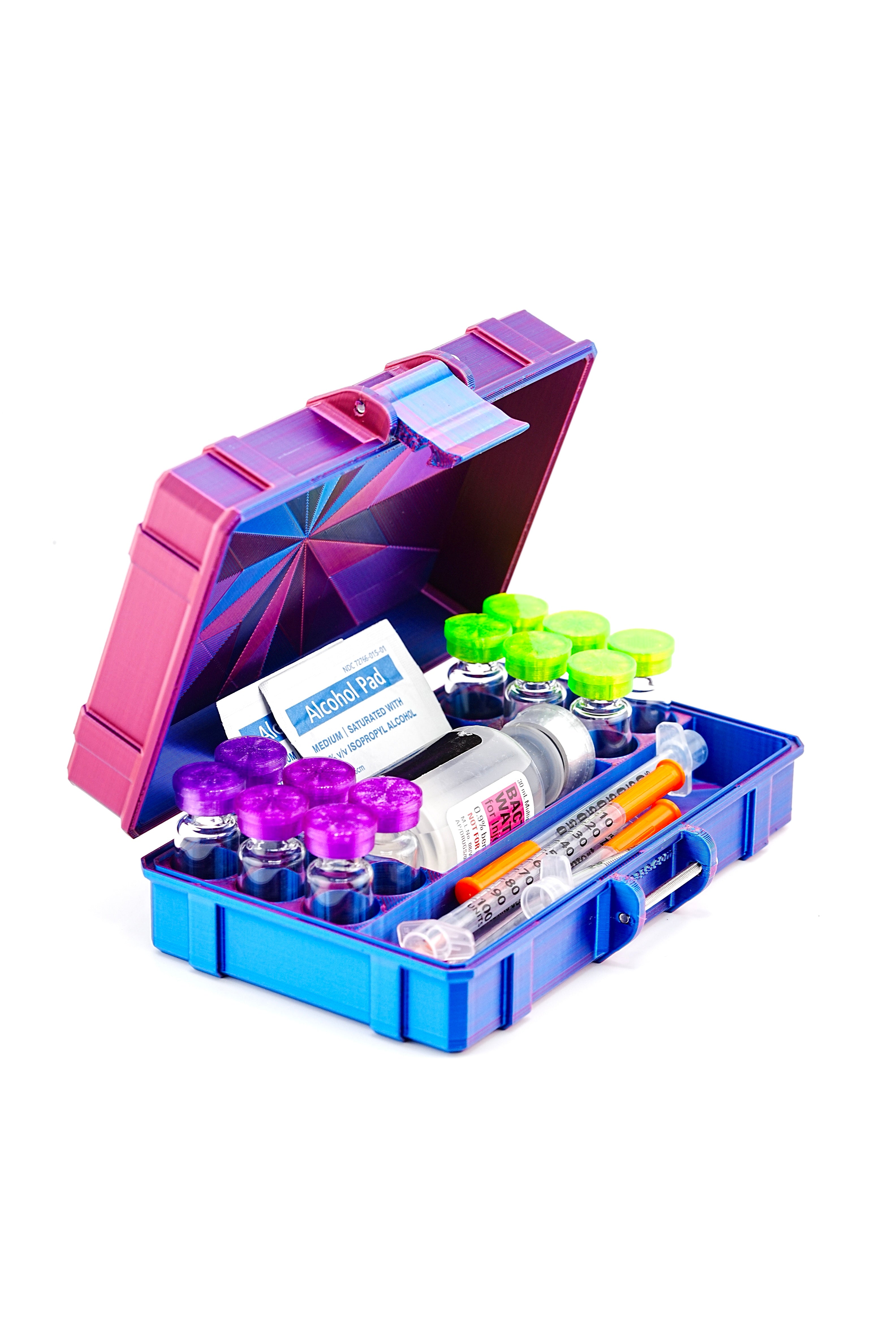
Cooling Strategies by Trip Length
Short Trips (Under 5 Days)
For domestic weekend trips and short business travel: an insulated medication pouch with one frozen gel pack maintains 36–46°F for 6–12 hours, which covers most flights and ground transport. Once at your destination, transfer to the hotel room mini-fridge.
Medium Trips (5–14 Days)
The room-temperature window for all four branded GLP-1s exceeds two weeks, so refrigeration is helpful but not strictly required mid-trip. Plan to refrigerate at your destination — every US hotel has either a mini-fridge in-room or a fridge available on request as a medical accommodation. International hotels are similar; ask at check-in if no fridge is in your room.
Long Trips (14+ Days)
Beyond two weeks, you're approaching or exceeding the room-temperature window for Mounjaro and Zepbound (21 days) and Wegovy (28 days). Reliable destination refrigeration becomes essential. For trips longer than 56 days, even Ozempic exceeds its window — plan to acquire a replacement pen from a destination pharmacy or limit the travel duration.
Cruise Ships
Most modern cruise cabins include a mini-fridge — see our cruise ship peptide guide for Carnival, Royal Caribbean, and NCL specifically, and our Disney/Princess/Holland America/MSC/Celebrity/Virgin Voyages guide for the others. Disney requires advance request for a true medical fridge; the rest typically include suitable refrigeration in standard staterooms.
Long-Haul International Flights
For 8+ hour flights, ask the flight attendant if galley refrigeration is available for medication. Most long-haul carriers — Delta, United, American, British Airways, Lufthansa, Emirates, Qantas, ANA, Singapore Airlines — accommodate this on request. Bring your medication in a small clearly-labeled insulated bag. They'll keep it cold for the flight duration.
International Customs by Country
European Union (Schengen Zone)
All four medications are legal across the EU. France, Germany, Spain, Italy, the Netherlands, and other Schengen countries permit personal-use prescription medications for travelers. No advance declaration required for personal-supply quantities. Bring original packaging and your prescription paperwork in case of questions.
United Kingdom
UK customs allows personal medication import. Bring prescription documentation. UK and EU customs procedures diverged after Brexit, but for personal-use prescription medication, both jurisdictions remain straightforward.
Canada
Canada allows personal-use prescription medications, with reasonable quantity limits. The Canada Border Services Agency (CBSA) accepts a 90-day personal supply for entrants. Bring the original prescription and pharmacy label. Trade names (Ozempic, Wegovy, Mounjaro, Zepbound) are well-known to Canadian border officers — these are commonly prescribed in Canada too.
Mexico
Mexico permits personal-use medications with declaration. For brief tourism visits, declaration is informal — most travelers pass without question. For longer stays, bring documentation. See our Mexico peptide travel guide for additional context.
Japan
Japan has stricter rules. For more than a 30-day supply of any prescription medication, including GLP-1s, you must apply for a Yakkan Shoumei (medication import certificate) before traveling. The application takes 2–4 weeks and is processed by Japan's Ministry of Health, Labour and Welfare. Trips with under 30 days of medication and reasonable carry-on quantities are typically fine without a Yakkan Shoumei, but the practical recommendation is to obtain one if your trip is borderline.
Singapore
Singapore is strict about medication imports. The Singapore Health Sciences Authority (HSA) requires that travelers carrying prescription medications carry the original prescription and may require a permit for extended supplies. For Ozempic, Wegovy, Mounjaro, and Zepbound specifically, personal-supply quantities for trips are typically accepted with a doctor's letter and the original prescription. Verify current rules at HSA before traveling.
United Arab Emirates (UAE)
The UAE has detailed rules about medication imports. Some compounds are restricted; GLP-1 receptor agonists are generally accepted with a prescription, but the safest path is to register the medication with the UAE Ministry of Health and Prevention (MOHAP) prior to travel through their controlled medications portal. For routine personal supply for tourism, this is rarely enforced, but for longer stays or work travel, complete the registration.
Australia
Australia allows personal-use medication import for stays under 3 months. Carry the prescription, the medication in original packaging, and ideally a doctor's letter. The Therapeutic Goods Administration (TGA) Personal Importation Scheme covers GLP-1 medications.
Other International Destinations
For countries not listed above, see our broader international peptide travel guide. The general rule: if it's a Western tourist destination (Caribbean, Latin America, most of Europe, most of Asia), personal-use injectable prescriptions in original packaging with documentation pass without issue. If it's a country with stricter pharmaceutical regulations (Japan, Singapore, UAE, Saudi Arabia, China), check the country's health ministry website before travel.
Documentation: What to Bring (And What's Optional)
For US domestic travel, no documentation is required. For international travel, the documentation hierarchy:
- Original pharmacy-labeled box — your prescription label includes your name, the medication, dose, prescriber, and pharmacy. This is the strongest single piece of evidence.
- Prescription paperwork — the actual prescription from your prescriber, paper or printed PDF.
- Doctor's letter — a one-page letter from your prescriber or telehealth provider stating that you are under their care for a documented condition (Type 2 diabetes for Ozempic/Mounjaro, weight management for Wegovy/Zepbound) and that you are authorized to travel with the medication. Particularly useful for stricter international destinations.
- Medication ID card — some pharmacies provide these. Optional but useful.
For international trips: bring all four. They take no space and resolve any customs question in seconds.
What If Your Pen Gets Damaged or Lost
Even with the best planning, pens break, get lost, or get confiscated. Here's the recovery hierarchy:
- Contact your prescriber. Most prescribers can transfer a prescription to a destination pharmacy if you have one in mind. CVS and Walgreens have nationwide prescription transfer; international transfers depend on country.
- Telehealth backup. Hims, Ro, Sequence, and many regional telehealth providers can issue replacement prescriptions for travelers with documented original prescriptions.
- Travel insurance. Comprehensive travel insurance with prescription medication coverage reimburses replacement costs and may include 24/7 medical concierge to coordinate replacement scripts.
- Local pharmacy. In most EU countries, Canada, Australia, Mexico, and many Asian markets, GLP-1 medications are available at local pharmacies with a local-issued prescription. Local urgent care or telehealth in-country can issue the prescription.
What NOT to Do
- Do not check your medication. Cargo holds freeze pens at altitude. There is no exception.
- Do not leave a pen in a parked car. Interior temperatures hit 140°F+ in summer; this destroys all four medications.
- Do not freeze pens. If you forget about them in a freezer or accidentally pack them with dry ice, they're done.
- Do not let an "in-use" pen accumulate excessive time at room temperature beyond the manufacturer's stated window. The 21/28/56-day windows assume continuous storage at safe temperatures; multiple temperature excursions and high heat shorten effective shelf life.
- Do not transfer medication out of original pens for travel. Branded pens are pre-filled; do not draw the contents into vials or syringes for travel "convenience." This destroys the manufacturer's stability profile.
- Do not assume international destinations have your specific medication. Wegovy and Zepbound, in particular, may not be available in some markets where Ozempic and Mounjaro are widely stocked. Plan supply accordingly.
Sharps Disposal While Traveling
Used pen needles and used single-dose pens are sharps. They cannot be disposed of in regular trash, including in hotel rooms.
- Pack a small portable sharps container. Travel-sized FDA-cleared sharps containers fit in any toiletry bag.
- At hotels: ask housekeeping or the front desk if they have a medical sharps disposal protocol. Most major hotel chains do.
- At cruise medical centers: the ship's medical center accepts sharps disposal.
- At pharmacies: CVS, Walgreens, and many international pharmacy chains accept sharps disposal. Bring your container in for safe drop-off when you reach a destination with a participating pharmacy.
- Do not put loose syringes or pens in trash bags. This is a needlestick hazard for cleaning staff and a violation of policy at most lodging.
Frequently Asked Questions
Can I bring Ozempic or Mounjaro pens through TSA?
Yes. Both pens are allowed in carry-on under the TSA's medically necessary liquids exemption. Declare upfront, and screening typically takes under two minutes.
Does Ozempic need to stay refrigerated during my flight?
Not strictly. Ozempic tolerates up to 86°F for up to 56 days after first use. For a typical 1–12 hour flight, an insulated case with one cold pack provides margin without being required.
Will TSA take my Wegovy pen if I forget the prescription?
No. TSA does not check prescriptions for domestic flights. The pen is allowed regardless of whether the box label is visible. International customs is a different question — bring documentation for international travel.
Is Mounjaro the same as Ozempic for travel purposes?
For TSA and most customs, they are treated identically as injectable prescription medications. The differences are practical: Mounjaro's room-temperature stability is 21 days vs. Ozempic's 56-day in-use window. For trips over 3 weeks, Mounjaro requires destination refrigeration; Ozempic has more buffer.
Can I bring Zepbound to Mexico?
Yes, with a US prescription and original packaging. Personal-use quantities for tourism are accepted at Mexican customs. For longer stays, bring a doctor's letter.
What if my Ozempic gets warmer than 86°F during travel?
Brief excursions above 86°F (a hot taxi, a warm Uber, a brief outdoor walk) are not catastrophic. Sustained high heat — like leaving the pen in a hot car for hours — degrades the medication. If you suspect significant heat exposure, contact your prescriber and consider replacing the pen at your destination.
How much medication can I bring across borders?
Most countries permit a 90-day personal supply for tourists. For trips longer than 3 months, customs scrutiny increases — at that point, the right approach is often to transfer your prescription to a local provider in your destination country.
Are Ozempic, Wegovy, Mounjaro, and Zepbound prescribed differently for travel purposes?
For TSA, customs, and cruise lines, they are all treated as injectable prescription medications. Differences in indication (Ozempic and Mounjaro for Type 2 diabetes; Wegovy and Zepbound for chronic weight management) don't matter at security checkpoints. Your prescription label and a doctor's letter — if you bring one — should describe the medication, not your underlying condition.
Disclaimer: This article is for informational purposes only and does not constitute medical or legal advice. Manufacturer storage windows, TSA rules, airline policies, cruise line policies, and international customs rules change. Always verify current information with the manufacturer's prescribing information, the TSA, your airline, your cruise line, and the destination country's customs authority before traveling. Consult your prescriber before making any medication-related travel plans.